The most revealing object in NRG Energy's portfolio may be a thermostat. Not a turbine, though the company owns plenty. Not an electricity plan, though millions of households buy one from its brands. A thermostat is where the two halves of modern NRG meet: the expensive machinery that makes power and the customer who decides, room by room, when to use it.
NRG is a competitive energy company, not the local utility that owns the poles outside your house. Through brands including Reliant, Direct Energy, Green Mountain Energy and NRG itself, it sells electricity and natural gas in markets where consumers and businesses can choose a supplier. It also operates roughly 25 gigawatts of generation, enough capacity to place it among the significant independent power producers in the country. Vivint takes the company into home security, automation and subscription services. CPower, acquired in January, coordinates flexible demand from commercial and industrial sites.
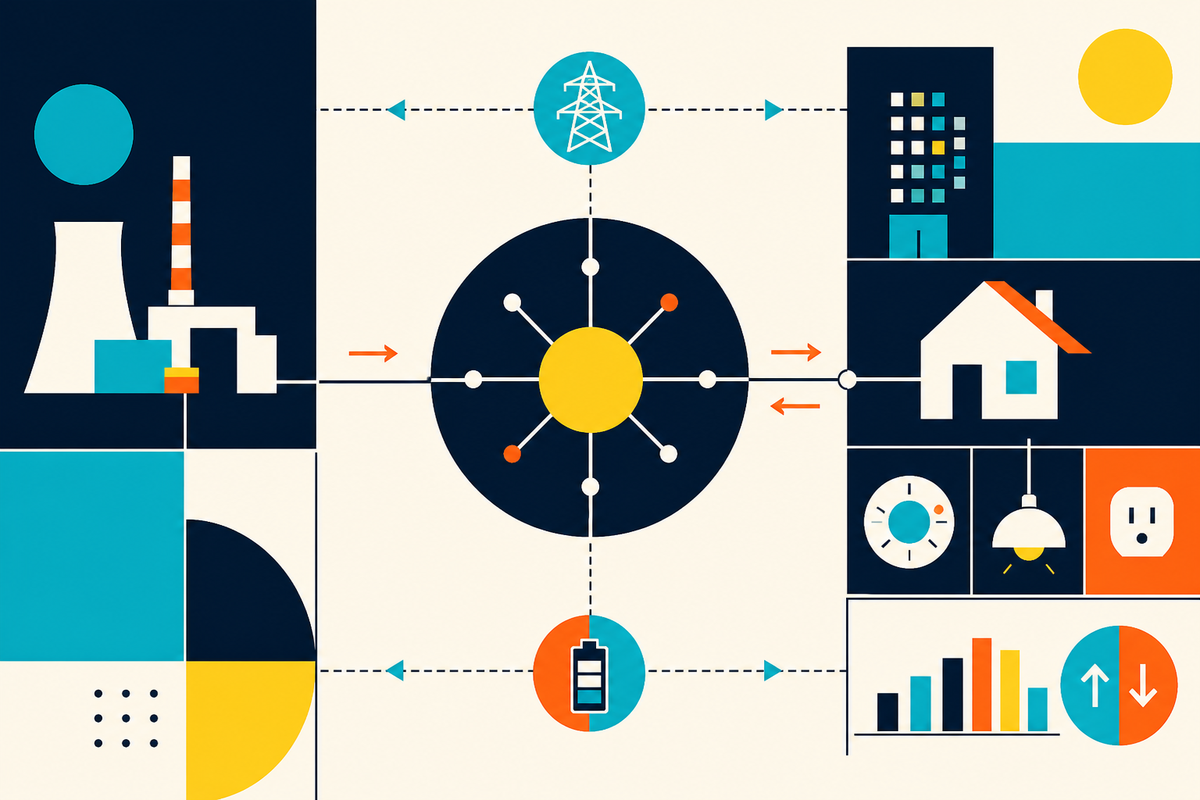
Seen separately, those businesses look like an unruly corporate cupboard. Seen as a system, they form a feedback loop. NRG can generate or contract for power, hedge the price, sell it through a retail plan, observe how demand behaves, and offer a customer money or convenience for shifting usage away from a strained hour. That is the strategy hiding behind the bill.
The business on both sides of the meter
The meter is a useful dividing line. On one side sit power plants, wholesale markets and risk desks. On the other sit homes, stores, factories and an increasingly crowded collection of connected devices. Most companies specialize. A generator worries about heat rates and outages. A retailer worries about customer churn and the wholesale cost of serving a fixed-rate contract. A security company worries about cameras, sensors and monthly subscriptions.
NRG has chosen the complication of doing all three. Its energy business serves roughly six million residential customers. Vivint contributes about two million smart-home customers and a recurring service model that is less exposed to weather than commodity sales. Commercial customers range from schools and hospitals to manufacturers and data centers. They buy structured power and gas supply, renewable products, energy advice and, through CPower, the ability to earn money by reducing demand when a grid or market needs relief.
The customer problem is mundane and difficult: energy must be affordable, available every second and understandable enough to manage. Businesses add another layer. A factory may want price certainty; a hospital cannot casually shut down; a data center needs enormous new supply on a tight schedule. NRG's offer is customization backed by market experience and physical assets. The company can assemble contracts, generation, demand response and sustainability instruments rather than sell one generic unit of electricity.
The shopping spree that built the stack
Modern NRG was assembled as much as it was invented. The $3.625 billion purchase of Direct Energy in 2021 added more than three million customers across the United States and Canada. The Vivint deal closed in 2023, paying about $2.8 billion for the equity and leaving NRG with a smart-home platform, professional installation network and a new kind of monthly relationship.
Then came the large, counterintuitive move. In January 2026, NRG completed its acquisition of 18 natural-gas-fired plants and CPower from LS Power. The transaction, valued at about $12 billion when announced, added 13 GW and doubled the generation fleet. CPower brought roughly 6 GW of commercial and industrial virtual power plant capacity representing more than 2,000 organizations.
Scale solves several problems at once. More plants near NRG's customer load can reduce the mismatch between what the company sells and what it controls. Quick-start gas units can respond when wind, solar or demand changes. CPower adds the opposite response: instead of increasing generation, it can ask enrolled buildings to decrease consumption. Owning both levers gives NRG more ways to handle a tight hour.
“This is the model for how large load growth should work. The customer supports the investment, with reliability and affordability protected for all.”Robert Gaudette, NRG president and CEO, on Bring Your Own Power
A power plant made of preferences
Virtual power plants are the most instructive part of the model. NRG's Texas residential program passed 200 MW in early 2026 and is targeting 1 GW by 2035. With Renew Home and Google Cloud, it is enrolling smart thermostats and using software to coordinate brief adjustments. A partnership with Sunrun is designed to add solar-charged home batteries through Reliant plans. During a peak event, the aggregated fleet can lower load or send stored energy back to the grid.
Customers get a rate, device discount, bill credit, backup power or some combination. NRG gets flexible capacity without building every megawatt in concrete and steel. The grid gets a resource that can react quickly. The catch is behavioral: enrollment, trust and retention matter. A virtual plant works only when real people allow devices in real homes to participate, and when the company keeps comfort within promised limits.
This is where Vivint starts to look less like a detour. Its devices, installation channel and app experience can make energy management tangible. A retailer with a monthly bill can market the program. A generator and trader can value the flexibility. Competitors offer pieces of this stack, but few combine such a large retail book, owned generation, a national smart-home platform and demand response for both households and big facilities.
The natural-gas contradiction
NRG's story is not a neat march from fossil fuels to renewables. The company has offered renewable electricity plans and carbon products for years, particularly through Green Mountain Energy. It has set a long-term net-zero emissions goal. Yet its largest recent investment was a fleet of gas plants, and it is developing more dispatchable gas capacity in Texas and the PJM market with GE Vernova and Kiewit.
NRG's argument is that fast-growing power demand requires resources that can operate on command, while virtual plants and customer devices reduce the amount of steel needed. Critics can reasonably ask whether a fleet built for the current shortage becomes an emissions burden later. The answer will depend on capacity factors, retirements, efficiency, regulation and whether demand flexibility grows from an interesting program into a dependable system.
The tension is commercially relevant, not decorative. Customers want reliability and lower bills, large companies have climate commitments, and investors want returns from assets that may run for decades. NRG must sell all three audiences a coherent plan.
The data-center customer changes the equation
Power demand from AI and cloud infrastructure has made electricity a boardroom constraint. In August 2026, NRG said it had aligned on principal terms with a global cloud and AI company for a 1.2 GW combined-cycle plant in Texas. The proposal remains subject to final agreements and approvals. NRG calls the approach Bring Your Own Power: the new customer helps support the generation investment required by its load.
The name is cheeky; the allocation question is serious. Communities worry that ordinary customers will finance grid upgrades for data centers. Developers worry that waiting for conventional infrastructure will stall projects. NRG's model tries to connect a creditworthy buyer, a long-term contract and a new plant, making the demand finance its own supply. If it works, the template is exportable. If costs or approvals drift, the slogan will not rescue the economics.
NRG's first new-build plant in nearly a decade, the 415 MW T.H. Wharton project, entered commercial service in May 2026 with support from the Texas Energy Fund. Two more fund-backed projects are intended to bring the group to roughly 1.5 GW by mid-2028. The company is demonstrating that it can build, not only buy. That matters in a market where turbine slots, interconnections and permits have become scarce inventory.
Where NRG fits now
Vistra is the clearest integrated rival, especially in Texas, with major generation and retail operations. Constellation is a formidable competitor in wholesale and commercial power, with a very different nuclear-heavy fleet. Traditional utilities own regulated networks and customer franchises that NRG generally does not. ADT and other security providers compete with Vivint. Demand-response specialists compete with CPower. NRG's position is between all of them.
That middle can be an advantage or a management tax. Integration promises cross-selling, better hedges and richer customer data. It also asks one organization to excel at plant safety, commodity risk, consumer marketing, field installation, software and subscription retention. NRG's second-quarter 2026 results showed the new assets contributing strongly in the East and Vivint growing its recurring margin, while higher supply costs weighed on Texas. The portfolio diversifies results, but it does not abolish weather or market risk.
For households, the practical products remain simple: choose an electricity plan, add a thermostat or battery program, install a Vivint system, or buy a renewable option where available. Businesses can structure supply, manage exposure, document renewable purchases and get paid for flexible load. The larger experiment is whether those individual choices can be orchestrated into something that behaves like a power system.
That brings the story back to the thermostat. NRG is not unique because it sells electrons or owns gas turbines. It is unusual because it can see the grid from the control room and the kitchen wall. The distance between those two places is where electricity is becoming software, where customer preference becomes capacity, and where NRG has chosen to place its bet.