For most of the twentieth century, the deal between a homeowner and their electricity was simple and one-sided. Power showed up, a meter spun, and once a month a bill arrived with a single number on it. What ran up that number - the dryer, the pool pump, the EV charging overnight, the mystery draw that never seemed to stop - was anyone's guess. Emporia Energy was built on the bet that people would care about that guess if you made it cheap and easy to answer.
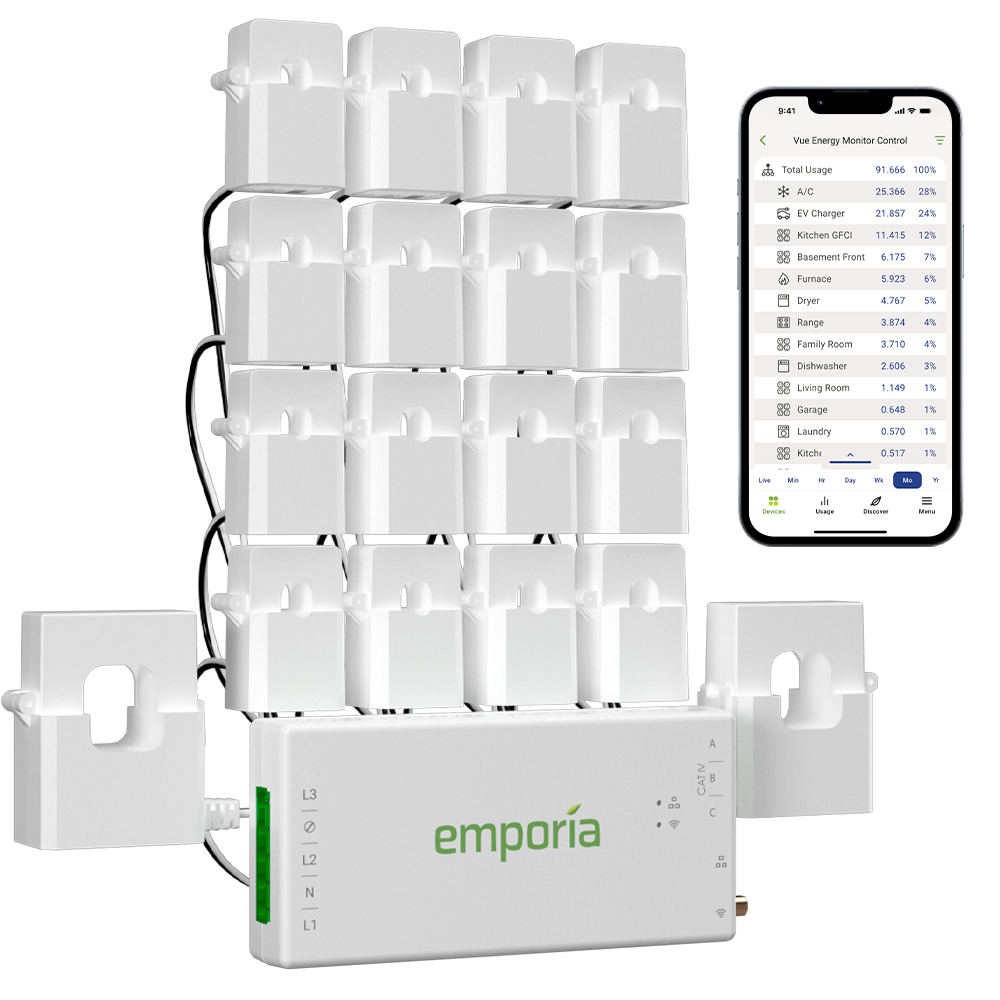
The company, based in Littleton, Colorado, sells home energy hardware and the software that ties it together: a circuit-level energy monitor called the Vue, Level 2 EV chargers, smart plugs, and a modular home battery. The through-line is a monitor you clamp into your electrical panel that reports where your power is going, roughly second by second, through an app - with no monthly fee. That last part is not a footnote. It is the wedge.
Founded in 2018, Emporia now says it is connected to more than 400,000 homes and has analyzed north of 50 billion energy data points. In August 2025, Siemens - the German industrial giant whose gear sits inside a large share of American electrical panels - took a strategic stake in the company. For a 95-person business that reportedly raised a single $7 million venture round, that is a notable vote of confidence. To understand why, you have to start with the founder's day job.
01 / The OriginA trader who could see the whole grid - except his own house
Shawn McLaughlin spent about 25 years in North American energy trading before starting Emporia. He began as a floor trader at the Chicago Board of Trade in the early 1990s and later ran an energy trading firm. In that world, information is the product. Large industrial and commercial buildings had long had sophisticated systems to watch, shift, and shave their energy use in real time. The average house had nothing remotely comparable.
"We were inspired by the amazing energy management tools for large, industrial buildings but saw a need for an affordable and easy to install option."
Shawn McLaughlin, Founder & CEOThat gap - enterprise-grade visibility on one side, a monthly mystery bill on the other - is the whole origin story. The founding premise, as the company still frames it, is that if you give homeowners circuit-level visibility into their energy, everything else follows: the smarter charging, the load shifting, the battery, the participation in grid programs. Visibility first, automation later.
02 / The Pricing PlayHow to win a market by refusing to charge a subscription
The home energy monitor is not a new idea. What Emporia did was price it like a commodity accessory instead of a gadget. The Vue starts around $99 for whole-home monitoring, roughly $149 with eight circuit sensors, and about $200 for the sixteen-sensor kit. There is no recurring charge to see your data.
Compare that to the field. Sense, the best-known machine-learning monitor, sold for about $300 - and stopped selling its consumer monitor at the end of 2025, pivoting toward utility smart meters. Curb ran around $399 and added a monthly data subscription in late 2024. Span sells a whole smart electrical panel, a different and far pricier category. Against that backdrop, Emporia's math is blunt: same shelf, a third of the price, no toll booth.
Cheap hardware with no subscription is a strange thing to build a company on - until you notice what the hardware is doing while it sits there. Every Vue is a sensor on the grid's edge. Every charger and battery is a controllable load. The monitor is not really the product. The installed base is.
03 / The Real Product400,000 homes, quietly wired into one virtual power plant
Here is the part that turns a gadget company into an energy company. The US grid is sized for peak demand - the few hours a year when everyone's air conditioning, ovens, and car chargers scream at once. Building power plants for those rare peaks is enormously expensive. The alternative is to gently nudge demand down when the grid is strained, across hundreds of thousands of homes at once. That coordinated fleet is a virtual power plant, or VPP.
Emporia describes itself as the largest residential VPP in the country and has been open about the ambition behind it: connect millions of home batteries and flexible loads so the grid can lean on the demand side "without building a single new power plant." Homeowners who enroll their charger or battery in a demand-response program earn cash or bill credits, and can opt out of any individual event from the app. The company launched its first savings programs with utilities including Dominion Energy and Green Mountain Power, using grid-software partners Virtual Peaker and EnergyHub to run the events.
This is why the free monitoring makes sense. Emporia is not trying to squeeze a few dollars a month out of a homeowner for a dashboard. It is trying to own the sensor and the switch in as many homes as possible, then sell the aggregate flexibility to people who value it a great deal: utilities.
04 / The Product LineMonitor, charger, plug, battery - one app to run them
The catalog has grown outward from the Vue. The third-generation Vue 3, launched in 2024, added independent voltage measurement for better accuracy, a wired Ethernet option, and control of some connected appliances. On the charging side, the Classic Level 2 charger became a reviewer favorite on price - available with both the standard J1772 plug and the NACS connector used by Tesla vehicles - while the Invite2Charge variant adds access control for apartments, workplaces, and fleets.
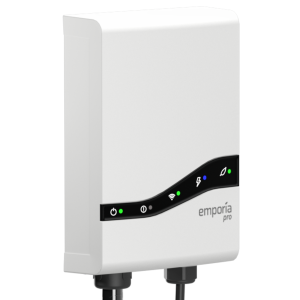
The 2025 Pro charger is the clearest example of the strategy clicking together. Priced at $599, it uses PowerSmart load management: it reads available capacity through the Vue monitor and dynamically throttles the car's charge rate as other appliances cycle on and off. Roughly half of US homes would otherwise need a costly panel upgrade to add a Level 2 charger. Solving that with software rather than an electrician's invoice is a real product, not a spec-sheet flourish.
"For many years now, consumers have been shell-shocked by the surprise that they have to spend thousands of dollars upgrading their electrical panel."
Shawn McLaughlin, on the Pro chargerRounding out the line are energy-monitoring smart plugs, which reviewers have repeatedly named among the best for the category, and a modular Alpha-ESS home battery that stacks in 8.2 kWh increments up to roughly 49 kWh. Bidirectional charging - letting an EV's battery power the house or the grid - is a direction the company demonstrates and talks about openly, betting that the biggest battery most people will ever own is already parked in the garage.
Emporia at a glance
- Founded2018, Littleton, Colorado
- FounderShawn McLaughlin, Founder & CEO (former energy trader)
- Team~95 employees; R&D in Colorado, manufacturing in India
- SellsEnergy monitors, Level 2 EV chargers, smart plugs, home battery, energy app
- BackersSiemens (2025), Honda (2024), a reported $7M Series A
05 / The Company It KeepsWhy Honda and Siemens wrote checks
Strategic investors do not buy stakes in accessory brands; they buy positions in platforms they need. In June 2024, Honda made a strategic investment and signed a joint-development agreement with Emporia covering smart EV charging and home energy in North America - a carmaker acknowledging that what happens after the car gets home matters to its customers. Emporia also partnered with WeaveGrid on managed charging.
Then, in August 2025, Siemens became a part shareholder. The two had already co-developed the Inhab home energy monitor, so the investment read less like a bet on a stranger and more like a company deepening a relationship it already trusted. Siemens brings power-distribution and circuit-protection reach into millions of panels; Emporia brings the consumer software and the installed fleet.
"Siemens' investment is a major milestone for Emporia and a strong validation of our approach to smart home energy management."
Shawn McLaughlin, Founder & CEOJacob Middleton, who leads residential electrical products at Siemens, framed it from the other side: the "evolving relationship with Emporia underscores Siemens' commitment to driving innovation and creating greater value for our residential customers." Terms were not disclosed. The signal was.

06 / The ReadWhere Emporia fits, and where the bet could wobble
In the home energy market, Emporia sits at the affordable, high-volume end. On monitoring it undercuts Sense and Span; on charging it undercuts ChargePoint and Wallbox while adding the load-management trick. That volume is the entire thesis: a VPP is only as valuable as the number of homes it can actually move, so cheap hardware is not a margin problem to be fixed later - it is the customer-acquisition strategy.
What could go wrong is worth naming plainly. VPP revenue depends on utility programs and regulation that vary by state and can change. Bidirectional charging is still early and depends on carmakers and standards catching up. And the same low prices that win shelf space leave thin margins on the hardware itself, which is exactly why the utility and partnership side has to carry the business. Selling a homeowner a $99 box is easy. Turning 400,000 of them into a dependable grid asset is the hard, unfinished part - and it is the part Emporia is actually being valued on.
For now, the pitch that started it all still holds up in one sentence: give people a cheap way to see their own electricity, and you end up holding something a lot bigger than a gadget business.