Consider the least theatrical power plant imaginable. It has no chimney, no turbine hall and no visitor wearing a hard hat. Part of it hangs on a living-room wall in Arizona. On a very hot afternoon, its owner permits the thermostat to rise a few degrees. Somewhere else, a battery supplies energy. An electric car postpones charging. The utility gets breathing room. The household gets an incentive. EnergyHub supplies the software and much of the organizing work that makes these separate decisions useful together.
- The product: software and services for coordinating customer-owned energy devices.
- The buyer: utilities that need flexible demand and dependable grid resources.
- The household bargain: incentives for allowing eligible devices to help at useful times.
- The lesson: technical savings must survive the cost of equipment, enrollment and customer comfort.
The name for this arrangement is a virtual power plant. “Virtual” can suggest something rather optional, like a meeting you could have avoided. The grid’s needs are quite physical. A megawatt of electricity demand removed at the right time can help meet a peak without generating that megawatt elsewhere. A thermostat contributes by changing consumption; a battery can contribute by supplying stored energy. EnergyHub brings those different abilities into a system a utility can operate.
01 The $85 invitation
To see the business clearly, start with Arizona Public Service’s Cool Rewards program. An eligible residential customer enrolls an internet-connected thermostat that controls central air conditioning. APS offers a $50 enrollment credit and a $35 annual participation credit per thermostat. That adds up to $85 in the first year. In exchange, the thermostat can be adjusted automatically during summer conservation events.
The rules give the proposition its shape. APS describes up to 20 events between June 1 and September 30, typically lasting two to three hours. Some thermostat manufacturers pre-cool homes before an event. Customers can change the temperature whenever they choose. The program therefore buys a limited, conditional permission to manage demand. It must offer enough value to keep that permission worth giving.
“You are always in control of your thermostat and can adjust it at any time.”
APS · COOL REWARDS PROMISE
EnergyHub works behind this invitation: vendor coordination, marketing, enrollment and dispatch. Those jobs sound administrative until you imagine omitting one. A device that cannot connect produces no response. A household that never enrolls provides no permission. A household that becomes uncomfortable can override the event. The human arrangement belongs in the engineering calculation.
02 A good gadget, an expensive answer
EnergyHub’s early business included home energy hardware. Its 2011 financing announcement described both a home management system and Mercury, a wireless thermostat software service. The company raised $14.5 million that August from investors including .406 Ventures, Physic Ventures, Acadia Woods and the New York City Investment Fund. It was building ways to make household energy use visible and controllable.

A founder with a timing problem. Seth Frader-Thompson helped start EnergyHub in 2007. The company’s early products made consumption visible; its utility platform makes consumption schedulable.PHOTO: ENERGYHUB
An Xcel Energy evaluation published in 2014 shows the economic obstacle. Its Colorado pilot installed EnergyHub Home Base displays, thermostats, smart plugs and sensors. Annual savings averaged 300 kilowatt-hours per participant, and 74% of participants were satisfied. Yet the utility declined a direct rollout because device costs were too high. It identified a thermostat-focused approach as a way to lower costs. Customers opting out or devices being offline also reduced event response.
That episode supplies a useful distinction for anyone building a climate business: a product can work and still fail the purchasing test. Reading EnergyHub’s later software focus alongside the evaluation suggests an economic advantage in coordinating devices customers already own. The pilot documents the utility’s decision; it does not establish what every founder privately thought. The observable change is from selling a household system toward operating a broader connected-device platform.
Alarm.com acquired EnergyHub in 2013, announcing that it would continue independently with its existing management. Today it remains an Alarm.com subsidiary. The continuity matters: this is an established utility software business with a long product history, rather than a new name attached to the current enthusiasm for virtual power plants.
03 The fleet is the product
EnergyHub now calls its software Edge DERMS. The letters stand for distributed energy resource management system. Historically marketed as Mercury, the platform helps utilities enroll resources, forecast their availability, dispatch them and measure performance. Its device relationships span thermostats, EVs, chargers, batteries and other equipment. Utilities can add operational services rather than staff every part of a program themselves.
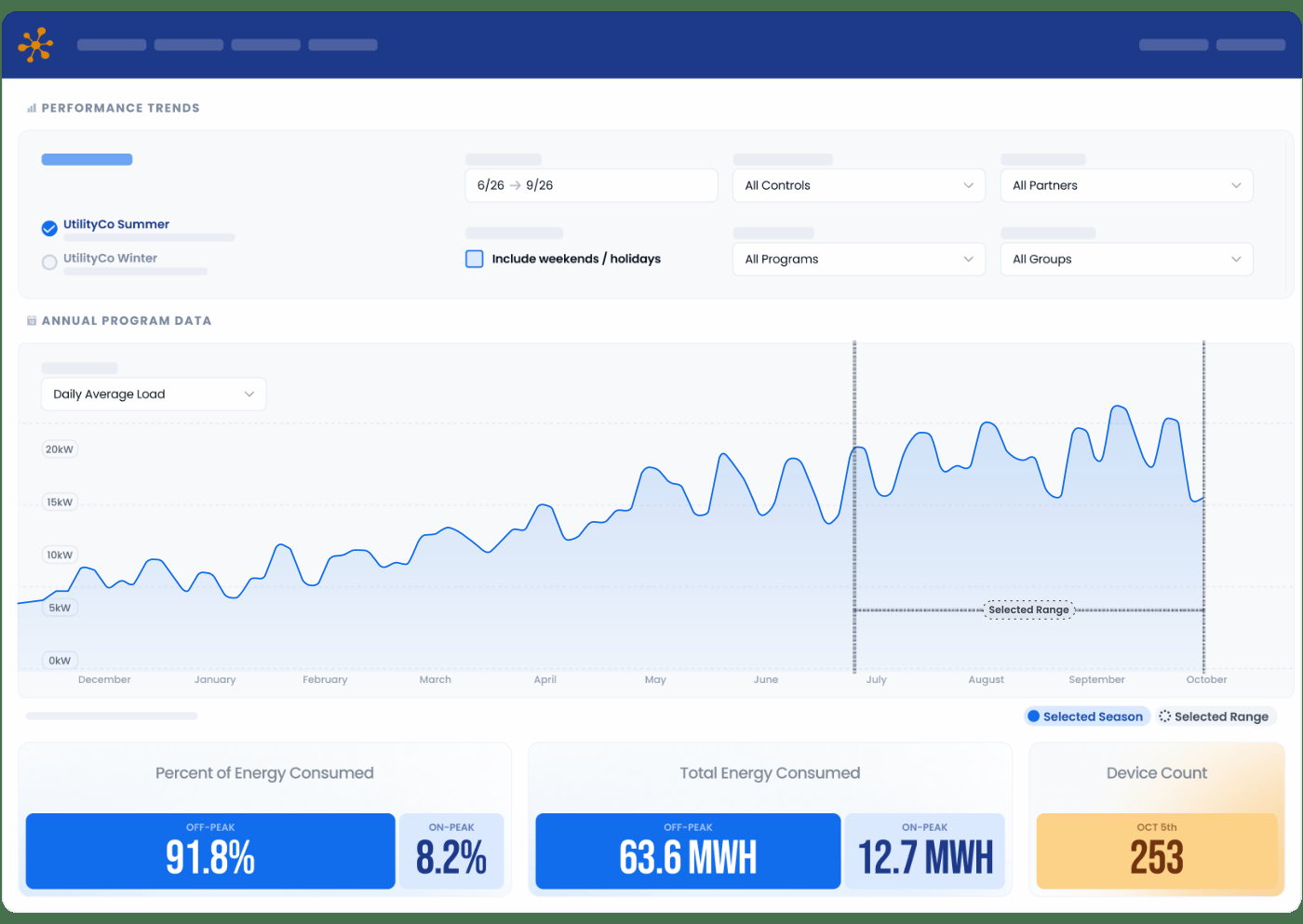
The paying customer is generally the utility or program operator. The participating household is another essential user, often encountering EnergyHub through its utility or device provider. This is enterprise cloud software with services attached. It requires utilities to make a procurement decision and households to make a participation decision. Winning one audience does not automatically win the other.
The competitive distinction is the combination of device connections and program delivery. Uplight’s AutoGrid also offers multi-resource virtual power plant software. GE Vernova’s GridOS DERMS addresses broader utility grid orchestration and can integrate with edge systems. EnergyHub occupies the busy space between household devices and utility operations. Its breadth is useful when a customer’s thermostat, charger and battery come from different manufacturers.
04 Count the response, not just the devices
Scale has changed considerably. EnergyHub reported passing one million managed devices in 2023. By July 2026, a company announcement put the fleet above 2.6 million DERs, with more than 3.6 gigawatts of dispatchable flexible capacity across 230-plus utilities and local power companies. These are company-reported portfolio figures. They describe resources distributed across programs and places; they do not mean a single 3.6-gigawatt plant is constantly available everywhere.
Distributed resources. Different locations. Availability depends on the program and the moment.
The event record is more revealing. In its 2025 review, EnergyHub reported 3,140 dispatch events and more than 38,300 megawatt-hours of load shifted. It also reported 130 megawatts of load shed during Ontario’s June annual peak. Those figures get closer to the question a grid operator actually asks: what did the resources do when needed? Device count and delivered response deserve separate columns.
Timing presents another complication. If all devices reduce consumption together, then recover together, the recovery can create a new peak. EnergyHub’s dynamic load shaping uses staggered schedules and thermal models to sustain relief through longer windows. Participation limits can keep an individual household’s contribution shorter than the system-wide event. The goal is a useful shape across several hours, including what happens before and afterward.
05 Meet the driver inside the app
Recent acquisitions reveal where EnergyHub sees more opportunities. The 2024 Kapacity.io deal brought European heat pump optimization and electricity retailer relationships. The BTR acquisition, announced in September 2025, added EV telematics connections and embedded driver experiences. Resideo Grid Services followed, broadening the utility aggregation business. Each deal adds relationships as well as technology.
For a driver, the useful question is simple: will the car have the energy I need? For a utility, charging also has to respect local infrastructure limits. EnergyHub’s February 2026 Rivian partnership aims to bring managed charging programs into the manufacturer’s ecosystem. It is a sensible place to make the invitation: the driver already goes there to manage the vehicle.
A July 2026 collaboration with Eversource, National Grid, Sunrun and The Mobility House takes a further step by testing residential vehicle-to-grid participation in Massachusetts. Qualifying vehicles could supply stored electricity during peaks. This requires compatible bidirectional equipment and program eligibility. Ordinary managed charging, which schedules consumption, does not by itself turn every parked EV into an electricity exporter.
06 The people behind the permissions

The advertised workplace combines a climate mission with engineering and program operations. EnergyHub’s careers page lists credibility and candid communication among its values, and offers Brooklyn, Burlington and remote work. Those priorities fit a business where a persuasive sales story must eventually become a dependable dispatch. A utility needs useful capacity; a participant needs an acceptable experience.
There is a practical lesson to copy here. Start with the installed equipment and the customer’s routine. Make enrollment short. Offer a clear benefit. Preserve meaningful control. Then measure actual response against the grid problem being solved. This is an interpretation of EnergyHub’s approach, and it travels beyond electricity: coordination businesses succeed when each participant has a reason to keep participating.
The conditions matter. A household needs eligible equipment, connectivity and a participating program. Relief has to arrive where the network needs it. Tariffs can complicate the calculation: APS warns that pre-cooling can increase costs for some grandfathered solar customers. Software cannot remove those constraints by naming them flexibility. It can work within them.
EnergyHub’s story comes back to that wall-mounted thermostat. The device is ordinary. The arrangement around it is the interesting invention: payment, permission, scheduling and proof, repeated across a fleet. A power system built from small household contributions must make those contributions convenient enough to remain available on the afternoon they matter.
↗ Follow the current
Explore the programs, the product and the people explaining how it works.