The most revealing thing about Energy Capital Partners is that its current pitch can sound futuristic while its working vocabulary remains stubbornly physical. Megawatts. Turbines. Storage. Transmission. Waste. Contracts. Collateral. The Summit, New Jersey investment firm has spent since 2005 buying and financing the unglamorous machinery that keeps a modern economy running. Now the age of artificial intelligence has discovered an old industrial truth: computation is electricity with a dress code.
ECP does not make chips, train models or sell software. It manages institutional capital and puts that money into electricity and sustainability infrastructure. Its equity funds often buy control of companies, then work with management on strategy, operations, cost, safety and growth. Its credit business structures loans against hard assets and contracted cash flows. Across both, the underlying bet is that electrification, decarbonization and reliability are not separate markets. They are one difficult system.
The grid, not the slogan
Plenty of investment firms have added “energy transition” to a presentation. ECP's claim is narrower and more credible: its senior partners have invested in electricity infrastructure since the mid-1990s, through commodity spikes, recessions, changing regulation and several rounds of enthusiasm for new technology. The firm says it has invested in 80 companies, and by late 2024 had owned, controlled or operated more than 83 gigawatts of generation across major U.S. power markets.
That history explains a portfolio that can look contradictory from a distance. ECP invests in solar, wind, hydro, geothermal and batteries, but also in efficient natural-gas generation. It has backed carbon capture, renewable fuels, recycling, waste management and nuclear services. The connective tissue is not a purity test. It is the need for power and environmental infrastructure that remains available, affordable and increasingly lower carbon.
“Sustainability, reliability, and energy security are not competing objectives.”ECP, 2024 Responsible Investing Report
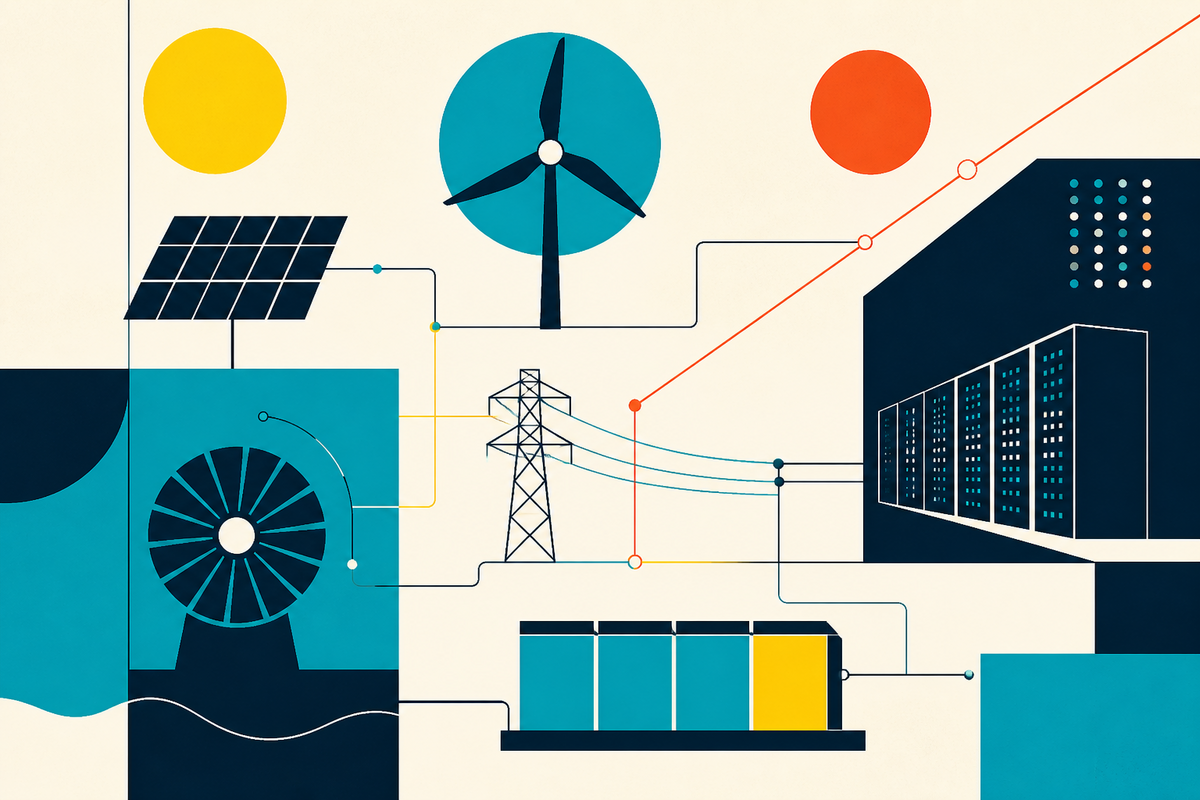
A wind farm produces when the weather cooperates. A data center wants electricity every millisecond. Batteries can move energy across hours, not seasons. Transmission takes years to permit. Natural gas remains flexible but emits carbon. ECP's portfolio construction tries to live inside those frictions. Contracts and hedges can steady revenue. Diversity across technologies and regions can keep every asset from responding to the same shock. Control ownership gives the firm a chance to change operations rather than merely price risk from a spreadsheet.
A product made of ownership
For ECP's limited partners - pension plans, sovereign institutions and other large allocators - the product is access to a specialized private-market strategy. The flagship equity funds make predominantly control, value-add investments in electricity and sustainability infrastructure. ECP reports roughly $23 billion across six such funds, another $2.8 billion across two continuation vehicles, and about $9 billion in co-investment. In May 2024, its fifth flagship strategy closed with $4.4 billion, 10 percent above target, alongside $2.3 billion of co-investment capital.
The business model is familiar to private equity: management fees pay for the platform, while successful realizations can produce carried interest. The practice is less generic. ECP hires or backs management teams, sets a strategic plan with them, and brings an in-house operating group into financial and operational decisions. It speaks repeatedly about safety, an unusually important word when the portfolio includes high-voltage equipment, heavy industry, waste facilities and combustion turbines.
One system, four jobs
Renewables, geothermal, hydro and flexible thermal plants make the electrons.
Storage, grid services and dispatchable capacity match supply to demand.
Waste, recycling, carbon capture and nuclear services handle the consequences.
Control equity and private credit turn long-lived hardware into investable cash flows.
Private credit completes the loop. ECP says it has issued more than $73 billion of debt as a borrower over two decades. That experience gives its lenders a practical view of documentation, collateral and what goes wrong after a forecast meets an operating asset. Loans are structured around downside protection, cash yield and tangible infrastructure, often supported by long-term or inflation-linked contracts. The distinction from a generalist lender is plain: ECP has sat on the other side of the table and has owned the machinery underneath it.
The customer behind the customer
ECP technically serves its fund investors. Its influence reaches a much wider set of end users through portfolio companies: utilities buying power, corporations seeking renewable supply, communities using local solar, households buying gas, governments handling nuclear material, and municipalities collecting waste. A single ECP investment can sit several steps behind the monthly bill, the factory shift or the cloud service.
The fastest-growing customer archetype is the hyperscale data-center operator. AI training and inference require dense clusters of servers with large, steady power loads. Interconnection queues and generation shortages make electricity a gating item. ECP's response has been to package capital, power-market knowledge, land, generation and digital infrastructure into large partnerships.
In October 2024, ECP and KKR announced a strategic partnership with the capacity to support $50 billion of data-center, power-generation and transmission projects. The first announced development is a 190-megawatt campus in Bosque County, Texas, built with CyrusOne next to Calpine's Thad Hill Energy Center. Its initial IT load is planned at 144 megawatts, with operation expected in the fourth quarter of 2026. A dedicated power agreement is designed to serve the campus while allowing generation to support the wider grid during scarcity.
Five months after the KKR announcement, ECP and Abu Dhabi investor ADQ unveiled a separate 50-50 venture targeting more than $25 billion in new generation and energy infrastructure for data centers and other energy-intensive industries. These figures are ambitions, not money already spent. Still, they show the size of the constraint and the kind of consortium required to address it.
Bridgepoint, Calpine and the long cycle
ECP itself became part of a larger machine in August 2024, when it combined with London-listed Bridgepoint. The deal gave Bridgepoint a North American infrastructure platform alongside private equity and credit. ECP kept its brand and investment operation, while its leaders joined the combined group. The arrangement suggests that its scarce asset was not a generic fund-management process but a team, network and track record rooted in a particular market.
Calpine provides the clearest example of ECP's long-cycle approach. An ECP-led consortium agreed in 2017 to take the generator private, completing the transaction the following year. Calpine owned natural-gas plants and the Geysers geothermal complex, giving it both flexible capacity and a major renewable resource. In January 2026, Constellation completed its acquisition of Calpine, combining the fleet with its nuclear generation and creating what the companies described as America's largest electricity producer.
Kimmelman, Lane and Helm establish ECP.
Fund V closes, Atlantica is acquired, Bridgepoint combines with ECP and KKR signs on.
The ADQ venture and Texas data-center project move the AI thesis from slides to sites.
Calpine is sold; ECP agrees to buy nuclear-lifecycle specialist EnergySolutions.
The Calpine exit did not mark a retreat from conventional generation. ECP also invested in PROENERGY, a turbine-services and manufacturing platform, and in early 2026 agreed to sell three gas plants totaling about 2.6 gigawatts to Talen Energy. Its planned acquisition of EnergySolutions moves further into the nuclear lifecycle - transport, processing, recycling, decommissioning and disposal - as extended plant lives and energy-security concerns revive the sector.
Where the edge can fray
ECP competes with infrastructure giants including Brookfield, KKR, Blackstone, Stonepeak, I Squared, Macquarie and BlackRock's Global Infrastructure Partners, plus power specialists such as ArcLight and Quinbrook. Many can write large checks. Several have global development networks. KKR is both partner and, elsewhere, competitor. ECP's differentiation rests on concentration: a proprietary sourcing network, control experience, operating intervention and decades spent inside U.S. electricity markets.
Concentration also creates risk. Policy can change faster than assets. Electricity prices are volatile. Construction schedules slip. Interconnection and permitting can turn a development pipeline into a waiting room. Gas generation may help reliability while drawing opposition over emissions. Data-center demand may arrive later, relocate or demand cleaner supply than a project initially offers. Private ownership can accelerate decisions, but it does not repeal physics or regulation.
ECP's answer is portfolio discipline rather than certainty: use contracts and hedges, avoid over-correlating assets, control leverage, improve operations and invest across multiple forms of generation and sustainability infrastructure. Its culture language follows the same pattern. The firm stresses respect, open communication, mentorship and shared success; its responsible-investing reports add safety, environmental stewardship and transparent governance. In a business built around long-lived assets, culture is another kind of maintenance schedule.
The next AI breakthrough may depend less on a clever model than on a permitted site, a firm power contract and a turbine that starts on time.
The physical layer wins attention
The fashionable story around AI is weightless: intelligence arriving through an interface. ECP's story is heavier. It is concrete pads, fuel supply, switchgear, cooling, batteries, transmission and financing documents. That physical layer has become strategically important because power demand is rising after years of relative stagnation, pushed by computing, manufacturing and broader electrification.
For institutional investors, ECP offers a way into that buildout through a manager that speaks both the financial and operating dialects. For portfolio-company leaders, it offers capital plus an owner willing to participate in hard decisions. For hyperscalers and industrial users, its partnerships aim to shorten the path from a large electricity requirement to a functioning site. None of those jobs is simple, and none is performed by ECP alone. Utilities, developers, communities, regulators, equipment makers and co-investors all sit in the chain.
That may be the most useful way to place ECP in the market. It is not a clean-tech venture fund hunting for the next device. It is not a utility with a regulated territory. It is not a broad buyout shop occasionally visiting energy. It is a private-market owner and lender operating where the energy transition meets the reliability problem. The AI boom did not invent that niche. It merely made the niche impossible to ignore.
Keep exploring