The kitchen is an excellent place to lose faith in the word waste. Yesterday’s meal leaves peelings, scraps and leftovers. Tomorrow’s meal needs heat. Mainak Chakraborty has spent much of his working life trying to make those two facts useful to each other. The proposition sounds almost impolitely simple. The years required to turn it into a dependable business were considerably less so.
In 2022, when GPS Renewables turned ten, its co-founder and CEO described a company whose growth charts had finally acquired the attractive upward curve founders like to show. His account of getting there borrowed from Rocky Balboa. That is a more revealing choice of reference than a spreadsheet: the anniversary story gave considerable space to staying afloat, collecting money and carrying on.
By June 2026, GPS was announcing a ₹635 crore financing package to support its next phase of bioenergy infrastructure. Between those two moments sits Chakraborty’s distinctive subject: the time it takes to build something useful when the technology, customers and financial backers do not all arrive together.
A lesson in keeping the surroundings clean
Chakraborty grew up in Mizoram. Asked in a 2024 interview about his interest in sustainability, he pointed to the civic habits of the Northeast, where he had seen people respect the environment and keep their surroundings clean. It is a modest origin for an industrial ambition. There is no dramatic invention in that recollection, just an early expectation about how a place should be treated.
His formal education took him through engineering at NIT Calicut and management at IIM Bangalore, where he studied from 2008 to 2010. Bengaluru supplied a different education. It offered the excitement of startups, but also a waste problem that was difficult to overlook. A city could be inventive in its offices and decidedly less inventive about what happened after lunch.
His interest in making products had another influence. A former boss had worked in the early C-DOT team assembled by Sam Pitroda. Stories about that effort encouraged Chakraborty’s belief that Indian teams could build technology products with a public purpose. The appeal was tangible: people had done it before. Useful technology could be something built here, for a problem here.
With Sreekrishna Sankar, another IIM Bangalore graduate, he began exploring what to work on. GPS Renewables was founded in 2012. The problem they settled on was organic waste, and the business they began building was biogas. The city’s untidy remainder offered a starting point for two engineers who wanted their work to have a social and environmental consequence.
The customer had to cook dinner
Biogas was already an established idea. GPS’s opportunity lay in making a system that institutions could accommodate and use. A hotel, campus or corporate office has food waste, limited room and little appetite for troublesome equipment. A product that fitted those conditions could turn the waste generator into a fuel user. BioUrja became the company’s modular answer.
Early descriptions of the system are gratifyingly practical. There were shredders for the incoming material, storage for the gas, equipment for handling the remaining slurry, and piping and burners connecting the system to a kitchen. The whole arrangement mattered. Producing gas was one achievement; getting a customer comfortably through another day of cooking required the rest.
Remote monitoring helped connect equipment on customer premises with the company looking after it. By 2016, Chakraborty was describing operating information and alerts travelling through SMS and WhatsApp. Waste still had to be fed into the plant. The digital layer helped the team watch what happened afterwards. The technology carried a familiar consumer convenience into an unfamiliar industrial setting.
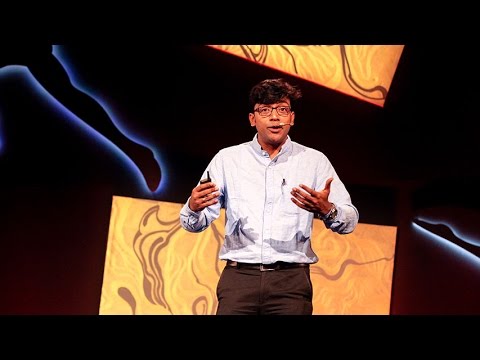
The title of his INK talk, The Internet of Biogas, captures that combination rather neatly. The internet had found another thing to connect, and this one had a feedstock problem. His presentation made a case for treating organic waste as an energy resource. The attention was welcome, but a talk could only explain the proposition. A working installation had to keep proving it.
GPS eventually installed more than 100 BioUrja systems. Its projects include a Sri Lankan resort where gas from organic waste is used for cooking, and installations for industrial clients such as Saint-Gobain. These are places with routines, bills and people expecting equipment to behave. The original idea earned its place by fitting into those routines.
A simplified view of the captive biogas model: the institution supplying the waste can also use the fuel.
When patience has a balance sheet
The early financial story was less glamorous than the product story, and probably more instructive. Chakraborty has described a sector that took time to attract the kind of capital other renewable-energy businesses enjoyed. In his Series B announcement, he credited Caspian Debt and the CGTMSE loan-guarantee scheme with helping GPS through those years. BIRAC grants kept research moving.
Those forms of support did different jobs. Research needed room to proceed before there was a finished product to sell. The operating company needed money to work between orders and payments. Equity investors were another part of the picture, arriving in greater force later. His recollections make the dependence on each form of capital clear without turning the early years into a tidy funding montage.
By the tenth anniversary, he was discussing average customer credit periods of under 45 days and a target below 30. A founder celebrating a birthday with accounts receivable may sound unusually sober. Yet payment timing tells you whether the business can afford its own success. More orders can also mean more money waiting to come back.
“Restless as ever. Grittier than ever.”Mainak Chakraborty, on GPS Renewables’ tenth anniversary, 2022
He also acknowledged that he and Sankar had started without the educational qualifications or industry experience needed to build a biofuels company. It is a useful admission from an engineer with a management degree. Credentials gave them tools; the sector still required learning. The anniversary’s confidence came with a memory of that gap, rather than a claim that the founders had always known the way.
The old campus, the larger city
One customer brought the story back to Chakraborty’s own education. In 2017, GPS installed the biogas plant at IIM Bangalore. The campus that had trained the founders became a site for the technology they had built afterwards. There is something satisfying about this return: the alumni contribution came with piping and a waste-processing requirement.
The relationship with the institute also placed GPS within an entrepreneurial network that could recognize what the founders were attempting. When IIM Bangalore announced the company’s Series B funding in March 2022, it described BioUrja alongside BiogasBot, the company’s predictive software for remote bioprocess management. Management education and engineering work had acquired a shared case study.
Indore marked a larger change in scale. GPS helped construct and commission the city’s municipal organic-waste BioCNG plant, inaugurated in February 2022. The company describes a design processing capacity of 550 tonnes of organic waste a day and an output of 17 tonnes of compressed biogas. These are plant figures, rather than a measure of Chakraborty’s personal contribution; the work belongs to an engineering organization.
Indore design figures published by GPS Renewables. Capacity figures describe the plant, not a daily production guarantee.
The destination of the fuel also widened. The early campus model brought kitchen waste back as kitchen heat. A municipal BioCNG project can supply transport and industrial users. The circle has more participants now: waste collection, processing, fuel preparation and customers beyond the place where the waste began. Each connection adds a practical obligation.
That helps explain the company’s move into project development. GPS launched Arya in 2022 to develop climate projects on its own books. An Indian Oil joint venture followed in June 2024. Chakraborty’s business was increasingly concerned with the structures that allow projects to exist, as well as the technology inside them.
The cheque comes with several compartments
The June 2026 announcement makes that structure visible. Its ₹635 crore total comprised ₹125 crore of company equity led by PixelSky Capital, a ₹200 crore equity tie-up for Arya with a Korean conglomerate, and an earlier ₹310 crore Sojitz tie-up for the asset-platform business with Indian Oil. Reading the components gives a better picture of the next phase than treating the whole sum as a single fresh cheque.
Chakraborty tied the announcement to a growing portfolio of large bioenergy projects across India and the infrastructure needed for cleaner fuels. The ambition now involves execution at multiple sites. In its March 2026 operations update, GPS described a 27-site Reliance operations-and-maintenance portfolio. The work continues well after construction: a plant needs to be run, maintained and made to perform.
It is an expansion that preserves a connection to the early product. The kitchen customer wanted dependable gas. The infrastructure customer wants dependable gas too, with substantially more equipment and capital involved. For Chakraborty, the question that began with institutional waste has grown into a question about how an energy system gets built.
A little room for boring
There is another expression of his interest in the field: The Boring Climate Podcast, a GPS initiative featuring conversations with scientists and conservation experts. Its first season included climate scientist Madhavan Nair Rajeevan, ecologist Harini Nagendra and water conservation expert Vishwanath Srikantiah. Chakraborty described an aim to simplify climate issues and make deeper conversations more accessible.
The title has a welcome lack of ceremony. Climate discussions are often asked to arrive dressed for an emergency or a sales pitch. Here, the invitation makes room for explanation. A company that works with equipment and long project schedules has reason to value the details that sit behind a large claim.
That is where Chakraborty’s story becomes most interesting. He can talk about civic habits in Mizoram, a digester at his old campus, grants that supported research, and the number of days a customer takes to pay. The subjects belong together. They show how an environmental intention acquires the habits of a working business.
The discarded meal is still the beginning of the proposition. What has changed is the organization assembled around it, and the number of people who can use the resulting fuel. Chakraborty’s long wait has produced a larger set of responsibilities. Somewhere, a kitchen has more scraps. Somewhere else, an engineer has another day’s operating figures to check.