On a visit to China, Devdatt Kurdikar had the usual executive business to attend to: a commercial team to meet, a plant in Suzhou to visit, conversations about growth. The trip also fell on Lantern Day, at the end of the Spring Festival. He joined his colleagues in making dumplings. Later, describing the visit, he made sure to add that the dumplings became part of dinner. Even a chief executive likes to establish that the meeting produced something edible.
The detail sits pleasantly beside his formal title: chairman, president and chief executive officer of embecta. The title takes some room. The anecdote takes rather less, and helps bring the person into view. Here is an executive whose working life crosses borders, functions and corporate boundaries, sometimes with a meal at the end of it.
Kurdikar has spent much of his career helping businesses change their circumstances. A division becomes part of another company. A company emerges from financial difficulty and finds a buyer. An established operation leaves its parent and has to build the machinery of independence. The interesting question in his story is what happens after the announcement, when the people left with the work open their calendars.
Four degrees, several ways of seeing
His education runs through four institutions. He earned his bachelor’s degree in chemical engineering at the University of Bombay, followed by a master’s in the same subject at Washington State University and a doctorate at Purdue. An MBA from Washington University in St. Louis added another discipline to the list. There is plenty of engineering in that education, followed by an explicit interest in how an enterprise works.
He began his career as a senior research engineer at Monsanto. At Baxter, where he spent eleven years, his responsibilities extended across finance, strategy and integration, research and development planning, operations, and marketing. This was a working education in the different languages spoken inside a large company. A budget, a development plan and a commercial proposal can concern the same business while making rather different demands of it.
By 2011 he was a vice president of marketing at Baxter; he remained there until 2013. The movement across functions matters because his later jobs would involve making separate parts fit together. A corporate transition looks tidy in an organizational chart. The people responsible for delivering it must contend with all the awkward joins.
A career at the joins
In 2013, Kurdikar joined American Medical Systems as a vice president and general manager. He subsequently led his business through a carve-out and sale to Boston Scientific, then through its integration into the buyer. He held the corresponding Boston Scientific role from 2015 to 2016. That sequence gave him responsibility on both sides of a corporate boundary: preparing a business to move, then helping it belong somewhere new.
His next chief executive role began at Cardiac Science in 2016. The company had been acquired by a private equity firm through bankruptcy proceedings. During his tenure it returned to profitable growth and was subsequently sold to ZOLL. He served as president and CEO through 2019. The outcome belongs to a company and its employees, although it also helps explain why a board would turn to him when another business needed to change its footing.
By February 2021, BD had appointed him to run one of its worldwide businesses. Alberto Mas, then the executive overseeing BD’s Medical Segment, pointed to Kurdikar’s experience across functions and described his leadership as hands-on and authentic. The appointment brought him into the organization from which embecta would emerge. Once again, the assignment would soon acquire a second dimension.
- 2013American Medical Systems
Carve-out, sale and integration - 2016Cardiac Science
President and CEO - 2022embecta
Independent public company - 2026embecta + Owen Mumford
An acquisition to integrate
An old business gets its own keys
Embecta became independent of BD on April 1, 2022, with Kurdikar as president, CEO and a director. He later called it a “100-year-old startup.” The phrase captures a peculiar management problem. There was an inherited business, with established expertise and commercial relationships, alongside a new public company that had to make its own decisions and provide its own corporate services.
For Kurdikar, the attraction was the ability to determine where resources went. Inside a parent company, a division competes with other divisions for investment. Outside it, management can recruit for its own priorities, seek capital and decide how to deploy it. Independence gives those decisions a clear address. It also gives their consequences the same address.
The business brought dedicated manufacturing operations, commercial teams and a research center into its new existence. Finance, information technology and human resources infrastructure still needed to be established. The opening ceremony, in other words, came with a substantial to-do list. Having your own balance sheet is an appealing freedom until you remember all the people and systems required to keep it useful.
A new headquarters in Parsippany opened in January 2023. Kurdikar paid attention to something easily overlooked in the excitement of a new corporate home: the commute. The company had employees in New Jersey whom it wanted to retain. Moving for the pleasure of moving could make their working lives harder, and could cost the business experienced people. A location decision had become a talent decision.
“A 100-year-old startup.”
Dev Kurdikar on embecta’s unusual beginning
The work that rarely gets a ribbon
There is a familiar photograph for a corporate beginning: executives, applause, a ceremonial moment. The independent company’s plumbing is less photogenic. Procurement processes are unlikely to draw a crowd. Yet they determine whether a business can buy what it needs, account for what it spends and keep its commitments. Kurdikar’s embecta assignment involved a great deal of that work.
The company worked with Genpact on its transition. The partnership included an enterprise resource planning system, standardized global processes, and human resources, finance and procurement operations. In July 2024, the two companies described a collaboration intended to maintain the flow of goods and working capital as embecta established itself separately. The ambition was continuity during a considerable internal change.
By its fiscal 2025 reporting, embecta said it had completed its global ERP implementation and moved from its “Stand Up” phase to “Seed Growth.” Those are management labels, but the distinction has substance. The systems a business requires to operate independently have to be in place before management can give more attention to expansion. The clock does not stop while those systems are being built.
The same reporting described approximately $185 million of debt reduction during fiscal 2025. That figure gives the transition a financial dimension. Independence brings discretion over cash, along with obligations on that cash. Paying down debt was part of creating room for subsequent investment. The freedom Kurdikar had wanted was something the organization had to keep earning.
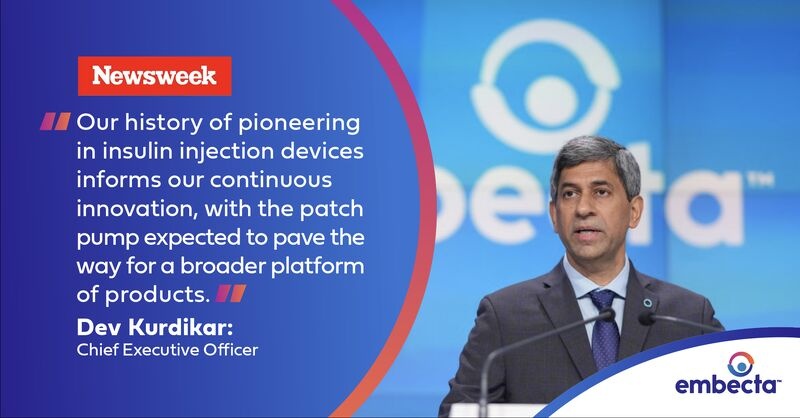
A moment at the lectern. The less visible part of the job comes with systems, schedules and a considerable to-do list.
Photo: embecta, via LinkedIn. Image framed to show the speaker.A room where disagreement can work
Kurdikar’s account of leadership gives people permission to complicate the conversation. He has argued for teams with different backgrounds and experiences, brought together around a shared goal. His advice includes avoiding groupthink and being prepared to have one’s ideas challenged. That is a more demanding proposition than assembling a room of people who can be relied upon to nod.
“Be ready to be challenged,” he has said. The invitation is useful only if it extends to the person who issued it. His stated approach asks people to offer solutions that colleagues can improve, with a culture in which team members are seen and heard. The practical test of that approach comes when somebody has an inconvenient observation and enough confidence to make it.
A visit to the international leadership team in Switzerland prompted him to write about employees having their own stories and backgrounds. He connected that variety to the company’s ability to work across regions and emphasized an open, collaborative culture. The idea fits the geography of his job. A global operation asks people with different local knowledge to contribute to decisions that cannot be understood from one office.
The Suzhou dumpling session belongs at this smaller scale of corporate life. It does not prove a management philosophy. It does show a chief executive participating in a local occasion with colleagues, and choosing to tell people about it afterward. A company culture is partly made from what gets attention. Dinner can occasionally earn a place beside the quarterly results.
Debt reduced as embecta completed its global ERP implementation.
Another boundary to cross
On February 11, 2026, Kurdikar became embecta’s chairman as well as its president and CEO, following David Melcher’s retirement. Claire Pomeroy became lead independent director. The arrangement expanded Kurdikar’s formal responsibilities while establishing a separate role for independent board leadership. He credited employees around the world for the company’s progress since the separation.
He also sits on the boards of Zimmer Biomet, AdvaMed and LMG Holdings. Zimmer Biomet appointed him in June 2024. These connections put him in conversations beyond his own company, with the perspective of an executive who has worked through ownership changes, integrations and the construction of a public company. His career supplies plenty of examples of what happens when strategy reaches the operating level.
In May 2026, embecta completed its acquisition of the British company Owen Mumford. The agreement provided for £100 million in upfront cash and up to £50 million in performance-based payments. The transaction brought design, molding and assembly capabilities together with embecta’s manufacturing scale and commercial infrastructure. The proposed advantages now had to become working relationships.
The acquisition adds a fresh integration task to a career already familiar with them. Kurdikar had sought the ability to choose where embecta would invest. The company now had a completed transaction and the work of bringing two organizations together. A signature can settle ownership. It takes rather longer to establish how colleagues will make decisions together on an ordinary Tuesday.
His story keeps returning to that interval between a decision and a functioning business. Four degrees, several employers, a turnaround and a spinoff have brought him to another beginning. The recurring work is specific: allocate capital, establish systems, retain people, invite disagreement, make the next organization function. And, when the occasion permits, stay for dinner.
Follow the next chapter
Public profiles, conversations and company updates.
- Dev Kurdikar on LinkedIn
- embecta
- Kurdikar’s board biography
- The conversation about building inclusive teams
- The work of becoming independent
- Chairman appointment · February 2026
- Owen Mumford acquisition · May 2026
- Quarterly results · August 2026
- A video conversation with Oliver Renick
- embecta on YouTube