Consider the small indignity of making a sale and then waiting to use the money. The customer has left. The receipt exists. The business still has suppliers to pay. In that interval sits an opportunity for a bank: make the journey from payment to available cash less awkward, and the checking account becomes considerably more useful.
That is a useful place to begin with U.S. Bank. Its parent, U.S. Bancorp, serves about 15 million clients globally. But size alone explains little. The interesting detail is what sits beside the bank account: card acceptance, treasury tools, investment services and, increasingly, capital markets advice. The company wants to handle more of the financial work surrounding each customer.
- Business Essentials connects checking with card payments.
- Elavon gives the group a merchant payments business beyond its branch network.
- Buying BTIG expanded its institutional trading and advisory capabilities.
- Convenience has a price: processing fees survive the zero monthly fee.
The bank account meets the counter
Business Essentials, introduced in 2025, puts a business checking account and payment acceptance together. An owner can take a card payment, issue a receipt and see the financial picture through connected tools. The first mobile reader is included. So are unlimited digital transactions and checking without a monthly maintenance fee.
The appeal is less administrative juggling. A customer who previously needed separate arrangements for banking and accepting cards can buy both from one group. U.S. Bank’s Elavon subsidiary supplies the payments side. For a small operation, reducing those handoffs may be more useful than adding another impressive-looking screen.
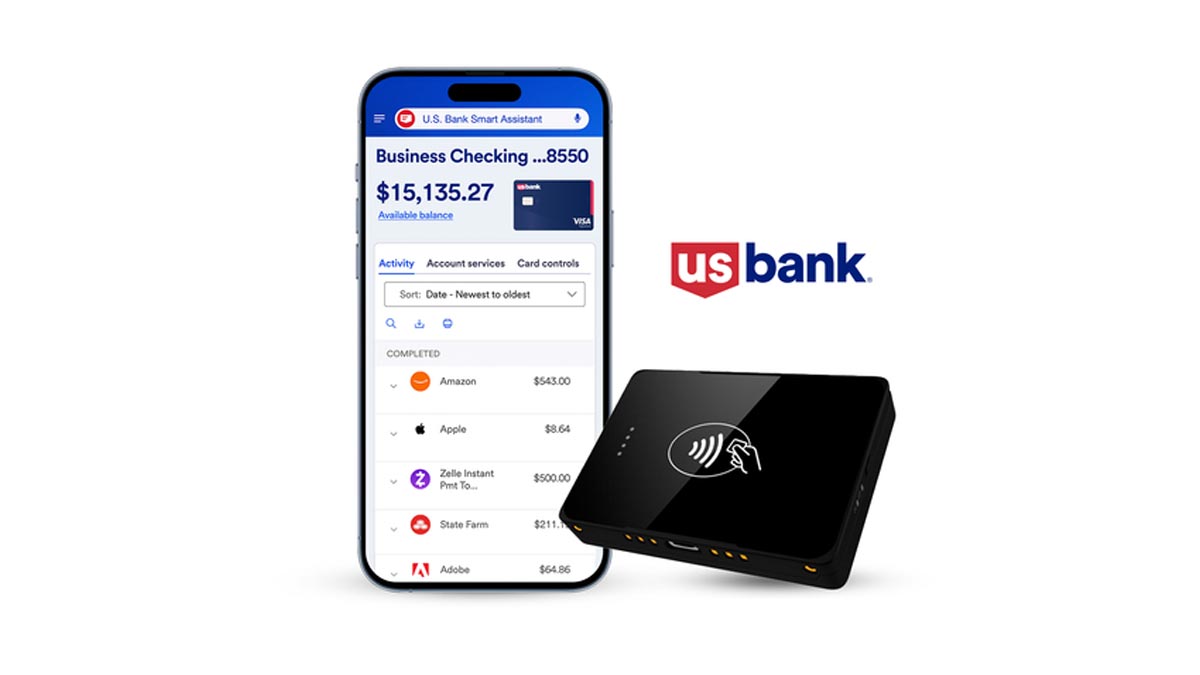
There is evidence behind the product choice. In the bank’s 2025 small-business survey, 80% of owners wanted more digital tools and 82% wanted a consolidated solution. Those findings support a specific design decision: connect tasks owners already perform. They do not establish that every owner wants their bank to supply every tool.
Free checking. Paid transactions.
The arithmetic deserves its own moment. Published online-application pricing starts at 2.60% plus ten cents for an in-person swipe, tap or insert. On a $100 sale, that is $2.70 before additional applicable charges. Online payments start at 2.90% plus thirty cents; manually entered transactions cost more again.
Illustration using published online-application rates. Card-brand assessments and other applicable charges are additional.
Paper-heavy businesses should also count their transactions. The account includes 25 teller and paper transactions per statement cycle, then charges fifty cents each. Faster access to sales proceeds depends on settlement and batch timing. The product can simplify a workflow without making every payment instant or every service free.
That provides a practical comparison with Square, Stripe or another bank. Count the entire job: taking payment, receiving funds, reconciling records and getting help. A business already satisfied with a specialist system may gain little from moving. A business tired of stitching systems together has a clearer reason to investigate.
A bank assembled around adjacent needs
U.S. Bank’s ancestry makes the strategy easier to understand. Its lineage reaches back to an 1863 national charter issued to First National Bank of Cincinnati. The present group emerged through combinations of regional institutions. Even its name travelled: United States National Bank of Portland opened in 1891.
Payments became another branch of that family tree. The 2001 acquisition of NOVA brought capabilities later branded Elavon. Today, Elavon reports serving more than two million merchants in over 36 countries. A company associated with American branches also helps businesses accept payments well beyond them.
- Consumer & Business Banking
- Payment Services
- Wealth, Corporate, Commercial & Institutional Banking
Business-line shares exclude Treasury and Corporate Support.
This breadth distinguishes the proposition from a payments specialist or a purely consumer banking app. A household can borrow for a home. A business can finance equipment. An institution can obtain fund administration or trust services. Interest income pays for part of the enterprise; fees from payments, investments and other services pay for another part.
Buying the next conversation
Expansion has required serious money. The Union Bank agreement was announced at approximately $8 billion, including $5.5 billion in cash and shares. Completed in 2022, it expanded the West Coast franchise and moved the group’s California deposit position from tenth to fifth.
BTIG addresses a different adjacency. U.S. Bancorp completed that acquisition in June 2026, adding institutional equity trading, equity capital markets and advisory capabilities. The announced agreement targeted $725 million at closing, with up to $275 million more tied to performance. A commercial client seeking a loan might also need help with a transaction.
“BTIG adds highly complementary capabilities to our capital markets platform”Stephen Philipson · June 2026

Gunjan Kedia became chief executive in April 2025 and took the chair role a year later. The company’s stated priorities include organic growth, productivity and payments transformation. Read together, the acquisitions and connected business tools suggest a consistent ambition: give existing relationships more reasons to stay, and more useful services to buy.
The permission problem
Connecting products carries an obvious danger: employees can be rewarded for selling things customers never wanted. In 2022, the CFPB found U.S. Bank had opened certain accounts and issued credit without customers’ knowledge or consent. Its findings described sales goals and incentive compensation. The penalty was $37.5 million, alongside required consumer redress.
The bureau terminated the order in August 2025, noting penalty payment, redress and steps toward preventive relief. That history belongs in any account of the company’s people-first culture. A useful additional service begins with a customer’s agreement.
The latest results show momentum: third-quarter 2026 net revenue reached $7.970 billion, including a full quarter of BTIG. The transferable lesson is smaller than that number. Follow what a customer does immediately before and after using your product. There may be a better business in connecting those steps. At U.S. Bank, the test is whether those connections save customers enough time, money and frustration to earn the next conversation.