Before Entegris became a supplier to chip factories around the world, one of its predecessors had a wonderfully direct sales technique. Dan Quernemoen would arrange plastic products on a table in a semiconductor manufacturer’s lobby. Engineers gathered. Questions followed. In his SEMI oral history, the former Fluoroware executive likened it to a Tupperware show.
- Materials to make chips. Filters to protect the process.
- Customers include fabs, toolmakers and chemical suppliers.
- The economic prize: more usable chips from each wafer.
What initially strained the business was making enough tools and securing enough Teflon. DuPont, its sole supplier, struggled to keep up with a market it had been slow to appreciate. Quernemoen took engineers along to explain the applications. The lesson was practical: demand meant little without a supplier who understood what was coming.
Fluoroware began operating in 1966. It merged with wafer-handling company EMPAK in 1999 to become Entegris; Mykrolis added filtration and purification capabilities in 2005. The products grew more sophisticated. The underlying assignment remained recognizable: get delicate things through hostile processes intact.
“like a Tupperware show”Dan Quernemoen, on early Fluoroware demonstrations
02The speck has a business model
Chipmaking is a sequence of opportunities to spoil something valuable. Materials must be deposited, patterned, polished and cleaned. Wafers travel between operations. Every transfer introduces another place where a particle, an unwanted molecule or a trace metal can become a problem. At smaller dimensions, yesterday’s tolerable impurity becomes today’s defect.
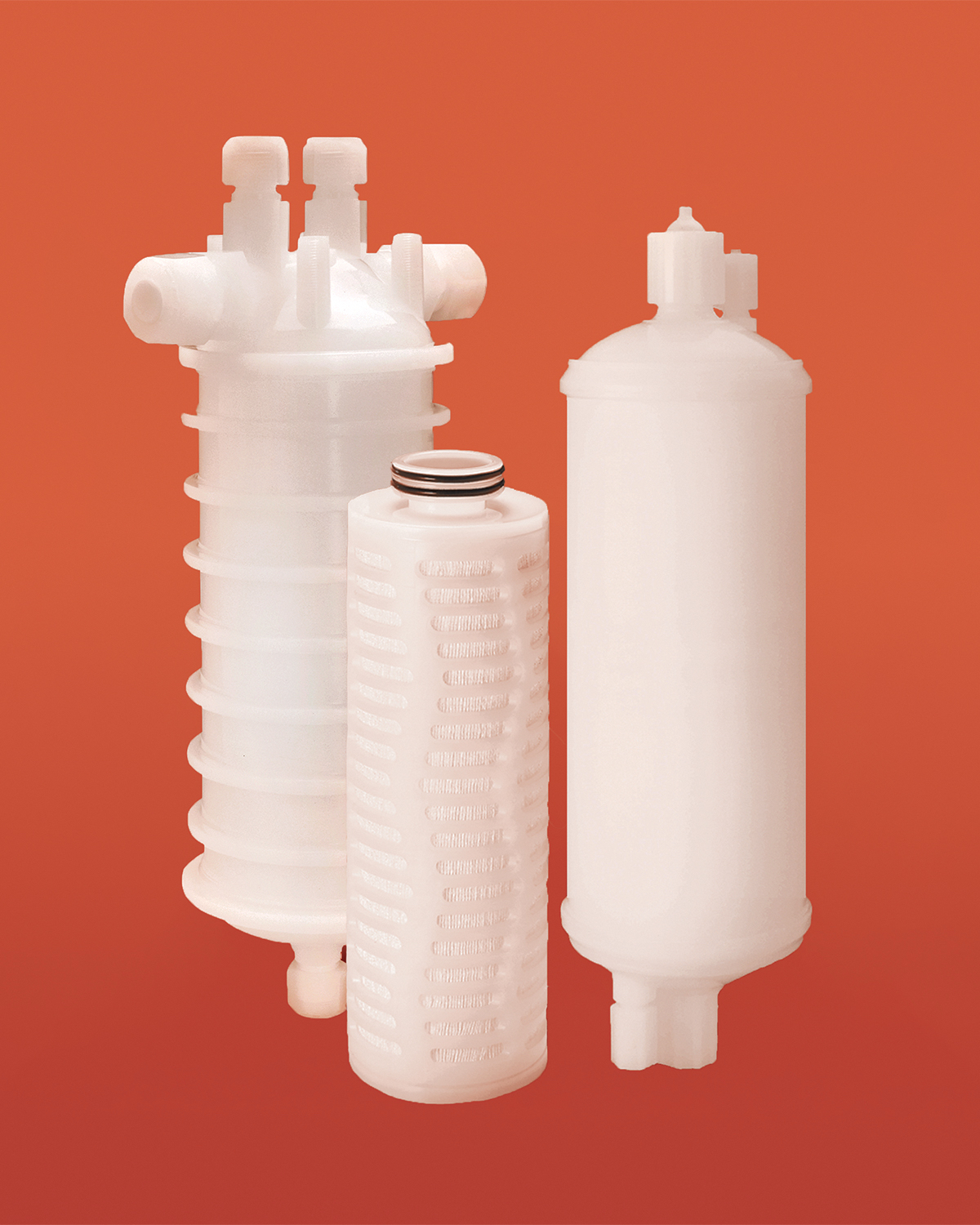
Entegris sells into those vulnerable moments. Its Torrento filters handle demanding liquid applications; GateKeeper systems purify process gases. Its front-opening unified pods, mercifully shortened to FOUPs, protect wafers as they move through fabrication. These are portable controlled environments. The container belongs in the same engineering conversation as the material inside it.
Consider polishing. Chemical mechanical planarization, or CMP, flattens wafer surfaces using a slurry and a pad. Entegris supplies those consumables, along with filters, cleaning chemistries, brushes and monitoring. Polishing particles have a useful job; agglomerated particles can leave scratches. The trick is to manage the particle population rather than simply wish every particle away.
03Sell the whole journey
The customer list spans chip manufacturers, equipment makers, chemical suppliers and wafer growers. TSMC alone represented 16% of 2025 sales. The ten largest customers together contributed half. This is an industrial business with a relatively concentrated audience, where a successful qualification matters considerably more than a clever advertising campaign.
Its competitive pitch is breadth. Pall competes in filtration; Merck and other materials suppliers overlap elsewhere. Entegris can work on the chemistry and the equipment that protects and delivers it. That offers a plausible advantage when a process problem crosses the boundaries between individual products. It still has to prove compatibility in the customer’s actual conditions.
The economics favor repeated use. Manufacturing consumes chemicals, slurries and other supplies, creating repeat orders tied to production. Equipment and carriers also connect Entegris to factory investment. Changing a qualified input can require time and introduce yield risk. Those relationships are valuable, although customers’ forecasts are generally not binding purchase commitments.
For a fab engineer, the practical starting point is a specific defect or process constraint. Entegris offers analytical services covering particles, metals, ions and other contamination. Its FOUP services combine laboratory work with field support. The buyer gets help investigating a process, as well as products to put into it.
Same wafer.
More keepers.
04Purity is expensive. So is ambition.
Building that range cost real money. The CMC Materials deal was announced in December 2021 at approximately $6.5 billion in enterprise value and completed in July 2022. It brought CMP slurries and pads into a broader materials-and-purity offering. The strategic logic was to earn more business around each wafer and develop complementary products together.
The factory bill is substantial too. Entegris expects its Colorado Springs manufacturing investment to reach roughly $600 million over several years. In December 2024 it signed an agreement for up to $77 million in CHIPS Act funding. An award ceiling is not cash already collected; payments depend on milestones.
Then comes the less photogenic expenditure: experimentation. Engineering, research and development consumed $329 million in 2025, against $3.197 billion in revenue. Entegris calls its values PACE, including teamwork, accountability and innovation. In this business, those ideals face a concrete test: can people with different specialties make their products behave together?
About 10.3 cents of every sales dollar went into engineering, research and development.
05Even a purity company needs a cleanup
Breadth has limits. Revenue fell from $3.241 billion in 2024 to $3.197 billion in 2025. The company recorded $29.7 million in restructuring costs in 2025, including a divisional reorganization and workforce reductions. Its 2026 disclosures also identify the wind-down of Life Sciences Fluid Management. Technical overlap does not guarantee an attractive adjacent business.
David Reeder became chief executive in 2025. By the second quarter of 2026, sales had reached $883.2 million, up from $792.4 million a year earlier. GAAP operating margin rose to 18.6% from 13.4%. That is evidence of improvement, while the restructuring record supplies a useful check on any frictionless growth story.
A separate change is visible in the legal paperwork. In May 2026, Entegris and JSR’s Inpria agreed to cross-license metal oxide resist patents and terminate specified patent-review challenges. They also outlined possible collaboration around future photoresist materials. A contested boundary became an opportunity to combine materials, filtration and handling expertise.
Sales return to growth
06Borrow the question, before the factory
The transferable idea is to follow a customer’s valuable material through its entire journey. Look at the handoffs. Find where quality is lost. Then test whether fixing the neighboring step makes the original product more useful. That is a reasonable reading of the distance between a plastic wafer carrier and an integrated CMP offering.
The approach makes less sense where contamination costs little, a standard component works adequately, or qualification cannot justify its expense. It also remains exposed to semiconductor production cycles and customers’ investment decisions. A filter cannot create demand for chips. It can help a factory waste less of the demand it already has.