Walter J. Zable could have asked William & Mary’s football coach about recruitment, fundraising or the season ahead. What Jimmye Laycock remembered was a more particular concern: were the players learning to tackle better? Decades after leaving college, the former receiver still had an opinion about the fundamentals. A stadium carrying your name apparently did not excuse anyone from getting the basics right.
By then, Zable had spent much of his life running Cubic, the San Diego electronics business he founded in 1951. Its work reached military training ranges and public transport networks. His interests had become international; his attachment to a college football field remained wonderfully specific. He wanted the team to succeed, and he cared about how it played.
That attachment eventually acquired a financial shape. In April 2013, the year after his death, William & Mary announced a $23.9 million gift from his estate. Part would help students attend. Part would repair the place where they played. A young athlete had once needed a way into college. The older businessman had arranged to keep that way open.
A radio with one missing part
Born in Los Angeles in 1915 and raised in Boston, Walter Joseph Zable grew interested in electronics early. His favorite account of that beginning involved a crystal radio set and an inconvenient omission: he had no earphones. They cost $15, a price beyond his means. For a boy hoping to hear something, this was a fairly decisive problem.
As Zable told the story in a 2005 television interview, he was sitting outside when a passing truck lost a pair of earphones. He could scarcely believe it himself. The episode belongs here as his own recollection, complete with its unlikely delivery service. A technically minded child had found the missing component, and he remembered the moment many decades later.
Sport supplied another opening. An athletic scholarship brought him to William & Mary, where he completed a physics degree in 1937. He also earned letters in football, baseball, basketball and track. The combination leaves a rather crowded imaginary timetable: laboratory work, practice, another practice, and presumably an occasional opportunity to sit down.
His football earned honorable mention All-American recognition. He played for the Richmond Arrows after college and completed a master’s degree in physics and mathematics at the University of Florida in 1939. Athletics and scientific study both survived the transition into adulthood. They would continue to appear together in his choices long after either might have become a pleasant item in an alumni biography.
William & Mary
University of Florida
San Diego
Before the name went on the door
Zable’s engineering career included Sperry Gyroscope, Federal Telecommunications Laboratories of ITT, Flight Research Company and Newport News Shipyard and Drydock Company. At Convair, his responsibilities included electronics, microwave and antenna development. These were jobs in which technical knowledge had to survive practical demands. A promising idea still needed to work inside a larger system.
The route to Cubic included a garage business in 1949, followed by the company’s founding in 1951. Its early product measured microwave power. The scale was modest enough to make the later business seem an improbable relative: one instrument, a small San Diego operation, and a founder with experience across several engineering employers.
Betty Carter Zable worked in the business at its beginning as its first secretary. She and Walter had met at William & Mary. Their later gifts would often carry both names, as does the foundation they established. It is easy for a company’s origin to contract into a single founder’s photograph. Betty’s work belongs in the account of how this one began.
Zable selected “Cubic” to suggest engineering and precision. It was an economical name for a business that would try many things. The company went public in 1959. For Zable, the engineering career had widened into the work of finding customers, developing an organization and deciding which technical possibilities deserved another investment of effort.
A ticket gate and a fighter pilot
The range of Cubic’s work can look eccentric at first glance. Its history includes elevator controls, satellite tracking, electronic scoreboards, transit fare collection and combat training. These products occupied different settings, but each depended on making electronics useful in the physical world. Someone needed a measurement, a movement recorded, a payment accepted or an exercise understood.
In 1973, Cubic delivered an instrumented air combat training range for the Navy’s TOP GUN program. In 1974 came its first major automated fare collection contract, for the Bay Area Rapid Transit system. Those two consecutive entries in the company’s history capture the breadth of the enterprise rather well. Fighter pilots and commuters had very different destinations; both became customers for Cubic’s technical abilities.
By June 2012, the company’s board described its fare systems as enabling 10 billion passenger rides annually across 40 major markets. That figure counted journeys, including the repeated trips that make up daily life. A fare gate earns its place through repetition. Its most useful performance is often the one a passenger barely notices.
That ordinary usefulness is part of Zable’s story. His name appears prominently on sports facilities, while Cubic’s technology worked in settings where the supplier’s identity could remain in the background. You could encounter the business on the way to work without knowing anything about the former college athlete who started it.
Passenger rides enabled annually by Cubic fare collection systems across 40 major markets, as reported by its board.
The founder kept coming in
Zable remained Cubic’s chairman, president and chief executive until his death on June 23, 2012, aged 97. The title lasted more than six decades. The company also remembered his continued interest in employees and their work. In its account, people sometimes spent their entire careers there. The founder’s working life and the organization’s memory had grown together.
“You can’t buy experience,” reads the quotation beside his photograph in Cubic’s 2012 annual report. It is a suitably terse line from someone who had accumulated so much of it. The report recalled a working culture built around honesty, entrepreneurship and personal interest in colleagues. That description gives the long tenure some human scale beyond the impressive number of years.
The succession also requires a careful distinction between two Walters. After Walter J. Zable’s death, his son Walter C. Zable became chairman. William W. Boyle became interim president and chief executive. The company had thousands of employees and an established leadership team. The business continued, while the founder’s own chapter had closed.
“You can’t buy experience.”
Walter J. Zable
A stadium, and the people inside it
The stadium dedication photograph from 1990 contains a neat piece of foreshadowing. Walter and Betty stand with William & Mary leaders holding a sign bearing his name. A $10 million estate pledge had prompted the naming. It was a public moment for a commitment whose effects would extend well beyond the ceremony.
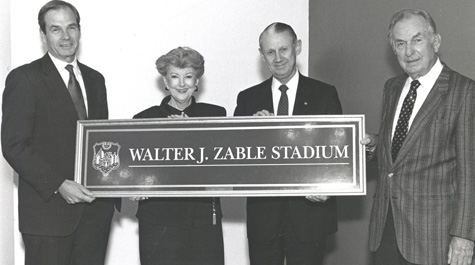
The eventual $23.9 million estate gift included $10 million for student athlete scholarships and $10 million for stadium renovations. The remaining $3.9 million was undesignated when announced. Those allocations gave the university both educational support and a start on repairing an aging facility. The pairing fits a donor whose own college years included serious study and serious sport.
His connection extended to university service: Zable sat on William & Mary’s Board of Visitors from 1992 to 2000. In football, he helped establish the National Football Foundation’s San Diego chapter in 1971 and received the organization’s Gold Medal in 1980. His sporting commitments had become opportunities to support other people’s participation.
The gifts crossed the country, too
San Diego received a substantial share of that attention. Walter served on the University of San Diego’s board of trustees from 1977 to 1996. In 2014, the university announced that he and Betty had left more than $6 million for athletics and scholarships. Its stadium field had already received his name in 2006.
At UC San Diego, their bequest supported endowed chairs in management leadership and energy technologies, together with scholarship and fellowship funding. The choices brought the familiar interests into another setting: education, practical science and the resources that allow people to pursue them. The grants were attached to institutions capable of carrying the work forward.
The Walter J. and Betty C. Zable Foundation, established in 1997, provided another means of continuing their giving. In 2022, San Diego State described the foundation’s support for its new stadium project and earlier campus initiatives. Ten years after Walter’s death, his enthusiasm for sport was still producing opportunities for a university community.
A name on the next student’s award
At William & Mary, his bequest also funds graduate fellowships across subjects including history, anthropology, computer science and physics. Beginning with the fall 2025 cohort, the listed award rose to $5,300 annually for the first two years, with another $500 each year for research expenses. The support reaches well beyond a football roster.
That is a useful place to leave Zable: beside the incoming student, before the work has happened. His life contained a radio, four college sports, an engineering career and a company that outgrew its small beginning. Some of what followed depended on opportunities other people had made available. He left behind several ways for the next person to get started.