After a hostile takeover, Alan B. Miller had a choice familiar to anyone whose business card has suddenly become a souvenir. He could go back to what he knew before. Advertising had been good to him. He had risen at Young & Rubicam, and there was every reason to imagine a respectable return. Instead, he rented an office and began again.
In 1979, Universal Health Services started with six employees and one telephone. The equipment list was modest. The experience in the room was rather more substantial. Miller had already run American Medicorp, helped restore its fortunes and watched it pass to Humana in a hostile takeover. He understood that building a business and being allowed to keep running it were separate achievements.
That distinction gives his story its tension. The familiar corporate biography begins with the founding date and proceeds toward the large numbers. Miller’s has an earlier business, a lost position and an unused exit back to Madison Avenue. UHS was a second attempt made by someone who knew what a first attempt could cost.
Brooklyn, with a bicycle
Miller was born in Brooklyn in 1937. His father ran a dry-cleaning business; his mother worked in the millinery trade. For a time, the family lived behind the shop. The household supplied examples of work and persistence long before it could supply professional connections. His father’s businesses struggled, and he eventually worked in a paper-box factory.
As a teenager, Miller stocked groceries and delivered Western Union telegrams by bicycle. School, jobs and sport shared the week. He skipped two grades and finished high school in 1954 at sixteen. Basketball offered a way to leave New York and attend college. The first destination was the University of Utah; he later transferred to William & Mary.
There is a temptation, when writing about a founder, to make the childhood job an omen. Every grocery shelf becomes a training exercise in management. Miller’s recollection is less tidy and more useful: he did not arrive at college with a settled profession in mind. Economics offered possibilities. He graduated from William & Mary in 1958, then earned his MBA at Wharton in 1960.
An advertising executive changes the channel
His first substantial business career involved selling attention. At Young & Rubicam, Miller became a vice president. He also helped develop The Galloping Gourmet, the television cooking program associated with Graham Kerr. It is a pleasing interruption in a résumé otherwise populated by corporate titles. Before the boardroom chronology settles into place, a television chef wanders through.
The move into American Medicorp took him into a different kind of enterprise. By 1973, he was its CEO, dealing with a company in financial difficulty. A turnaround followed. Then came the takeover in 1978. An improving business could attract an unwanted buyer as readily as it could attract congratulations.
Miller’s next venture retained the business experience while giving it a new corporate home. The 1979 founding of UHS matters partly because of what preceded it: he was starting with knowledge of operations, acquisitions and disappointment. None of those appeared as furniture in the rented office. All of them had arrived for work.
“I rented an office, and we just started calling people in our industry.”
Alan B. Miller, recalling the new venture
A company built to keep going
UHS went public in 1981. In 1986, Miller founded Universal Health Realty Income Trust, adding a separate publicly traded real estate enterprise to his responsibilities. UHS moved its stock listing to the New York Stock Exchange in 1991. The sequence gives the founding story some necessary machinery. A telephone can begin a conversation; a growing organization needs capital and structures that last beyond it.
His account of expansion is practical. UHS acquired businesses, built new facilities in growing markets and invested in existing operations. In a 2019 interview, he described a selective approach to deciding where the next dollar should go. The emphasis was on choosing markets and investments, then supplying the people and resources to make them work.
He also spoke about recruiting and retention, including mentoring, development and opportunities for employees to advance. Growth multiplies the number of people who make decisions without the founder in the room. Hiring becomes a way of extending judgment across an organization. Keeping capable people matters just as much as persuading them to join.
Alongside those operating concerns sits a recurring personal vocabulary: preparation, character, teams. Miller served as an Army officer after college, and he has connected that experience with organization and leadership. He talks about basketball in similar terms, emphasizing practice and the coach’s responsibility to bring people together. The examples are concrete even when the lesson sounds familiar.
The return trip to Williamsburg
In March 2007, Miller stood at William & Mary for the groundbreaking of a business school building that would bear his name. More than two hundred people gathered for the occasion. There were hard hats, ceremonial shovels and a virtual tour of the proposed building. Institutional ambition had acquired a floor plan.
For Miller, the occasion connected business education with the development of future entrepreneurs. He described helping produce business leaders as something he wanted to take part in. The former scholarship student was helping shape a place where other students would make their own uncertain starts.
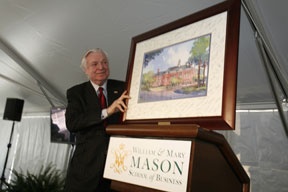
Alan B. Miller Hall welcomed classes in August 2009. The 166,000-square-foot project brought the business school together under one roof. Its design made room for classrooms, conversation and collaboration. The details included an atrium, study spaces, a café and a courtyard. Education needs rooms where a discussion can continue after the scheduled hour.
The building’s exterior took its cues from the university’s older architecture. Its interior served contemporary teaching. That combination suits an institution that must keep introducing new ideas without pretending it arrived yesterday. The $75 million project was a public-private partnership, with numerous supporters contributing to the undertaking.
At the dedication, Miller spoke about a building’s capacity to raise the ambitions of the people using it. The hope was attached to a specific, usable place. Students would have classes there on ordinary weekdays, long after the ceremony’s distinguished guests had gone home. A donor’s name stays over the door; the daily life belongs to everyone coming through it.
The university had already recognized him with its Alumni Medallion in 1999 and the business school’s Clarke Medallion in 2007. An honorary Doctor of Public Service degree followed in 2014. These were different forms of recognition, spread across fifteen years. Together with the building and the scholarships, they place the campus relationship on a longer calendar than a single donation or dedication. He kept returning to an institution where his own direction had once been unsettled.
His support extended beyond the hall. William & Mary’s entrepreneurship center carries his name, and his giving has included scholarships and a recreational basketball gymnasium. The basketball connection has a particular charm. A sport that helped bring him to college remained part of what he wanted later students to have.
Passing the job, keeping a role
In September 2020, UHS announced that Marc D. Miller would become CEO in January 2021. Alan would continue as executive chairman. The successor was his son, but the appointment also followed a long operating career within the company. Marc had been president since 2009 and had held responsibilities in individual facilities and at the corporate level.
By the time of the announcement, UHS had about 90,000 employees, operations in the United States and United Kingdom, and $11.4 billion in 2019 revenue. Those figures belong to that moment in the story. They show how much had changed since the first office, and how different the task of succession was from the task of getting started.
The handover separated the CEO role from the founder’s continuing involvement. Alan retained executive responsibilities and continued his leadership of Universal Health Realty Income Trust. The arrangement made room for a new chief executive while preserving a formal place for the person who had spent four decades building the company.
“I am a competitive person with very high standards and always have been.”
Alan B. Miller · interview published in 2026
In July 2026, UHS featured Alan and Marc together in a joint interview and reported Alan’s recognition as the inaugural recipient of The CEO Forum Group’s Lifetime Achievement Transformative CEO Eagle Award. The joint appearance is a useful later scene: two generations, distinct titles and a shared organization. The story continues after the succession announcement.
The next person through the door
Miller’s interests also extend into American history and the performing arts. His civic associations have included the Museum of the American Revolution and Philadelphia’s opera and performing arts institutions. George Washington is a recurring point of reference in his conversations about leadership, particularly perseverance and composure under pressure.
These interests put the business career in a wider setting. The former Army officer is interested in how institutions endure. The former student supports places where people learn to build them. His public record moves between the company he founded and organizations whose histories began long before his own.
The most revealing return trip remains Williamsburg. Miller arrived there as a basketball scholarship student without a fixed career destination. Years later, his name became part of a building devoted to preparing people for business. Somewhere inside, another student can consider a profession, change direction or find a collaborator. Miller’s career leaves plenty of room for all three.
Follow the conversation
- UHS · official biography
- LinkedIn · Alan B. Miller
- Watch · Horatio Alger biographical film
- Read · the 2019 leadership interview
- Read · Alan and Marc Miller in conversation, 2026
- William & Mary · the 2007 groundbreaking
- William & Mary · Miller Hall opens, 2009
- William & Mary · a career and campus connection
- Explore · the entrepreneurship center
- Horatio Alger · Miller’s life story
- UHS · the CEO succession announcement
- Listen · the June 2026 interview