Mike Rydin built a software company with a rather inconvenient promise: somebody would answer the telephone when the customer needed help. Construction estimators sometimes worked through the night to finish a bid. Their software supplier, he decided, ought to keep similar hours. In the early days, the person taking those calls could be Rydin himself. A bedroom business had acquired a night shift.
That arrangement contains much of his story. Rydin understood an estimator’s deadline because he had worked with estimating himself. He made HeavyBid to help contractors prepare bids more efficiently, then made support part of what they were buying. A useful program could get a customer started. Being available when a deadline was approaching gave that customer another reason to stay.
Eventually, availability presented a problem inside his own office. People needed decisions, and the founder had become the place to find them. The company could grow only so far if every question made a return trip to Mike. His career became an extended exercise in teaching other people to do work he had once kept for himself.
There was money in the eventual result, including money for employees. Vistage’s 2023 Legacy Award profile credited HCSS and its employee stock ownership plan with helping make 70 millionaires when the business was sold. The telephone, the ownership plan and the founder’s gradual retreat from daily decisions belong in the same story. They show different ways of deciding who matters in a company.
A philosopher gets laid off
Rydin’s preparation for business included a philosophy degree from Oklahoma State University in 1974 and a mathematics degree the following year. He later credited philosophy and critical thinking with helping him understand business problems, singling out professor Robert Radford. The combination makes sense for someone who would spend his working life translating the messy practical questions of construction into software.
He began as a software developer in Tulsa and later worked in Houston. In 1981, he wrote estimating software for a construction company. By 1985, with that employer heading toward closure, he was rewriting the program for personal computers in the evenings. He was laid off in 1986 and started Heavy Construction Systems Specialists from the master bedroom of his house.
His wife, Sophie, supported the early business while holding two jobs. She joined HCSS five years later. The domestic address can sound charming at a distance; the working arrangement was demanding. Credit cards financed the venture. The founders were committing their household’s time and resources to a product whose customers had quite practical reasons to be impatient.
The first office move came in 1989. HeavyBid gave the business its starting point, and the support promise gave it a recognizable way of operating. The work was specific: contractors needed to assemble estimates and submit bids. Rydin had chosen a problem he could explain without a lecture on the future of computing.
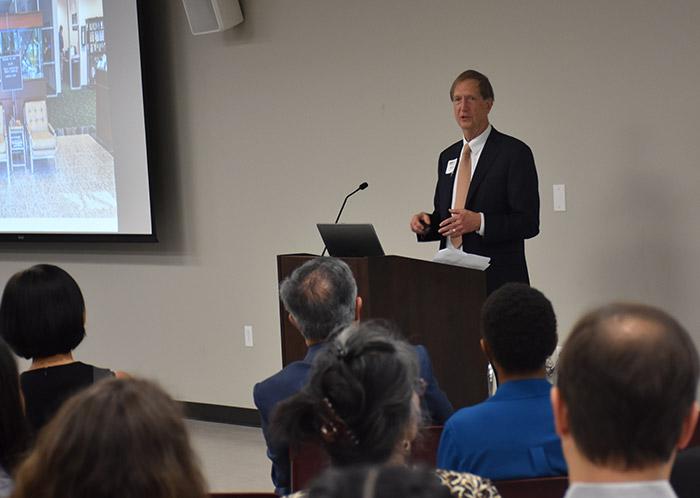
When every question came back to Mike
After roughly a decade, HCSS had a dozen employees and about $1 million in annual revenue. Rydin was still handling the daily problems. He joined the executive peer organization Vistage in 1996 and began drawing on other owners, speakers and business books. Asking for help became part of how he ran the company.
“I needed to build up the people around me,” he said. He put three executives into Vistage’s Key Executive Program. Later, 26 employees entered its two-year Emerging Leader Program. By 2020, HCSS had passed $100 million in annual revenue. These figures describe a long stretch of development, with managers learning to carry decisions that had once landed on his desk.
The change also required an owner to accept that experience could come from outside his own business. A peer group offered people with different companies and familiar management problems. For someone accustomed to fixing software, listening was another working tool. The business could benefit from knowledge he had never had to acquire alone.
There is something pleasantly unglamorous about that change. A programmer can improve a program by doing the work personally. A growing employer has to improve the conditions under which somebody else does it. Rydin’s response involved structured learning for colleagues, repeated over years. The founder who had supplied so many answers was paying to give other people better questions.
An ownership stake, and a slide
Employee ownership gave that delegation a financial dimension. At HCSS’s 25th anniversary in 2011, Rydin identified selling 25 percent of the company to employees as one of its important milestones. He linked business success to employees being able to approach their jobs with an owner’s sense of responsibility. People were being asked to think beyond the immediate task, with a stake in the company behind the request.
The anniversary celebration itself was cheerfully literal about the passage of time. More than 750 customers and 115 employees gathered in Houston. A “Back to the Future” party supplied Rubik’s Cubes, boom boxes and an eighties cover band. A company selling construction software had reached the age at which its founding decade qualified as a party theme.
Rydin also liked showing visitors an office that included a slide, a game room and stacks of Lego. At a 2016 university talk, he explained that shared sports could help people from different departments get to know one another and reduce friction at work. Every office had a window view; employees had covered parking. He wanted people to enjoy coming in.
That preference had an earlier opponent. As a teenager, Rydin told his factory-worker father he wanted work he would enjoy. His father regarded that as an unrealistic expectation. Years later, the son was showing business students photographs of a workplace with a basketball court. A slide is an unusually large prop to bring to a disagreement with your father.
External recognition followed. HCSS appeared among the Wall Street Journal’s 15 Top Small Workplaces in America in 2009. Rydin received Vistage’s Lifetime Achievement Award in 2021, then its Legacy Award in 2023. The latter’s account of employee wealth gave the ownership policy an outcome more concrete than a cheerful office photograph.
Millionaires helped along by HCSS, its sale and employee ownership, according to Vistage’s 2023 Legacy Award profile.
Let the customer take the bow
Rydin’s interest in construction extended beyond selling software to its employers. In 2016, he started I Build America to encourage pride in construction and introduce young people to careers in the industry. Roads, buildings and water lines were everyday evidence of work that often received attention only when it inconvenienced somebody.
The initiative offered another way to tell those stories. Its aim was to help workers explain the value of what they did and help the public recognize it. For Rydin, the customer’s difficulty included attracting future employees. Better estimating software could address one part of a contractor’s business; a more appealing account of construction careers could address another.
HCSS’s marketing team developed the effort through customer stories, videos, project recognition and an ambassador program. Marketing chief Dan Briscoe described a decision to move the attention away from the software company and toward the people building things. It was a sensible adjustment for a founder whose own product began with close attention to somebody else’s working day.
There was an element of recruitment in the storytelling. Young people could see individuals doing the work, rather than an abstract category called construction. Rydin had built a career around helping contractors calculate what a project would require. Now he was helping the industry explain why a person might want to join it.
“No one should be indispensable.”
Mike Rydin · 2021 leadership advice
Selling the company, keeping a purpose
Thoma Bravo completed its acquisition of HCSS in November 2021. Rydin remained CEO until April 19, 2022, when Steve McGough succeeded him. McGough had joined the business in 2005. The handover put an established colleague in charge of a company whose founder had spent years trying to distribute responsibility.
Rydin’s retirement announcement pointed toward philanthropy. His giving already included education: HCSS provided a nearly $2 million gift for scholarships and infrastructure at the University of Houston’s Sugar Land technology building, in memory of Sophie. He also offered the HCSS property for Texas Woman’s University’s Houston-area graduation celebration in December 2020. The business campus could serve a purpose beyond the working week.
His interests also reached offshore wind. In July 2021, Entrion Wind announced his investment in its foundation technology and said he would help with strategic direction. He expressed interest in the technology’s potential to make offshore wind development more economical as projects moved into deeper water.
After the sale, conservative institution-building became another public focus. A 2024 biography described his support for the Texas Public Policy Foundation and the Conservative Partnership Institute, including help acquiring Washington properties and a Maryland retreat named Camp Rydin. These were places intended for meetings and collaboration, giving his political commitments a physical address.
HCSS has continued beyond his tenure. Nemetschek completed its acquisition of the company on July 1, 2026. The announcement put its 2025 revenue at approximately $215 million and its workforce above 550. Those are later chapters under subsequent leadership, following the business Rydin began four decades earlier.
For owners contemplating a sale, his later advice was practical: plan specifically for life after the company, and understand what giving up control means. That is a fitting destination for someone who once answered the support phone at night. He had spent years making himself useful. Learning to let other people take over gave that work somewhere to go.
Keep following the story
Interviews, organizations & further reading