The awkward part came after Cleary Construction bought the software. Ryan Cornwell, its estimating director, already knew how to prepare bids in spreadsheets. The new system was waiting. Management wanted more bids. Yet familiarity had its own gravitational pull: a process could feel comfortable even while the company was outgrowing it.
In HCSS’s account of the transition, Cornwell describes finally making his first bid in HeavyBid and finding the change easier than expected. That small episode explains something about construction technology. Purchasing a tool and trusting it with your working day are separate decisions.
- Bid: build estimates around crews, equipment, quantities, and production.
- Build: give the field a budget it can actually work against.
- Learn: send actual performance back into the next estimate.
01 / THE HABITThe spreadsheet was familiar. Too familiar.
Cleary, a Kentucky contractor, had already moved from paper to Excel. Its next problem was getting information across the distance between headquarters and scattered jobsites. HeavyBid and HeavyJob became part of that effort in 2014. Project managers also became more involved in estimating. The organizational change mattered alongside the software.
“We were a paper-driven, gut-driven company.”Dan Bryant / Cleary Construction
Customer-reported figures in HCSS’s Cleary story. Growth also involved changes in staffing and working practices.

02 / THE HANDOFFAn estimate is a theory about a crew
HCSS, founded by Mike Rydin in 1986, makes software for contractors building roads, bridges, utilities, and other infrastructure. HeavyBid assembles estimates from activities, labor, machines, materials, and expected productivity. Its expertise lives in the details of self-performed construction: what a crew can accomplish, with which resources, at what cost.
Winning creates another problem. Somebody must turn the estimate into a working budget. HeavyJob carries that information into field operations, where crews record time and quantities. Equipment360 manages maintenance; HCSS Safety handles safety records; digital plans and telematics address drawings and machines. The suite follows the job through several different working environments.
EstimateExpected crew output
HeavyBid
ExecuteTime + quantities
HeavyJob
CompareActual vs. assumed
Next bid
There is an important boundary here. Accounting still has its own job. HCSS connects to back-office systems rather than making the field wait for every invoice to arrive. The foreman needs a timely view of production; the accountant needs dependable financial records. A useful connection respects both clocks and reduces the amount of information somebody has to type twice.
That makes HCSS a specialist in a competitive market. Trimble’s B2W also connects heavy construction estimating and operations. InEight offers estimating within a broader capital-project controls platform. Buyers should compare workflows and integrations closely. HCSS’s appeal is the continuity between a resource-based bid and the people responsible for building it.
03 / THE CLOCKYesterday is still fixable
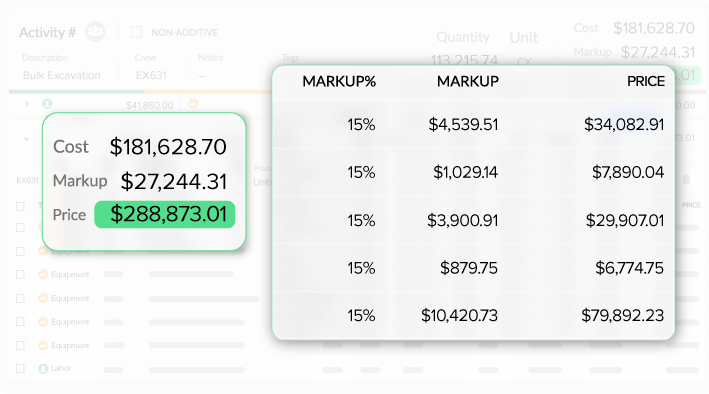
The Eclipse Company, an Ohio excavation contractor, offers a useful example. Its project managers transferred estimates into HeavyJob cost codes, carrying notes and supporting information along. Foremen could inspect the thinking behind the budget. Daily reporting then showed where production was falling short, giving managers something specific to address at their morning meetings.
In HCSS’s 2018 case study, Eclipse also reported shortening a time-and-material paperwork process from as much as 90 days to three or four. Tablet signatures and attached documentation helped move it along. Those are one customer’s reported results. The underlying mechanism is straightforward: capture the evidence while the work is happening, then pass it to whoever needs to act.
Rumco Construction describes the other half of the circuit. Its estimators compare completed work with the original bids, looking at actual crews and production. A field report becomes evidence for a future price. Without that return journey, a contractor can carefully record yesterday and still repeat its assumptions tomorrow.
04 / THE INVESTMENTThe purchase is the beginning
HCSS sells to businesses through custom quotes. HeavyBid pricing varies with licensing and tier; web subscriptions and hosted services add deployment choices. The meaningful budget includes setup, migration, training, and employees’ time as well as software. A contractor evaluating it should ask for those items explicitly, then test a representative job.
Ryatt Construction staged its rollout: HeavyBid first, HeavyJob about six months later. Before integration, staff printed bids and entered information again by hand. The lesson is copyable: connect one troublesome handoff, give people time to learn it, and expand from there. Installing every available module does not establish a useful reporting habit.
A pilot can also expose a less obvious bottleneck. James Construction Group found its shared Citrix environment was slowing access to HeavyBid. In an HCSS-published account, four users tested HCSS Cloud over three months; the contractor reported faster access both remotely and in its home office. Its problem involved the route into the software as well as the software itself. That is a useful buying question: which part of the working day is actually holding people up? Measure that before deciding what to replace.
Support is part of that calculation. HCSS offers human assistance around the clock and gathers customers at its annual Users Group Meeting. In a business organized around bid deadlines, access to someone who understands the software can influence whether people trust a new process. Training and troubleshooting belong in the buying decision, alongside the feature checklist.
The same logic sets the limits. Missing quantities or inconsistent cost codes weaken comparisons. A dashboard only helps when someone reviews it and can change the work. For firms whose projects differ substantially from heavy civil construction, the right evaluation starts with their own workflow. These are practical conditions for getting value, rather than promises a license can fulfill.

05 / THE NEXT BIDA bigger owner. The same small question.
Ownership has changed. Thoma Bravo acquired HCSS in 2021; Nemetschek completed its acquisition in July 2026. HCSS now sits alongside Bluebeam, GoCanvas, and Nevaris in Build & Construct. Drew Thomas succeeded Steve McGough as CEO. The portfolio offers a wider route into construction markets beyond HCSS’s North American base.
The Fall 2026 release makes the product direction unusually concrete: HeavyBid can bring actual HeavyJob production rates into an estimate. Desktop customers can also add a separate web subscription. For all the expansion, the central question remains pleasantly small: how much work did the crew actually do? Answer it soon enough, and the next decision has a better chance.