At Continuum Services, the week could disappear before anybody had won a job. The Michigan facilities company’s team spent 20–40 hours visiting properties and measuring them for landscaping and snow proposals. Someone drove. Someone walked. Someone drew polygons. Only then could someone work out the price. The customer had not yet agreed to pay for any of this industrious geometry.
- The job: turn property imagery and construction plans into measurements, quantities and estimates.
- The twist: Beam AI sells both software you operate and completed takeoffs with human quality checks.
- The calculation: compare annual license costs with the estimating capacity you can actually use.
Continuum’s team initially resisted automated measurements. In Attentive.ai’s published case study, operations director Jon King describes the moment the argument ended: “Literally, after the first demo, we realized that this platform has to be a part of our sales process.”
The attraction was wonderfully unglamorous. People who had been measuring could spend more time with customers and crews. A sales process had acquired a little breathing room. That is the useful way into Attentive.ai: follow the hours before following the artificial intelligence.
A week spent walking
Continuum reported a 75% reduction in measurement time and a 20% improvement in bid turnaround. Put those numbers beside each other. They describe different things. Measuring is one ingredient in a proposal; scope verification, production assumptions and pricing still take time. An impressive improvement in one task need not produce an identical improvement in the whole business.
Two different measures. One customer case study. No promise of identical results.
That distinction also explains what broke first. The company could perform the work it sold. Getting enough work priced was consuming its people. Measurement had become a queue through which opportunities had to squeeze. Attentive.ai offered a way to shorten that queue.
Grass was the first clue
The origin has two dates, each telling a different story. Investor Surge traces the original services company to 2017, when Sarthak Vijay and Shiva Dhawan founded it. The SaaS platform arrived in 2021. Rishabjit Singh, now co-founder and CTO, became a co-founder in 2022, according to the investor. A business can exist for years before finding the product by which people know it.
AutoMeasure used aerial imagery and computer vision to measure outdoor properties. Landscapers, snow managers and paving contractors could start with an address rather than a measuring wheel. Customers included Juniper and US Lawns. Their problem was specific enough to sell against: the labor required to establish what, precisely, they were bidding on.
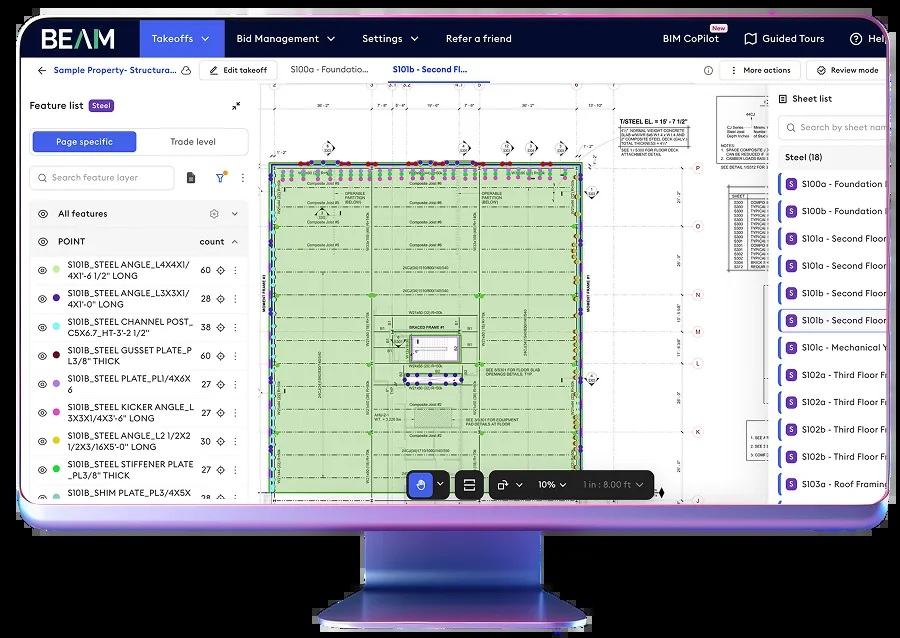
Then an adjacent problem came into view. Attentive.ai says customers’ construction divisions faced the same measurement burden in their plan sets. Beam AI extended the idea into construction takeoffs: extracting the material quantities that underpin an estimate. A lawn and a mechanical drawing look rather different. Both can hold an estimator hostage.

The reviewer is part of the product
Today, Beam AI addresses general contractors, specialty subcontractors and suppliers. A customer uploads PDF plans and supporting documents, specifies the quantities required and adds instructions. In the managed workflow, AI extracts quantities and a reviewer checks the output before delivery. The published turnaround is 24–72 hours. Estimates can reflect the customer’s pricing and preferred workflow.
The comparison with conventional tools deserves care. PlanSwift, STACK and Bluebeam belong in a contractor’s evaluation, alongside newer AI products. Attentive.ai’s distinctive commercial proposition is the option to buy completed, checked work. For someone whose scarce resource is an estimator’s attention, that delivery model can matter as much as the software interface.
“The goal isn’t to eliminate QA. It’s to make it lighter.”Shiva Dhawan / May 2026 interview
Dhawan’s explanation is practical: unclear specifications and missing sheets complicate automation. Different trades also have different data and different levels of maturity. Human verification is therefore part of the design. The current DIY offering covers HVAC, plumbing and steel; the managed service covers a broader range of trades.
Builders Stone supplies a second useful example. Its published case study describes large masonry projects that could occupy one estimator for a week using STACK. Offloading those takeoffs allowed projects to move in parallel. The company described potential to double bid volume. Potential deserves its own word; it is not a guarantee of twice the revenue.
The price of a shorter queue
Beam AI’s annual starting prices are $8,000 per trade for DIY construction software, $25,000 for managed construction takeoffs and $10,000 per trade for managed aerial-image takeoffs. Trade, volume, acreage and service affect the relevant plan. Enterprise pricing is negotiated. This is a recurring business purchase, with a workload calculation attached.
For illustration, a $25,000 license divided by a hypothetical $50 hourly labor cost equals 500 hours a year. That arithmetic is a starting question, not a savings forecast. Review time, onboarding and whether freed capacity becomes useful work all belong in the calculation. An empty calendar cannot earn back a license.
Deadlines matter too. A managed service promising delivery over one to three days may be a poor fit for a bid due this afternoon. A trade outside DIY coverage needs another route. Accurate quantities also leave decisions about labor productivity, supplier prices and risk with the contractor. The machine can count the pipe; somebody still has to price installing it.
Counting is becoming a doorway
The expansion has attracted capital. A January 2025 announcement put the combined Series A at $12 million across two tranches. In November, Attentive.ai announced a $30.5 million Series B led by Insight Partners. The money was intended to develop AI and extend estimating and bidding workflows.
The company now reports serving more than 1,200 construction and field-service businesses across the United States and Canada. Beam AI includes bid management, while BIM CoPilot supplies managed modeling, clash coordination and construction documentation. The opportunity has widened from establishing quantities to helping teams carry information toward the build.

The part another business can copy is the sequence: choose an expensive recurring task, make its output checkable, and let a customer test it against real work. Then measure the whole process. Continuum’s week offers a useful reminder: an hour recovered from counting becomes valuable when someone has somewhere better to spend it.