A roof is an awkward witness. It sits above the conversation, collecting rain, growing older, occasionally acquiring a solar panel. When someone applies for insurance, the roof cannot fill in the form. Itzik Lavi has built a business around giving it something resembling a voice.
Lavi, who uses the spelling Izik Lavy on LinkedIn and in his published writing, is the co-founder and CEO of GeoX. He works in property intelligence: extracting useful information about buildings from imagery and putting it into the hands of people who must decide what those buildings are worth, how vulnerable they are, and whether to insure them.
His explanation of the original opportunity was refreshingly practical. Insurance carriers lacked information. He wanted to fix that. An address could identify the place, but the relevant details lived on the ground and on the roof. A building might be changing while its paperwork remained reassuringly still.
That gap gives his story its shape. The work begins with a technical problem, moves into a commercial one, and eventually reaches a homeowner being asked to repair something. Between those points lie the less photogenic tasks of a founder: finding partners, getting data into existing systems, and persuading customers that a clearer picture is worth paying for.
An introduction, then a company
Before GeoX, Lavi led a technological team in an Israeli military mapping unit. His later co-founder Guy Attar described the problem Lavi spotted there as a lack of automation in stereoscopic imagery sampling. Lavi developed algorithms to address it. The recurring interest was already visible: take a task that depends on interpreting images, and make it work at a larger scale.
The founding team came together through an introduction. Eli Lavi had worked with Attar at Nokia Networks and introduced him to Lavi. Attar brought a career in engineering leadership and business development; Eli became the chief technology officer. GeoX was established in April 2018. Attar described it as Lavi’s second business endeavor.
That account is more interesting than the usual lone-founder photograph. A technical idea needed people who could build the software and find a market. The three founders arrived with different experience. Attar’s description of Lavi was personal as well as professional: an entrepreneur with enthusiasm for doing the work.
The commercial destination was insurance, a business in which a small physical detail can become a large financial consequence. Roof geometry, material, and condition were the sort of information GeoX could extract. Lavi’s earlier attention to mapping acquired a customer, a budget, and a practical reason to exist.
A building travels further than its owner
By October 2021, GeoX was announcing an online platform for US commercial and residential properties. The company described coverage of 160 million properties and as many as six billion data points. Those were its figures at the time. The ambition was plain: make detailed property information available through a portal, rather than require a separate visit for every question.
The same year, its work appeared in a very different setting. In Ghana, GeoX analyzed mapping based on Ofek Aerial Photography as part of a World Bank-funded flood project. Three-dimensional information about terrain and buildings helped identify where water could go and how infrastructure planning might reduce exposure. Here, a building’s position was part of a larger public planning problem.
Australia offered another use for the same underlying skill. Geoscape partnered with GeoX to improve its digital model of the country using aerial imagery. Planned enhancements included more accurate building heights, more detailed outlines, and better information about solar panels and swimming pools. The work extended into development, energy modelling, and telecommunications as well as insurance.
For Lavi, these projects put property intelligence into different institutional hands. A planner and an underwriter can look at the same building and ask quite different questions. The founder’s challenge was to make the information useful across those questions without losing the physical detail that made it valuable in the first place.
Japan, one house at a time
The Sompo relationship shows how a promising model becomes a working commercial arrangement. The Japanese insurance group and GeoX began work on estimating building attributes in January 2021. After completing a proof of concept, they announced a collaboration in February 2022 to develop an automated underwriting methodology.
The intended output was specific: information about roof type and shape, rooftop installations such as solar panels, and floor area. These attributes would help assess customer risk and inform insurance products. Lavi’s contribution was a way to produce building information from aircraft photographs; Sompo supplied an insurance setting in which that information had to earn its place.
In describing the collaboration, Lavi emphasized the cost of sending assessors to individual houses. He also discussed monitoring buildings that were already insured for deterioration. A property does not freeze when a policy is signed. Maintenance continues, or fails to continue, and the next renewal arrives with a slightly different building attached.
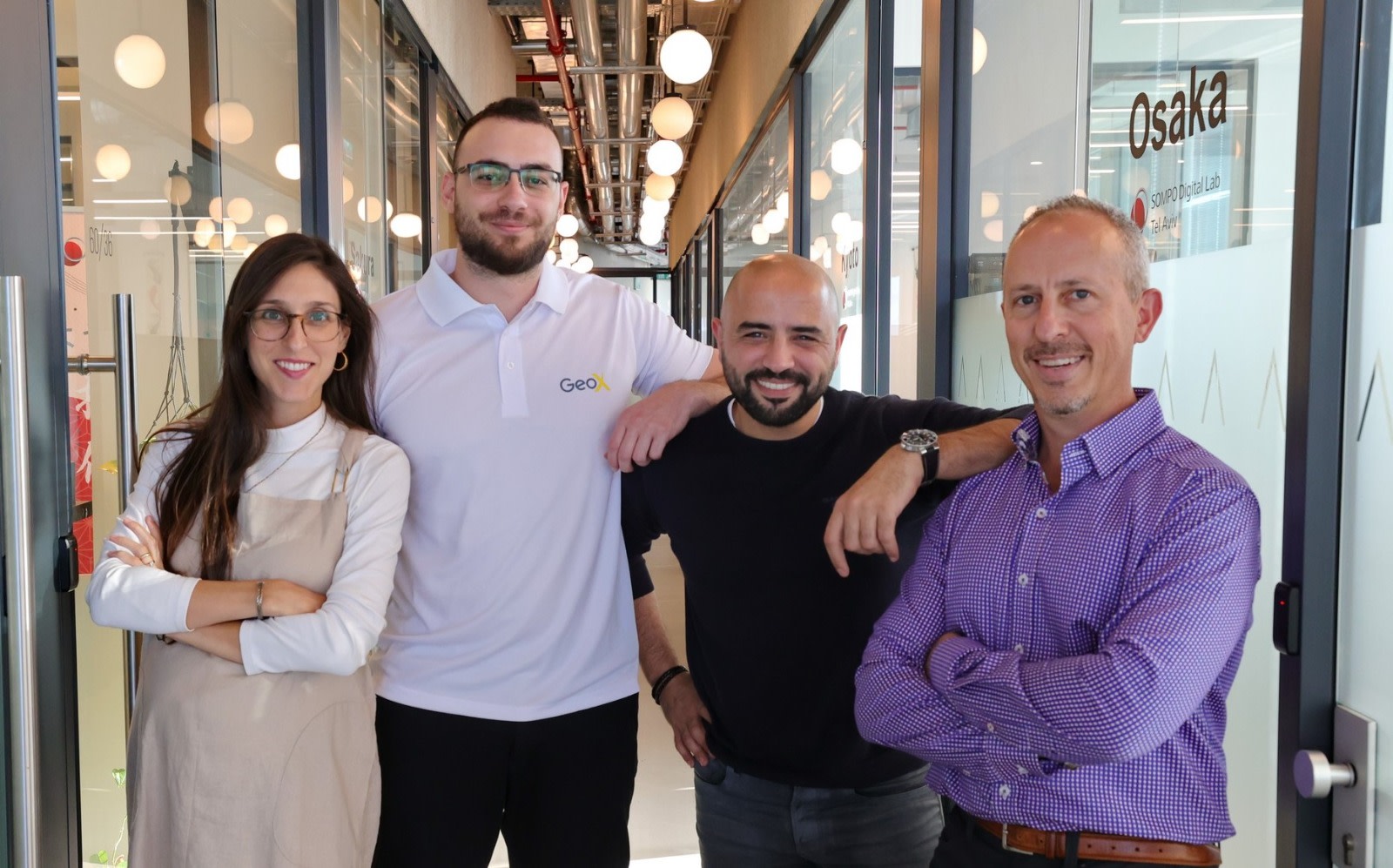
The partnership photograph catches him in a corridor with colleagues from the Sompo collaboration. Lavi is second from the left, in a white GeoX polo, surrounded by people whose work connects the imagery to insurance. The photograph suits the story: an international business being built through ordinary human proximity, rather than an aerial view.
The customer still has to answer the phone
Lavi’s public writing keeps returning to the condition of the underlying information. In a March 2023 essay on AI and climate risk, he argued that outdated data weakens a model’s usefulness. He also called for insurers, governments, and businesses to cooperate. The technology was only one participant in a larger system of decisions.
In another essay that month, he focused on aerial imagery for properties that are difficult to visit, including rural and coastal homes. A clear image could help at quotation and renewal. He treated roof condition as something worth examining repeatedly, with wear and nearby trees contributing to the picture. The familiar roof had become a changing record.
His July 2023 writing made a related point about the expense of acquiring imagery across large areas. Useful AI depends on access to useful material. He discussed tracking roof condition over time and recognizing changes such as replacement. The attraction was a better-informed decision about the actual property in front of the insurer.
When Lavi spoke with Ryan Hanley in March 2023, his attention also went to agencies and the sales process. He wanted data to help identify properties that matched a carrier’s appetite and reduce the back-and-forth involved in gathering information. His proposed benefit was blunt: get enough information to complete the sales process in a single call.
It is a revealing choice of ambition. The founder who works with aerial imagery was thinking about the next telephone conversation. His software could supply facts, but those facts still needed to help an agent ask useful questions and reach a decision. A beautifully analysed roof is of limited commercial use if nobody can turn it into a useful conversation.
“You can make the entire sales cycle in one phone call.”
Itzik Lavi, The Ryan Hanley Show, March 2023
Growth, distribution, and scrutiny
In June 2023, Insurity announced a partnership giving its insurance customers access to GeoX property data and first-floor elevation information. The connection matters because elevation can help distinguish buildings within a flood-prone area. It also put the information closer to the software and routines insurers were already using.
The initial offer included volume-based pricing and reduced contractual barriers for smaller and medium-sized carriers. GeoX’s own 2023 description of its business likewise emphasized customized data and flexible consumption. Lavi’s company was selling access to information in quantities that different customers could use, rather than asking every customer to operate an imagery business.
In September 2024, GeoX announced a $19 million Series A led by Flashpoint Venture Capital, with Suretech Partnership, Ariel Maislos, and Noam Lanir participating. The announcement put cumulative funding at $23 million. The money marked a larger stage for the company Lavi had co-founded six years earlier.
That expansion came with scrutiny. In September 2025, Canadian investor The Group Ventures filed a lawsuit seeking to cancel its $1.5 million investment agreement with GeoX. The fund alleged that the company had misrepresented revenue and customer agreements. These were allegations in a lawsuit, not established findings.
GeoX said it remained optimistic about its progress and would review the documents and respond. The dispute belongs in the account of Lavi’s company alongside its partnerships and financing. A business selling clearer information about other people’s assets must also answer questions about the information it provides about itself.
When the image reaches the homeowner
A later Japanese initiative brought the idea closer to the front door. On December 1, 2025, Mitsui Sumitomo Insurance and GeoX announced a trial in Hokkaido for selected policies expiring from December 2025 through April 2026. GeoX would analyze satellite, aerial, and street-level panoramic images and prepare reports on building maintenance.
The proposed checks covered roof condition, damage to walls, doors, windows and fences, and the state of gardens. Agents would explain the findings and suggest measures to reduce damage. Some homeowners could also be directed toward local repair support. The original imagery problem had arrived at a very tangible outcome: a conversation about what needed attention.
That direction fits Lavi’s earlier writing about wildfire prevention. He had argued that insurers could use information about vegetation near a building to contact owners with practical suggestions. The attraction was a relationship that continued between the premium payment and the claim. There was work to do while the weather was still ordinary.
On June 30, 2026, he appeared with GeoX colleague Jacob Grob on Making Risk Flow to discuss property intelligence, computer vision, and confidence-scored models. The discussion addressed pricing, portfolio choices, and the opportunities clearer information might reveal. Lavi was still pursuing the question behind the company: how does seeing more change the decision?
His work is full of enormous datasets, but its most understandable unit remains one building. A roof has aged. A tree has grown. A repair has happened. Someone has to decide what those changes mean. Lavi has made a career of moving those details into view, where an underwriter, an agent, or a homeowner can finally do something with them.
Keep looking
- GeoX - company website
- Itzik Lavi on LinkedIn, as Izik Lavy
- Listen: Property Intelligence at Scale
- Watch the Making Risk Flow conversation on YouTube
- Listen: The Ryan Hanley Show, episode 175
- Read Lavi: Aerial Imagery Maps the Future
- Read Lavi: How AI Can Help Insurers on Climate
- The founding team, in Guy Attar’s words
- Sompo’s February 2022 collaboration announcement
- Mitsui Sumitomo’s Hokkaido trial announcement
- Flashpoint’s financing announcement
- CTech’s report on the investor lawsuit