construction-software
(39)
Gregory Fast and the Art of Making Concrete Move
Before Gregory Fast designed software for construction payroll and compliance, he spent years close to the industry's drawings, models, and stubborn workflows. His career is a study in what happens when design stops decorating the work and starts removing the drag.
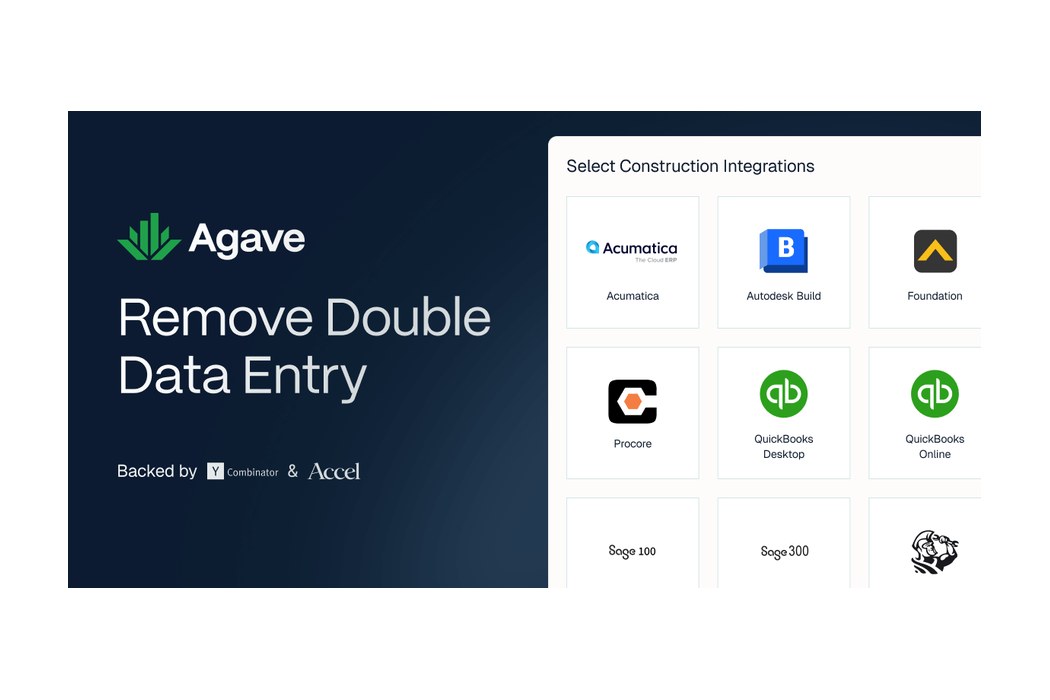
Agave Built the Pipes Before It Turned On the AI
Construction's back office runs on software old enough to have a mortgage. Agave's clever move was not to replace it, but to teach it how to talk - then put AI to work on the conversation.
Eleco sold the concrete. It kept the construction site.
The former building-products group now sells the software behind schedules, estimates and maintenance plans. Its next test is keeping those moving parts connected - and knowing which businesses to let go.

NBS wants buildings to match the small print
A delivery of the wrong handrails shows why construction specifications matter. NBS has spent half a century turning those instructions into a business - and now it is bringing carbon data into the same conversation.
Construction AI Wants Your Drawings to Show Their Work
The Canadian company turns construction PDFs into usable data. Its latest assistant counts, measures and asks awkward questions about the numbers before they reach a bid.

Xpedeon Put the Whole Construction Back Office on One Screen
Construction runs on thin margins and thick piles of paperwork. Xpedeon’s three-decade wager is that the site, the supply chain and the finance office should stop arguing from different spreadsheets.

The Software That Makes a Building Site Show Its Work
DataScope began with gates and attendance. Two decades later, its software records the untidy choreography of people, permits, plant and deliveries - and turns a building site into something its managers can actually read.
Eque2 Turned Construction's Spreadsheet Headache Into a £30.8 Million Business
The Maidenhead software maker connects estimates, contracts and accounts before the numbers wander off into separate spreadsheets - a practical niche now serving more than 3,000 construction businesses.
Causeway Is Building the Operating System Construction Forgot to Ask For
Construction runs on specialist software, stubborn spreadsheets and handoffs where useful data goes to die. Causeway's bet is that the industry's next productivity gain will come from connecting what already works.

Chris Woodard Is Making Construction's Paper Trail Pay
The Handle co-founder moved from measuring marketing funnels to untangling liens, waivers and late payments. Now he is helping turn construction's paperwork into a connected financial system - with AI waiting on clean data.

Two Brothers-in-Law Turned a Birdhouse Into a 3.5-Billion-Image Property Machine
Eagleview began with one roofer trying to avoid a ladder. Eighteen years later, its planes, patents and property models sit inside decisions about claims, construction, taxes, solar panels and disaster response.

Kahua Tore Up the SaaS Blueprint - and Built Construction Software That Bends
After selling an early cloud construction platform, Scott Unger and Brian Moore decided the category's real problem was rigidity. Their second act is a configurable system of record for the people managing billions in concrete, contracts and change orders.
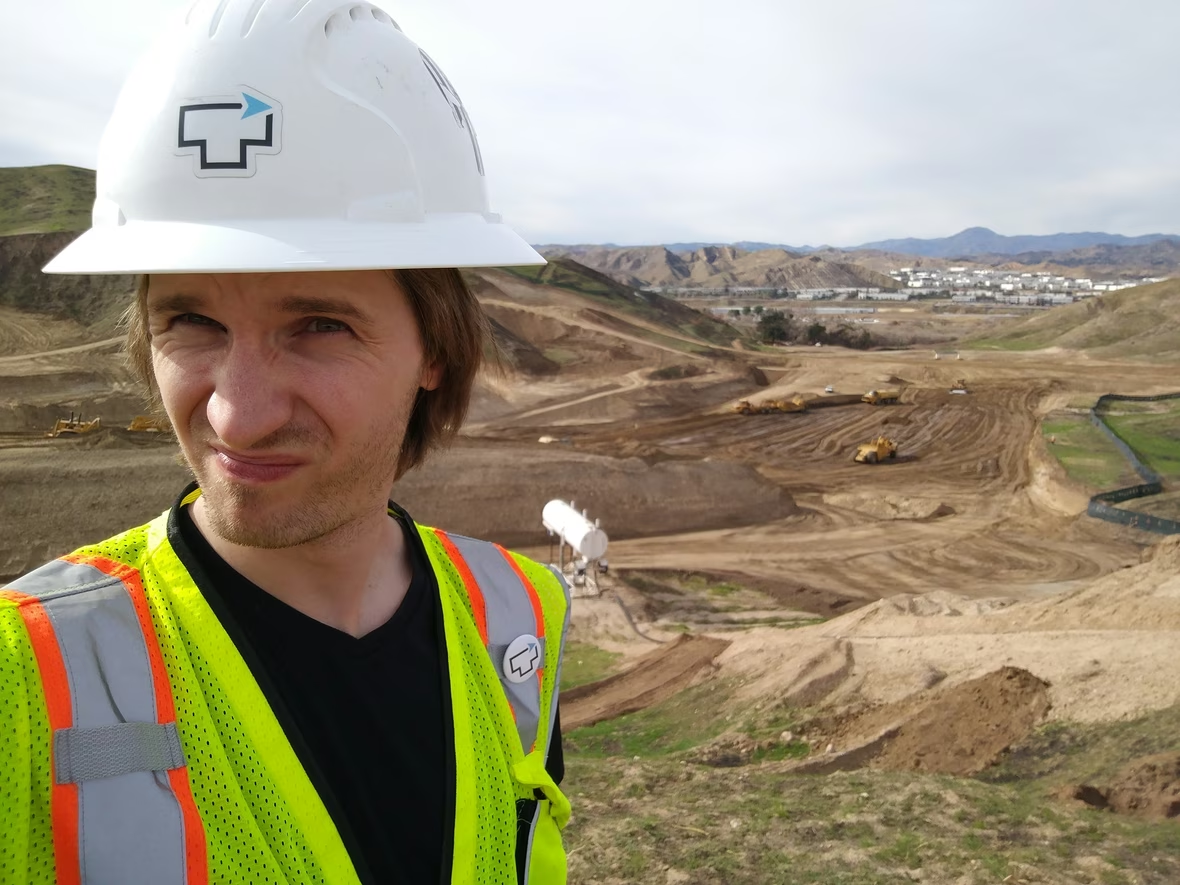
Dmitry Korolev Learned to Read the Ground by Flying Above It
A competitive paraglider turned drones from a costly coffee stunt into the eyes of a construction platform, where the real work begins after landing: helping every builder see the same site at the same time.

Your Project Software Bill Is Telling On You
Procore, Smartsheet and Microsoft Project can all track work. Their pricing models reveal three very different ideas about who should participate, what deserves control and where a project creates value.
ECI Built an ERP Empire From a Failed Office-Supply Bet
A dot-com office-supply seller discovered its most valuable product was the software behind the store. Twenty-seven years and 57 acquisitions later, ECI runs the digital back rooms of 25,000 small and midsize businesses.

Procore Technologies
A carpenter who got tired of paper blueprints built the software the construction industry now runs on - and priced it so nobody has to pay per seat.
Novade Solutions
Novade Solutions is a Singapore-based construction technology company that builds smart field management software for the building and infrastructure industry. Its mobile-first platform digitizes and automates on-site processes - quality control, safety inspections, site diaries, progress reporting, defect management and equipment maintenance - so contractors, developers and owners can capture what happens in the field and turn it into data managers can act on. Founded in 2014 by former Autodesk executive Denis Branthonne, Novade is used across roughly 25 countries and more than 10,000 sites, serving general contractors, real estate developers, trade contractors, home builders and government departments.

PlanRadar
PlanRadar is a Vienna-based SaaS platform that digitizes construction and real estate project management. Its mobile and web apps let site teams pin defect and task tickets directly onto digital plans and BIM models, capture photos, video and voice notes, assign work, and generate reports - replacing paper checklists and scattered spreadsheets. Founded in 2013, it serves more than 170,000 users across 75+ countries.

Sitemate
Sitemate is a Sydney-based software company building no-code tools for the 'built world' - construction, infrastructure, energy, mining, oil and gas, and manufacturing. Its flagship platform Dashpivot lets field and office teams replace paper forms, spreadsheets and PDFs with customisable digital workflows for safety, quality, compliance and project records, while Flowsite connects that data to other business systems. Used by thousands of companies across 150+ countries and backed by Blackbird, Sitemate is now positioning itself as a front-line AI company for industrial teams.
Adaptive
Adaptive is a New York-based fintech building an AI-native financial platform for the construction industry. It sits on top of QuickBooks to automate the money side of building projects - reading incoming bills, matching them to the right job and cost code, routing approvals, tracking budgets and draws, managing vendor compliance, and processing payments. Founded in 2021 by Matt Calvano, Henry Bradlow, and Francisco Enriquez, the company serves custom homebuilders, general contractors, developers, and specialty trades, and raised a $19M Series A led by Emergence Capital in 2024.

Evan Brown
Evan Brown is the CEO and co-founder of Rebar, a New York vertical-AI company building an operating system for the HVAC, electrical, and plumbing trades. Rebar's platform reads blueprints and spec books, pulls out tens of thousands of data points per project, and turns estimating and quoting work that once took days into a task of minutes. Brown grew up in his uncle's HVAC supplier office and later spent years as an estimator and sales engineer before starting Rebar in October 2024 with Andrew Schwartz. In March 2026 the company closed a $14M Series A led by Prudence.

Marc Visent
Marc Visent is the co-founder and CEO of Knowify, a New York-based cloud software company that helps trade contractors and small construction businesses run job costing, project management, billing, and accounting in one place. A trained computer engineer and lawyer turned software entrepreneur, he started Knowify in 2012 with Daniel de Roulet Jr. and has grown it into a platform used by thousands of contractors, an Intuit QuickBooks partner, and a 2025 Inc. 5000 honoree.

Clearstory
Clearstory is a cloud-based change order communication platform for commercial construction. It gives general contractors, specialty contractors and project owners a shared, real-time system to create, price, track and align on change orders and time-and-material (T&M) tags - the extra work that traditionally gets buried in email, PDFs and spreadsheets. Founded in 2018 as Extracker and rebranded to Clearstory in 2023, the company runs a business network where contractors exchange roughly $1B in change orders every month, and counts many of North America's largest general contractors as customers.

Houzz
Houzz is an online platform for home remodeling and design that connects homeowners with millions of design photos, products, and vetted professionals - and sells business-management software (Houzz Pro) to the contractors, architects and designers on the other side of the marketplace. Founded in 2009 by Adi Tatarko and Alon Cohen after their own frustrating remodel, it grew into a two-sided business spanning inspiration, e-commerce, and AI-powered tools for running a renovation business.

NEKLO LLC
NEKLO LLC is a US-headquartered custom software development firm that pairs an American front office with senior engineering teams in Eastern Europe. Founded in the mid-2000s and led by co-founder and CEO Ken Kopilevich, the roughly 200-person company builds web, mobile, e-commerce and AI products for clients in FinTech, healthcare, construction, retail and other industries. It is known for deep Adobe Commerce (Magento) expertise, a 5.0 rating on Clutch, and an unusually sticky client base - by its own account, most new work comes from returning customers.

AlignOps
AlignOps is a Colorado-based construction operations software company that unifies tool and asset tracking, workforce time tracking, jobsite safety and compliance, and fleet/materials management into a single platform. Formed in 2024 by consolidating four established construction-tech brands - ToolWatch, busybusy, Safety Reports, and FleetWatcher - AlignOps helps thousands of contractors gain real-time visibility into where their tools, crews, equipment, and money are going across warehouses and jobsites.
Clad
Clad is project management and billing software purpose-built for infrastructure. It unifies project operations and finance so telecom operators and construction subcontractors can track production in the field, automate invoicing and payments, manage vendor compliance, and handle 811 utility locate requests - all in one place. Founded in 2022 by ex-Instagram product manager Jason Rudin and backed by Y Combinator (W23), Clad aims to help the companies rebuilding America's internet and power networks build faster and get paid faster.

Monterra
Monterra is a San Francisco software startup building design and planning tools for the people who physically install EV chargers. Its platform lets charging contractors design site layouts on satellite imagery, model costs in real time, and auto-generate customer-ready proposals, bills of materials, and electrical schematics - collapsing a process that used to take weeks of engineering and tool-hopping into minutes. Founded in 2022 by David Kim and Kelson Reiss, the company raised a $2.5M pre-seed round led by Base10 Partners in November 2023 to help cut the 'soft costs' that slow down America's charging buildout.

Shibusa Systems
Shibusa Systems is a Monterey, California construction-technology company reengineering how single-family homes and ADUs get built. Instead of shipping boxes from a factory, Shibusa pre-engineers every home in a digital Configurator and turns the messy jobsite into a predictable, kit-of-parts assembly it calls Precision Component On-site Assembly. The company claims it cuts build time by roughly 50%, costs by about 30%, and construction waste to under 5%, while delivering homes to Fortified Home resilience standards with low-carbon materials and no natural gas. Founded in New Orleans in 2019 and now based in Monterey, it is backed by seed funding and led by Wall Street veteran Katy Reynolds.
TrueBuilt
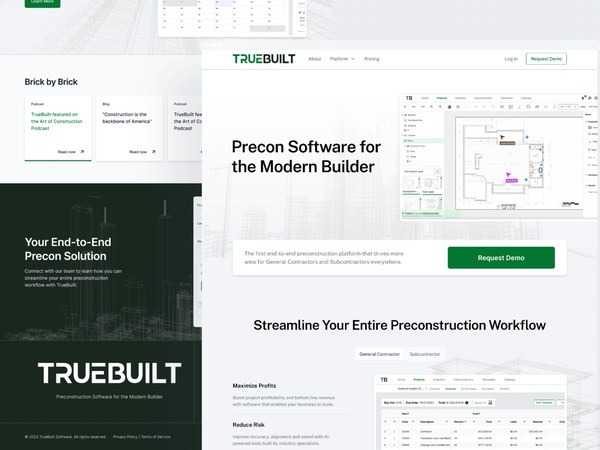
TrueBuilt is an AI-native, end-to-end preconstruction platform for general contractors and subcontractors. It uses computer vision and machine learning to speed up quantity takeoff, cost estimation, bid package management, subcontractor qualification, and document analysis - claiming takeoffs up to 70% faster with live, cloud-based collaboration. Founded in 2022 and based in Huntington Beach, California, the company raised a $4M seed round led by Bienville Capital with participation from Fifth Wall and construction firm Marek.