The handrails arrived, and then they went away again. At Bank House, a new office building in Newcastle upon Tyne, a delivery differed slightly from what had been specified. The team rejected it and brought in the correct product. For a software company, it is an unusually physical demonstration of value: the instructions had something to say about the objects turning up on a building site.
The episode appears in NBS’s account of the project with Ryder Architecture. Bank House rises 63 metres, its façade assembled from more than 860 precast panels. Ryder used NBS Chorus to develop specifications collaboratively, involving people working in different places. The finished building gets the photograph. The written decisions helped establish what belonged in it. Ryder’s project account makes the connection tangible.

NBS sells the tools and information behind that work. Architects and engineers use its software to describe materials, systems and workmanship; manufacturers use its services to make their products discoverable and easier to specify. Its territory is the space between a design intention and a sufficiently precise instruction. That is a good place to look for trouble, and therefore for a business.
A good idea with too few buyers
The origin story contains a warning for anyone who mistakes professional approval for sales. In an April 2020 retrospective, Richard Waterhouse traced incorporation to 1970 and publication of the first National Building Specification to 1973, after three years of development. The oil crisis was arriving just as the product did.
“Everyone said it was needed, but few copies were sold.”
Richard Waterhouse · NBS retrospective, 2020
Weak trading led to a management buyout. Two Newcastle-born managers moved the operation north to cut its costs, according to Waterhouse. The business survived, and Newcastle remained its centre. The lesson is refreshingly awkward: a respected solution to a recognised problem can still have the wrong economics.
The format kept changing. NBS dates its first steps into digitisation to 1979; Chorus launched in 2019. By its November 2020 acquisition announcement, the company described a transition from installed software to two principal cloud products, Chorus and Source. International expansion had brought permanent bases in Canada and Australia.
LDC’s reported £31.8 million investment in 2018 backed development and expansion. That figure describes an investment transaction, not the cost of creating Chorus. Byggfakta subsequently agreed to buy NBS, and later adopted the name Hubexo. The parent’s investors include Stirling Square, TA and Macquarie Capital. NBS’s present-day suffix, “Powered by Hubexo,” is a visible trace of those ownership changes. The 2020 deal report and TA’s portfolio record distinguish the transactions.
Two customers, one decision
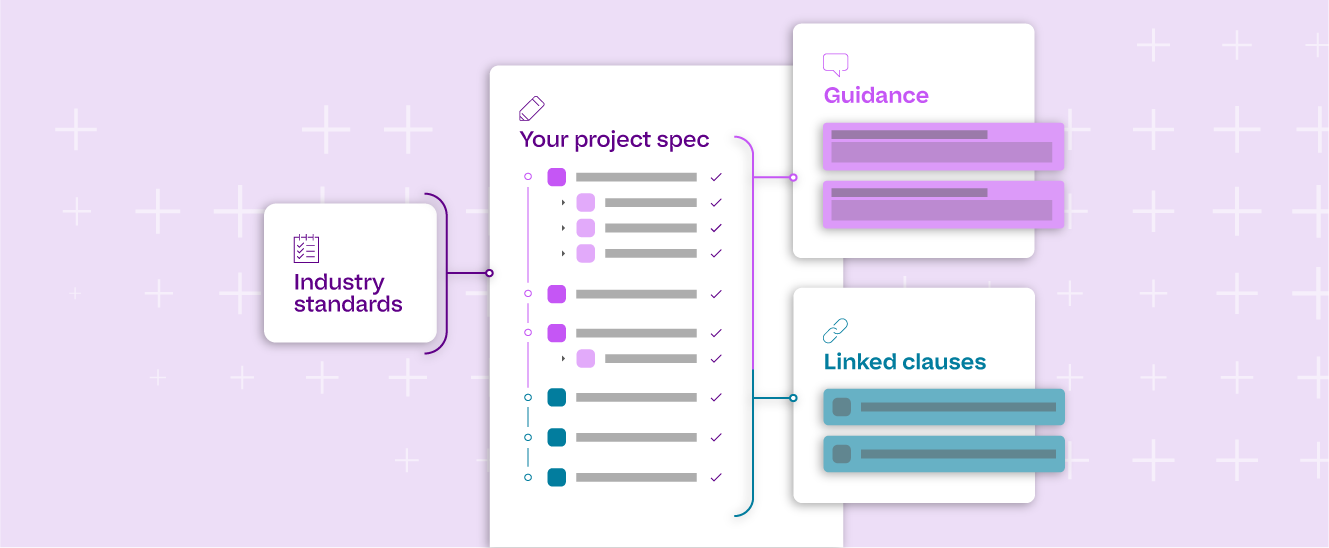
Chorus is the writing environment. A team develops specifications using structured clauses and technical guidance, then coordinates that information with design models. Colleagues can work together in the browser. The appeal is easy to grasp if you have ever tried to reconcile several supposedly final documents: the shared working record has somewhere to live.
Source handles product research. Specifiers can browse for free, looking at manufacturer information, certification and available sustainability data. Connections to Chorus let product information enter the specification workflow. A brochure can attract attention; structured information can help someone complete a task. NBS has built a commercial offering around the difference.
Products + evidence
Clauses + decisions
Check + issue
Connected information. Human decisions at every step.
Manufacturers pay for Source packages that build from brand presence to specification content, BIM connections and reporting. The packages are tailored to product ranges and required features. This is a marketplace for information and commercial attention: NBS puts suppliers near the point where designers choose what a project should contain.
The distinction matters competitively. RIB’s SpecLive Collaborate, integrated with SpecLink, also connects manufacturers and specifiers through shared specification work. NBS’s case rests on its own technical content, classification work and connected product catalogue. Buyers should compare the content and workflows their teams actually use, alongside the software features.
PPG Architectural Coatings offers a supplier-side example. It introduced Chorus into its processes in June 2020 after years of using NBS platforms. In an NBS customer account, the company described collaborating with practices including Gilling Dod Architects on paint specifications. Master files helped organise repeatable work, while shared access supported project-specific requirements. For a manufacturer, useful technical assistance can begin while the architect is still writing the instructions.
That example also explains why product marketing alone is an incomplete description of Source’s appeal. A supplier has to translate knowledge about its products into information a designer can use. Preparing that material, keeping it current and making it fit the project takes work. The commercial incentive is straightforward: make a product easier to assess and specify, and it has a better opportunity to enter the design conversation. A listing creates the opportunity; the quality of the information helps determine its usefulness.
Why the office PC lost its grip
For some customers, a looming retirement date did more to prompt change than a grand technology strategy. National Design Consultancy needed a replacement after learning that its NES specification tool would no longer be supported after December 2019. Its engineers worked across several offices and wanted mechanical and electrical content alongside their modelling workflow. The firm began with a webinar and a personalised demonstration, then wrote its first specification in Chorus. Its account describes saved time without attaching an audited return-on-investment figure.
At Mulroy Architects, the pandemic and the approaching retirement of NBS Scheduler encouraged a switch. Browser access allowed specification writing on Apple Macs, removing a dependency on PCs. Teams could contribute to the same specification remotely and leave notes as decisions developed. Here, the case for adoption was a set of mundane improvements with immediate consequences for how the office worked.
Large projects expose a related problem: expertise may sit outside the practice. KSS brought in specification consultancy SpecStudio on a stadium project. Their shared Chorus workflow let the consultant prepare the specification and the architect connect it with the model, revise it and issue it. The arrangement made the outside specialist part of an ongoing process, with work available for further development.
A practice can copy that adoption sequence: identify a live coordination problem, try one real project, train the people doing the work and decide who owns revisions. Buying seats is the easy administrative step. Establishing how a team will use the shared record deserves at least as much attention.
A shared vocabulary, free to use
One of NBS’s most consequential offerings has no subscription price. Uniclass is a set of construction classification tables, available to search and download for free. Designers can use the codes to structure specifications; owners and facilities managers can apply them to asset records. The same classification also appears within Chorus and Source.
NBS reports Uniclass use in 100 countries. The practical idea is less exotic than the terminology: agree on how things are classified so information can be organised consistently across people and systems. A classification code does not explain every property of a product. It gives participants a common place to put it.
Identification is another piece of that puzzle. In August 2025, NBS announced a GS1 UK partnership to bring Global Trade Item Numbers into Source. The aim is to give product data a consistent identifier across different systems. Early adopters listed in the announcement included Knauf Insulation and Ibstock. For manufacturers, the useful habit to copy is keeping product identity consistent wherever technical information travels.
What the subscription buys
Chorus currently offers Core, Pro and Premium plans, with pricing dependent on content, users and the chosen package. Specialist options cover smaller works, domestic projects and other workflows. A sensible evaluation therefore starts with who needs to write, who needs to collaborate and which content the practice requires.
The more revealing features concern what happens after the first draft. Detailed revisions show changes within clauses. Variables help keep recurring language consistent. Master change notifications alert writers when an office’s standard specification has been amended. These are tools for managing accumulated decisions, a recurring chore that becomes more important as a practice produces more projects.
The surrounding expertise remains part of the proposition. NBS offers consultancy and training, and maintains a longstanding RIBA relationship through the CPD Providers Network. Its institutional habits also show outside the product: for its 2023 anniversary, staff were supported in 50 acts of kindness, including volunteering and food-bank donations. That is a specific glimpse of company life, rather than a promise about every employee’s experience.
Carbon moves into the design conversation
The product range expanded on 21 May 2026 with NBS LCA. Developed with Circular Ecology and BDP, the cloud platform addresses upfront carbon assessment using generic materials, manufacturer data and pre-calculated assemblies. It targets everyday construction projects, bringing the carbon question closer to material and system choices.
Listed on the NBS product page, checked 7 September 2026. Confirm billing period, taxes and terms when buying.
The published plan comparison draws a useful distinction: Lite provides data access; Core adds project creation, A1-A3 calculations and Excel reporting. A team evaluating it should match that stated calculation scope to the assessment it needs. Carbon numbers become useful when the assumptions, quantities and comparison are appropriate to the design question.
The next delivery still needs checking
NBS’s opportunity lies in making information easier to use at the moment somebody has a decision to make. The customer examples suggest where that works: dispersed teams, repeated specifications, outside collaborators and manufacturers with technical information to maintain. The same logic identifies the limits. A shared platform contributes less if people keep working from separate copies, leave product information stale or never agree who reviews a change.
Bank House supplies a fitting final image. A specification was available, a discrepancy was noticed and people acted. Software supported the record; the project team still checked the delivery. NBS’s business depends on making that record worth consulting.