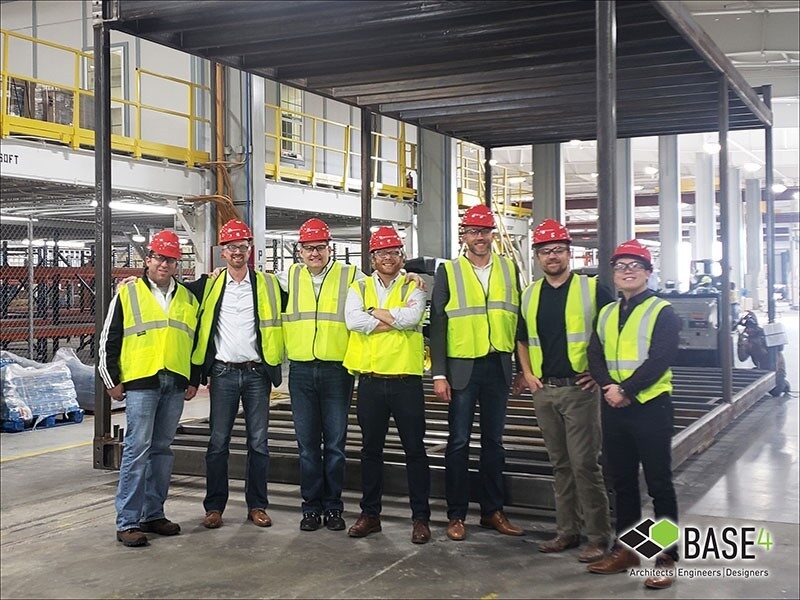
In a photograph taken at a Z Modular factory, Garry Vermaas stands third from the left, wearing a red hard hat and a fluorescent safety vest. Above the group is a steel frame. Around them are the components of buildings still on their way to becoming buildings. An architecture business can look rather different when you take it out of the rendering.
Vermaas, the founder and CEO of BASE4, has spent years trying to connect those two worlds: the design that exists in a model and the building that must eventually behave itself in public. In April 2019, he and colleague Blair Hildahl visited Z Modular’s Birmingham, Alabama, manufacturing facility. The attraction was practical. Rooms could be manufactured off site, then delivered for assembly. The drawings had to account for that journey.
A factory tour suits the engineer in him. So does the less visible work around it: coordinating disciplines, recruiting colleagues across countries, and teaching people how a different construction process works. Follow his career backwards and the trail leads to bridge research. Follow it forwards and it reaches a college. The family story takes a few turns of its own.
A bridge engineer with another congregation
His early technical interests were quite literal questions of connection. At Lehigh University, his master’s thesis examined how concrete-filled steel tubes connect to wide-flange beams under seismic loading. The title runs to several lines. The subject is how different pieces of a structure work together when the forces become demanding.
He earned his bachelor’s degree in civil engineering in 1994 and later reported graduating with his master’s in 1996. He then pursued doctoral work at Columbia. A journal paper he co-authored, published in 2000, studied corrosion and embrittlement in high-strength bridge wire. The researchers examined deterioration under controlled conditions, measuring changes in strength and other material properties.
That is a patient sort of engineering: finding out what happens to something people depend on, including the changes they cannot casually see. A suspension bridge offers very little room for a persuasive approximation.
Meanwhile, his working life had another setting. In the autumn of 1996, Vermaas began working as a minister for the NYC Church of Christ while studying at Columbia. By May 2001, he had completed his Master of Philosophy and doctorate in civil engineering. He was leading the church’s Mid Manhattan Region and consulting on bridge rehabilitation projects, including the Williamsburg Bridge and the San Francisco Bay Bridge.
Engineering and ministry sat alongside one another in that early account. Both remained part of the life he described as his work and family commitments spread beyond New York.
The office that needed a map
BASE4 was founded in 2009. Its later growth made the Inc. 5000 in five consecutive years, from 2016 through 2020, reaching No. 880 in 2018. Those rankings mark a period of business expansion. The more revealing details are the places where the work took him and the people required to carry it out.
In September 2013, Vermaas announced that BASE4 had been selected as lead design consultant and technology partner for an affordable housing development in Rajasthan, India. The plan covered sites in Jodhpur and Udaipur, with more than 2,000 apartments proposed across approximately one million square feet. The assignment brought master planning, architecture and several engineering disciplines into the same undertaking.
Three years later, Garry and Jodi Vermaas travelled to Tbilisi to help establish the firm’s Georgian office. Their October 2016 visit included meetings with investment officials and education institutions. BASE4 appointed architects Shota Saganelidze and Konstantine Giorgadze as local directors.
The trip also brought them together with 50 graduating architects and professors from three universities. An overseas office needed people who could do the work, learn the systems and become colleagues. Recruiting and training belonged in the expansion plan as surely as an address did.
Today BASE4 describes a global design team of more than 225 full-time designers and a 24-hour work cycle. Architects, engineers, interior designers and building information modelling specialists work within the same firm. The aim is a coordinated building design, with a shared three-dimensional model helping the disciplines work through their decisions together.
The attraction of that arrangement is easy to understand. Every additional person brings knowledge; every additional handoff requires care. A global practice has to make both sides of that equation work. A clock can provide more working hours, but colleagues still have to understand what they are handing over.
A Bavarian hotel, a factory floor
For all the attention to production, Vermaas’s project stories include distinctly local concerns. In 2015, BASE4 received an assignment for a Hampton Inn & Suites in Leavenworth, Washington, a town known for its Bavarian architecture. The hotel would have four storeys and 100 rooms.
The owner had particular ideas about where the property should sit. Vermaas and Hildahl became personally involved, working with a specialist in Bavarian architecture. The resulting project had to accommodate a hotel brand, an owner’s preferences and a place with a very definite opinion about how buildings should look. Even an efficient process occasionally needs to make room for Bavaria.
The modular work asked a related question at a different scale: how much coordination could happen before construction reached the site? In March 2019, BASE4 introduced its sister brand Modz4, with Vermaas leading the team. Its responsibilities included engineering, construction documents, communication with manufacturers and coordination between factory drawings and permitted plans.
These are specific jobs with consequences. The factory needs to know what it will produce. The contractor needs to know what remains to be built on site. The two sets of instructions need to agree.
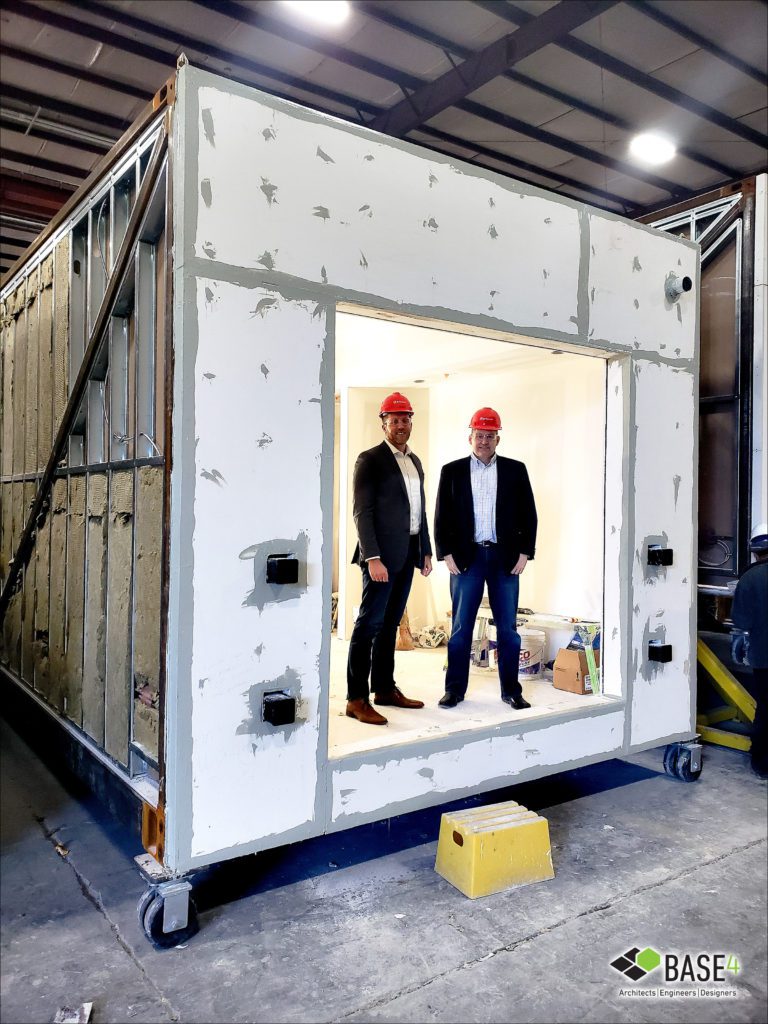
When architectural construction manager John Morefield joined BASE4 later in 2019, he described the importance of talking directly with permitting jurisdictions. The time saved by modular construction could be lost if officials did not understand what they were inspecting. Vermaas’s team was dealing with a building process that needed explanation as well as drawings.
It is a useful detail about his business. Moving work into a factory does not remove the people around a project. It gives them different questions to settle, preferably before an expensive component starts travelling.
Six siblings, one answer
At home, Garry and Jodi were making commitments of a different order. A 2019 account described them as parents of twelve children, ten adopted internationally. Six had recently joined the family from the Philippines. They were siblings, and keeping them together mattered.
“They are all siblings.”
Garry Vermaas, on the six children adopted together, 2019
The couple worked with the Philippine child welfare organisation Gentle Hands. Their other adopted children had come from China and India. They also founded Priority One Worldwide, connecting their faith with support for children and charitable work abroad.
These choices belong to the personal story because Vermaas has explicitly connected them to his beliefs. His Christian faith informed the way he spoke about adoption and responsibility. In Franklin, Tennessee, the family’s international life continued well beyond the boundaries of an engineering practice.
Jodi’s book, Get Money Do Good: A True Story How-To, brought their experiences into a memoir. Published in 2020, it placed business and the uses of business income in the same family narrative. Garry also appears among the audiobook’s narrators. The title is brisk enough to fit on a workshop noticeboard; the experiences behind it occupied a book.
The next project had a syllabus
In June 2020, BASE4 announced STONEPILE Construction College. Vermaas had added a school to the list of organisations he helped build. Its initial offering comprised three online degree programs: an associate degree in construction, a bachelor’s in construction management, and a master’s concentrating on prefabrication, modular and offsite construction.
The launch set September 1 as the start of classes. It also described an intention to attract and develop the next generation of construction leaders. For a founder working on different ways to organise building production, education was a way to address who would understand and lead that production.
There was an internal precedent. BASE4 had already made staff development a formal responsibility. In January 2019, Garry appointed Jodi Chief Leadership Officer after her work as Director of Leadership Development. Her remit included supporting team leaders, improving communication and developing future executives. The company’s stated values included humility, honesty, respect and fun. Fun had somehow survived the journey into an engineering organisation chart.
Vermaas’s own route makes the educational project particularly interesting. He had spent years studying structures, then years assembling a practice around design and delivery. STONEPILE brought formal learning back into the picture, this time with construction management and factory methods among the subjects on the timetable.
A sentence that travelled
In October 2026, BASE4’s Naslha Espinal offered a small example of his leadership reaching another person. Now Chief Marketing Officer and Executive Director of Interior Design, she recalled advice Vermaas had given her in a casual conversation when she was a team leader.
“Uplift your staff, and they will uplift you.”
Garry Vermaas, as recalled by Naslha Espinal in 2026
Espinal had advanced through project management, team leadership and regional direction into executive work. Her recollection gives that advice a setting: a colleague moving through responsibilities, remembering a conversation about the people she led.
That is where this career becomes most personal. There are steel connections, shared models, factory drawings and course programs. There are also colleagues who must learn, and colleagues who must make room for them to learn. Long before the building stands, Vermaas’s work keeps returning to the people who have to put it together.