The firm that turned time zones into a building material
A Boca Raton firm decided architecture should behave more like a factory than an atelier - so it wired together designers on four continents into a 24-hour workday and pointed the whole thing at one goal: build faster and cheaper.
Most architecture firms sell you a drawing. BASE4 sells you a shorter schedule and a smaller invoice. The building at the end can look like anyone else's branded hotel or apartment block - the difference is upstream, in a production model that treats design less like an art commission and more like a factory shift that never clocks out.
Founded in 2009 in Boca Raton, Florida, BASE4 - Architects, Engineers, Designers is a full-service architecture and engineering practice of roughly 250 people. Its tagline is refreshingly unpretentious for an industry fond of manifestos: helping developers build cheaper and faster. Everything about how the firm is wired flows from taking that sentence literally.
01 / The IdeaArchitecture, but run like an assembly line
The founder, Dr. Garry Vermaas, is not a typical design-school principal. He holds a PhD from Columbia University, is licensed as a Professional Engineer in 48 states, and spent decades across structural, architectural and MEP engineering before starting the firm. That engineering instinct shows up in the company's core belief: that the brick-and-mortar A/E industry is, in his words, ripe for change - and that most cost and schedule overruns are decided on the drawing board long before a single truck arrives.
So BASE4 does something a lot of firms only talk about. It keeps every discipline in-house - architecture, structural, mechanical, electrical, plumbing, fire protection, low-voltage and security, interiors, lighting, even wind-tunnel testing - and coordinates all of it in one 3D BIM model built in Revit. The point isn't the software. The point is that when the plumber's pipe and the structural beam want to occupy the same six inches of ceiling, the conflict shows up on a screen in the office instead of as a change order in the field.
"100% focus on building faster and cheaper."
- BASE4 company positioning02 / The TrickA workday that follows the sun
Here is the detail that makes BASE4 genuinely unusual. Its offices are not clustered in one metro - they are spread across the United States, the Dominican Republic, the Republic of Georgia and India. That footprint isn't a diversity slide. It's a clock. As one region logs off, the next logs on, and a project moves around the globe roughly every eight hours. On paper it's a distributed workforce. In practice it's a 24-hour design workday.
This is also, quietly, the firm's business model. The distributed teams lower cost, and the round-the-clock cycle compresses schedule. Both feed the same promise. A developer isn't buying a signature building; they're buying speed and a lower number, delivered by a vertically integrated shop where there's no other firm to point at when something slips.
03 / The MethodDesigning the box before the crane arrives
BASE4's second big bet is on industrialized construction: modular, offsite and prefabrication design, plus DfMA - Design for Manufacture and Assembly. The plain-English version is that a hotel guestroom, or an apartment wall, gets engineered from the start to be manufactured in a factory and assembled on site, rather than stick-built in place. The design has to anticipate the factory line and the crane. Get it right and you shave weeks off a schedule; get it wrong and modular becomes more expensive than conventional, not less.
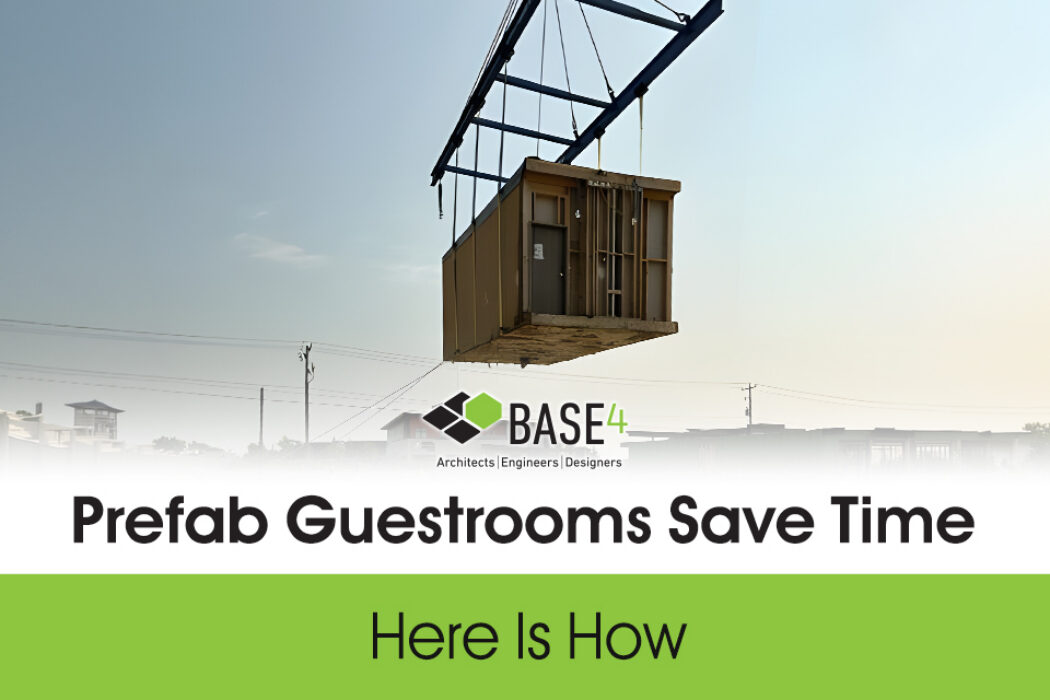
It's the same logic BASE4 applies whether the project is a Hyatt Studios or Atwell Suites hotel, a large multifamily community, or - increasingly - a modular data center. Standardize the pieces, prefabricate them, repeat. A data center gets designed with the same discipline as a hotel corridor: fewer bespoke parts, more repeatable modules.
04 / The MathWhat developers are really buying
Strip away the jargon and BASE4 competes on two axes almost everyone else in AEC treats as fixed: cost and schedule. The bars below are illustrative, not a spec sheet - but they capture the shape of the pitch. Bundle the disciplines, coordinate in one model, and prefabricate the repeatable parts, and you attack rework, waiting and change orders all at once.
Real-estate developers, hotel owners and franchisees, and general contractors - concentrated in U.S. hospitality and multifamily housing, with a growing modular data-center practice. The buyer is usually someone whose spreadsheet cares more about the delivery date than the architect's ego.
05 / The Long GameWhen you can't hire the workforce, build a college
Modular construction has a bottleneck that no software fixes: people who actually know how to design and build it. Most firms grumble about the labor shortage. BASE4 launched a school. STONEPILE Construction College is an accredited institution offering degrees in construction, construction management, and a master's focused on prefabrication, modular and offsite construction. It's vertical integration taken to an almost literal extreme - the firm decided to manufacture its own talent pipeline the way it manufactures walls.
"The AEC industry is ripe for change."
- Dr. Garry Vermaas, Founder & CEO06 / The PositionWhere BASE4 fits
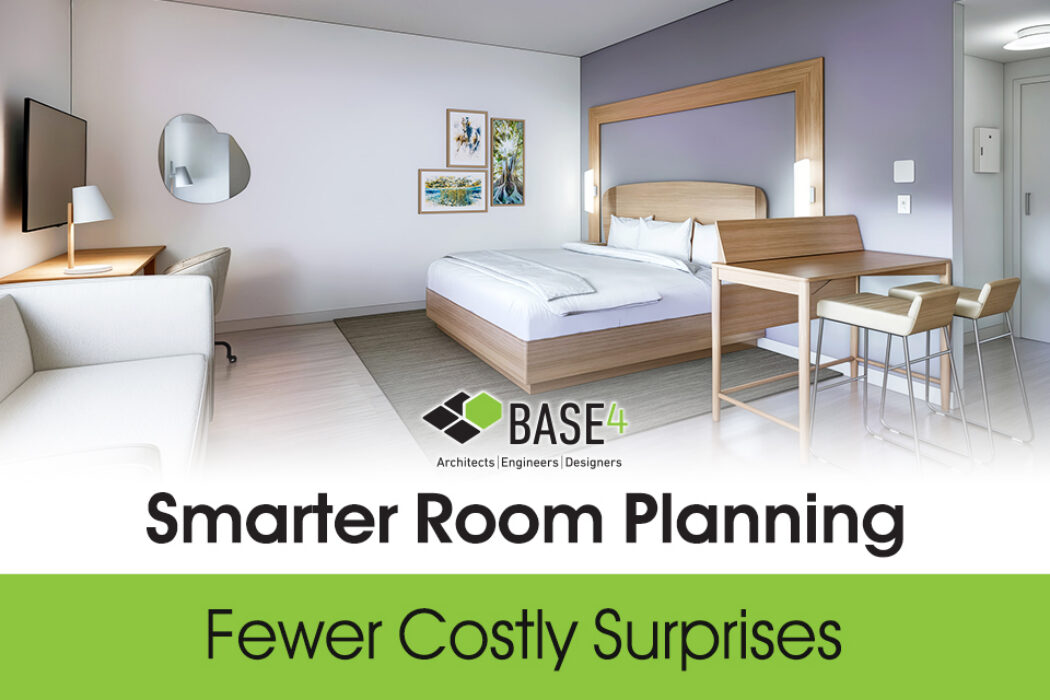
In the market, BASE4 sits in an interesting middle. It's larger and more integrated than a boutique studio, but it competes on delivery economics rather than design awards - closer in spirit to the big multidisciplinary A/E firms and the hospitality and multifamily specialists like Humphreys & Partners or BSB Design. The real alternative for a developer, though, isn't another named firm. It's the default: hire a separate architect, engineer and interior designer, then spend the project stitching their drawings together by hand. BASE4's argument is that the stitching is where the money leaks.
Whether "faster and cheaper" holds without quietly costing something in flexibility is the honest question any developer should ask - modular rewards repetition and punishes one-off ambition. But as a bet on where construction is heading, BASE4 has been consistent for over fifteen years, made the Inc. 5000 five times, and kept aiming the same machine at the same unglamorous target.