The most important MiTek product is small enough to lose in a workshop. It is a sheet of steel punched into rows of sharp teeth. Press it across the meeting point of two pieces of lumber and the joint becomes part of a roof truss. The connector disappears into the building, which is a useful metaphor for MiTek itself: an enormous company hidden in plain sight, sitting between the drawing, the component factory, and the framing crew.
John Calvin “Cal” Jureit patented the Gang-Nail plate in 1955. The invention did more than improve a joint. It made wood trusses cheap and repeatable enough to manufacture at scale. MiTek grew around that wedge, adding the engineering rules, design software, services, and machines needed to turn lumber into certified components. Berkshire Hathaway bought a 90 percent interest in 2001 for roughly $400 million. In fiscal 2024, MiTek reported $1.68 billion in revenue.
This is not the other Mitek, the publicly traded identity-verification business in San Diego. This MiTek is headquartered in Chesterfield, Missouri, employs thousands of engineers, software developers, factory specialists, and service professionals, and sells to the people who make buildings stand up. Its customers include architects, engineers of record, production builders, trades, and manufacturers of roof trusses, floor trusses, and wall panels.
The product is the handoff
Construction’s recurring nuisance is not a shortage of clever tools. It is the gap between them. An architect changes a plan. An engineer recalculates a load. A component designer redraws a truss. A factory recuts lumber. A crew discovers the conflict when a crane is waiting. Each participant can be locally competent while the project still burns time globally.
MiTek’s “Design-Make-Build” pitch attacks that sequence. Decide how the structure will be componentized while the building is still malleable on-screen. Carry those decisions into engineering and estimating. Send accurate instructions to the plant. Cut, position, and press the components with connected equipment. Deliver assemblies that require fewer improvised choices in the field.
That breadth is the differentiation. Simpson Strong-Tie is a familiar alternative in connectors. Autodesk sits upstream in design. Alpine and Eagle Metal serve pieces of the component-manufacturing workflow. Independent engineers and machinery vendors fill other slots. MiTek’s bet is that linking more of the chain creates more value than winning any single feature contest.
Four businesses wearing one hard hat
Start with engineered products: metal connector plates, fasteners, hangers, lateral force-resisting systems, and other structural components. These are physical products governed by loads, building codes, approvals, and installation details. Trust accumulates slowly here. A connector company cannot ship a charming beta and apologize to the roof later.
Then comes software. SAPPHIRE Build was introduced in 2013 for production builders. PAMIR, launched in the UK truss market in 2014, combines layout, engineering, output, and 3D tools for roofs and floors. MiTek Array is a Revit plugin that helps production builders manage the thicket of plan options and lot-specific variations. Kova aims at the factory itself, gathering people, machines, materials, money, time, and space into a common operations platform.
Services add elastic labor and expertise: estimating, drafting, structural design, component design, BIM support, and modeling. MiTek’s large operation in Vietnam supplies skilled technical work to customers in North America, Europe, Australia, and New Zealand. The 2017 purchase of Platinum Global expanded this layer. In 2024, MiTek acquired TrueNorth Development, a consultancy founded by Scott Sedam, to sell Lean workshops and process improvement to home builders.
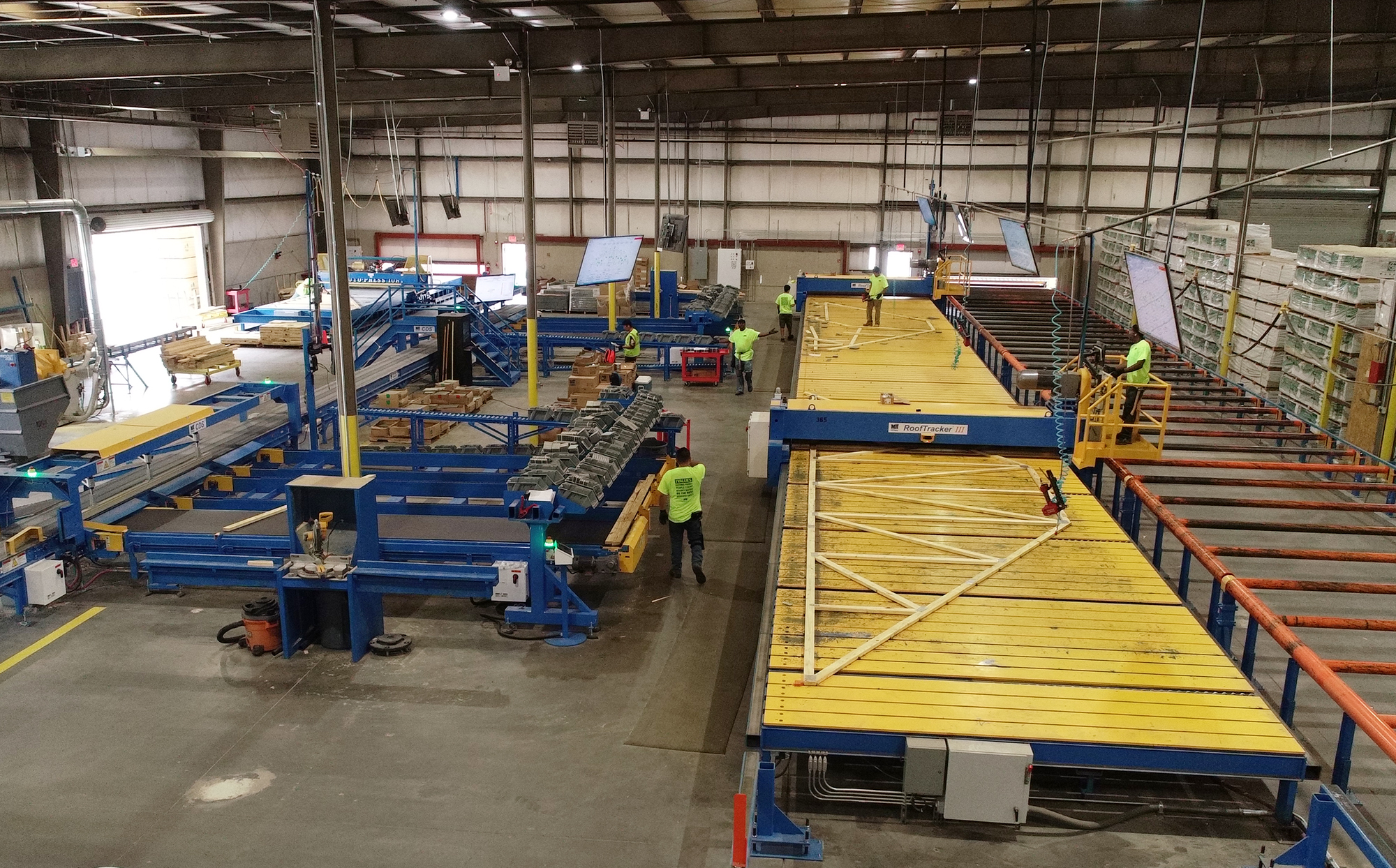
Finally, there is the factory floor. MiTek sells lumber retrieval, conveyors, precision saws, assembly tables, laser projection, jigging, presses, wall-panel equipment, control software, and maintenance. MatchPoint DirectDrive links multiple machines. Guardian sells preventative service. The revenue model is therefore a mix of products, software, equipment, support, and professional services. As a private Berkshire subsidiary, MiTek does not disclose the exact mix.
“Modular has such clear advantages, but for your average commercial builder, the risks are too high and the learning curve is too steep.”Danny Forster, architect and MiTek modular partner
What failed first was the easy story
Off-site construction has spent decades being one breakthrough away from the mainstream. The easy story said buildings would become cars: standard parts rolling down a permanent assembly line. Buildings objected. Sites differ. Codes differ. customers customize. Large modules are awkward and expensive to transport. A factory needs volume, but a developer may only have one project. The risk often lands on the first team asked to learn a new method.
MiTek’s 2021 modular initiative with Danny Forster & Architecture revealed a change in framing. Instead of asking builders to buy a closed prefab product, the partners proposed an activation platform with design software and hands-on guidance. Their prototype used a collapsible steel module intended to ship flat and be assembled near the project, sidestepping some of the cost and indignity of trucking giant finished boxes under bridges.
The idea matters even if that exact modular format does not conquer the market. MiTek moved the sales argument from “trust our box” to “reduce the learning curve.” That is consistent with the rest of the company. Its advantage is not a futuristic factory dropped from orbit. It is familiarity with the dull, expensive interfaces between design, approval, fabrication, logistics, and assembly.
The numbers are good - and conditional
MiTek reports striking outcomes from whole-home componentization: framing up to 60 percent faster than traditional methods, mechanical, electrical, and plumbing installation up to 20 percent faster, 25 percent less wood on average, up to 33 percent fewer hangers, and average carrying-cost savings of $630 per home. A company demonstration in Indianapolis framed a componentized house three full days ahead of an identical stick-built one.
These are company-reported results from MiTek programs and cited industry studies, not universal guarantees. Outcomes depend on project design, plant capability, logistics, labor, and local conditions.
There is real scale behind the claims. A 2025 MiTek handout listed roughly 6,300 people in 19 countries and 64 locations, including 17 plants. It said the company stamps 600 million pounds of engineered connections and seals 15 million engineering designs each year. The prior fiscal-year sustainability summary reported more than 5,800 employees in 15 countries. The dates explain the difference better than forced precision would.
The playbook hiding in the rafters
The copyable part of MiTek is sequencing. Begin with one painful, measurable constraint. The Gang-Nail plate solved a joint. Then add the engineering knowledge that makes the product safe, software that makes it specifiable, equipment that makes it repeatable, and services that help customers absorb the change. Each layer should improve the next layer’s economics.
A second lesson is to automate decisions before automating motion. A fast saw fed the wrong cut list creates scrap faster. A robot cannot rescue a late structural redesign. The useful digital twin is not a glossy model; it is a model that drives estimating, approvals, material, machinery, and field installation without being reinterpreted five times.
Where it tends to work
- Repeatable homes or building types
- Early trade and engineering input
- Enough factory volume to amortize equipment
- Stable designs and predictable logistics
Where it can break
- Late customization and frequent change orders
- One-off geometry with little repetition
- Weak local component capacity
- Transport costs larger than factory savings
The uncopyable part is the patient compound interest of codes, approvals, field support, and relationships with component manufacturers. MiTek has had 70 years to bury itself in the workflow. New software can be better looking and still lose because the old system knows which plate, load case, saw, technician, and installer must agree before Tuesday morning.
A climate claim that begins with waste
MiTek’s environmental case is pragmatic. Better material optimization can use less wood. Factory assembly can reduce jobsite waste and repeat trips. Environmental Product Declarations now cover products including Posi-Strut, metal connector plates, and building hardware in North America. PAMIR gained an output feature in 2023 to help customers calculate project carbon emissions.
The company is still building its own measurement practice. It has tracked Scope 1 and 2 emissions, conducted its first climate-risk assessment in 2025, and says Scope 3 work is next. Solar installations began at its Midrand, South Africa facility in 2024, followed by Worcester in the UK in 2025. This is progress reporting, not a victory lap, which is the more believable posture for a manufacturer selling steel, machinery, and global services.
MiTek’s mission is to advance off-site construction. Its more revealing ambition is to make off-site boring: a normal sequence of early decisions, certified components, predictable machines, and crews receiving fewer surprises. The company began by improving the place where two boards meet. Its next seventy years depend on improving the places where companies do.