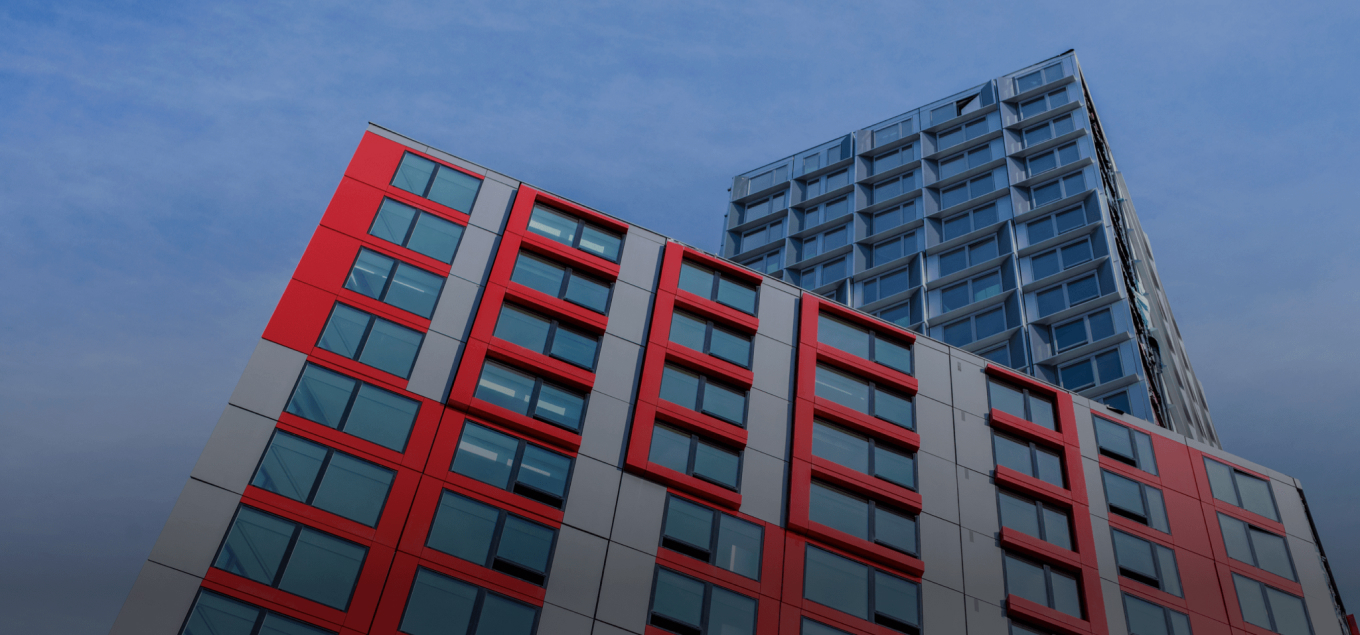
In Brooklyn, a building once behaved like an argument. At 461 Dean Street, 930 steel modules were made in a Navy Yard factory, carried a few miles, and stacked into 32 stories of apartments. The tower opened in 2016. It was the tallest volumetric modular building in the world at completion. It was also roughly three years behind its original ambition, born from a partnership that dissolved into litigation. The building demonstrated that high-rise modular construction could work and, at the same time, showed how the surrounding business could fail.
- FullStack sells an integrated system: design, steel-module manufacturing, transport, stacking, finishing, and operational data.
- Its best customers have repeatable rooms and expensive clocks - student housing, apartments, affordable housing, and hotels.
- The factory is only half the proposition. Early decisions, steady volume, short transport, and disciplined site work determine whether the economics survive.
- The copyable move is to standardize hidden components while keeping visible layouts flexible.
Roger Krulak had spent years inside that contradiction. A construction and development executive at Forest City Ratner, he had started working on high-rise modular research around 2007. When Forest City decided to leave the business after finishing 461 Dean, Krulak and an investment group bought the technology, equipment, intellectual property, and factory operation. FullStack Modular emerged in 2016 from what most companies would have filed under “lessons learned” and quietly avoided discussing.
This is the first useful thing about FullStack: its origin does not support a tidy miracle story. The original goal for 461 Dean was a 20 percent cost reduction and a schedule compressed from 30 months to 10. The actual project took about four years. What failed first was not the steel box. It was the arrangement around it - two large companies trying to invent a startup process together, trade and regulatory friction, and the awkward seam between factory work and the jobsite.
The product is the sequence
A conventional project moves like a relay race. The architect designs. Contractors bid. Trades arrive in sequence. Missing information gets converted into requests, change orders, and waiting. Modular construction is sometimes sold as that same race, only with the rooms built elsewhere. FullStack’s sharper idea is to change the race.
The company calls its method Design/Manufacture/Construct. Those verbs overlap. A proprietary steel chassis is flat-packed and assembled in the factory. Kitchens, bathrooms, facades, mechanical systems, electrical work, and plumbing become subassemblies before they meet the main module. Finished modules are waterproofed, trucked to the site, lifted by crane, and bolted together through proprietary connections. Stairwells and elevator shafts can be modular too, avoiding the conventional concrete core used by many competitors.
The customer does not buy a catalog apartment. A small family of module types can be recombined into studios, one-, two-, and three-bedroom plans. FullStack’s web layout application tests footprints and floorplate configurations. The trick is to standardize what residents rarely notice - chassis, risers, connections, manufacturing instructions - while leaving enough freedom for the building to suit its site and architect.
“First, know what your product is and know how you’re going to build it effectively.”Roger Krulak, founder and president
Do not buy the robots yet
Krulak’s most memorable manufacturing advice concerns a machine he does not want you to purchase. He has watched companies install enough automation to make 8,000 windows a week before proving they could use that many in three months. His instruction is blunt: understand the product and process first; then decide what the factory needs. “I’m buying a bunch of robots, and then I’m going to figure out how to use them,” he has heard. “Do not do that!”
That restraint explains FullStack’s culture better than a wall of values would. The company organizes work around assemblies and subassemblies, not around the usual parade of trades. Each repetition should improve the next. Automation magnifies a known process; it also magnifies a bad one. The lesson travels well beyond construction: before scaling a workflow, make the workflow legible.
Illustrative, not a project forecast. FullStack markets development as 20 to 50 percent faster; actual savings depend on early design lock, approvals, transport, foundations, and field scope.
Four thousand beds and one inconvenient loop
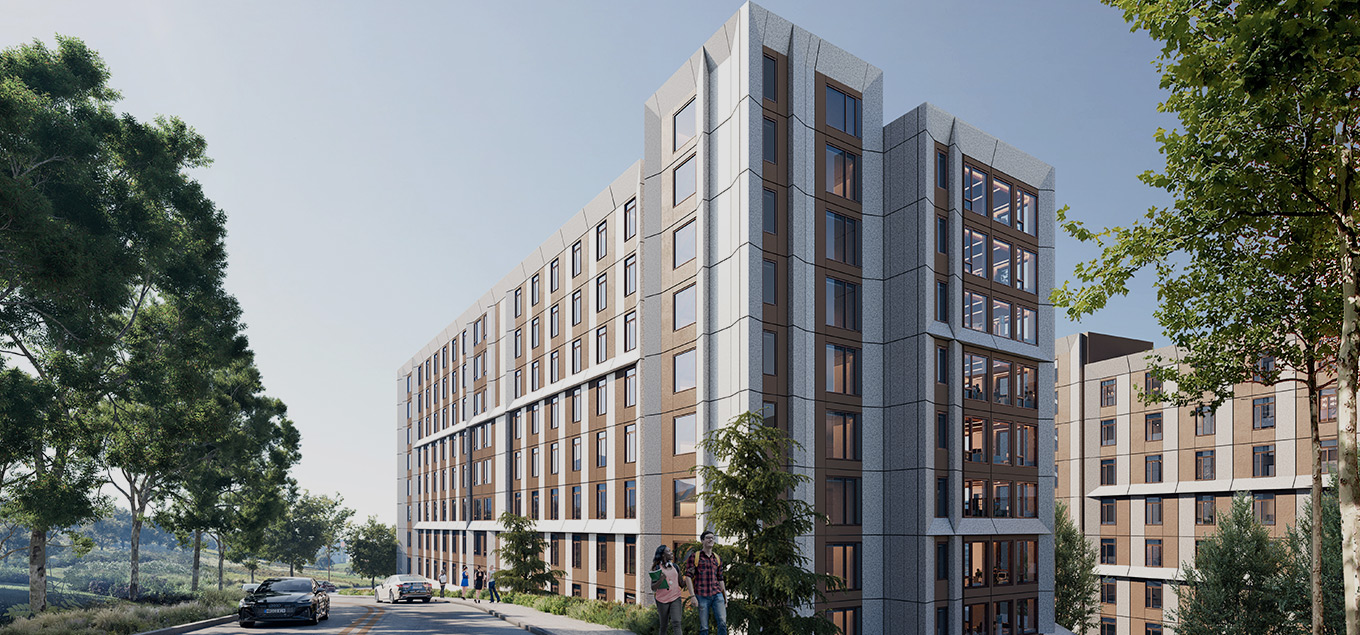
The clearest current test sits 200 miles from FullStack’s 130,000-square-foot factory in Carson, California. Cal Poly San Luis Obispo plans a multiyear housing program of roughly 4,200 beds across nine buildings. The broader development has been reported at $1.2 billion. A recurring six-bed suite makes up most of the modular area, giving the factory exactly what factories like: volume and repetition.
But Cal Poly’s constraint is more interesting than its scale. San Luis Obispo lacks enough local construction labor for a project this large. Importing workers from Los Angeles, the Central Valley, or San Francisco would mean importing hundreds of people who also need somewhere to live. Traditional construction would aggravate the housing shortage it was hired to solve. Factory production relocates much of that labor demand to Carson, where finished rooms can leave at night and arrive ready for the crane.
The company’s other recent proof traveled from a Portland factory to Sunnyvale. For Starwood Capital Group’s first U.S. Treehouse Hotel, FullStack developed six module varieties for a six-story, seismic-responsive building. The 200-module concept incorporated steel brace frames and drag beams for California conditions. Pandemic damage to hotel financing and supply chains delayed the job, but the Treehouse property opened in 2025. Again, the machinery was not the only story. Patient capital, an owner willing to collaborate early, and a repetitive hotel plan made the system plausible.
The part the crane cannot fix
FullStack’s own project list contains a useful warning. Its 581 Grant Avenue affordable-housing design in Brooklyn won a city competition and reached full design, then stopped during COVID-19. Under later developers, the site moved forward as conventional concrete construction. The module is not destiny. Financing changes. Owners change. Foundations, tunnels, transport routes, approvals, and onsite contracts can redraw the answer.
This approach works best when rooms repeat, the design team commits early, production stays busy, roads can accept oversized loads, and the field contractor prices only the field work. Krulak has said the value proposition is often lost when onsite cost refuses to shrink with onsite scope. It works less well for one-off geometries, constantly changing designs, distant sites, low volume, or owners who want to finish a conventional design and introduce the manufacturer afterward.
Competitors can supply modules. Conventional contractors can offer familiar risk allocation. FullStack’s wager is that one accountable system can preserve more of the value between drawing and occupancy. Its business stretches from a predevelopment agreement through manufacturing and assembly, then into a digital twin intended to monitor energy and maintenance. The company is selling fewer handoffs.
What can a reader copy? Pick the repeatable core. Bring production knowledge into the first sketch. Prototype before volume. Locate capacity near demand. Measure the stubborn costs outside the factory. And postpone expensive automation until the fifth repetition has taught you what the first could not. The great seduction of modular construction is the crane lifting a finished room into the sky. The practical advantage begins months earlier, in a meeting where someone decides the order in which the work will happen.