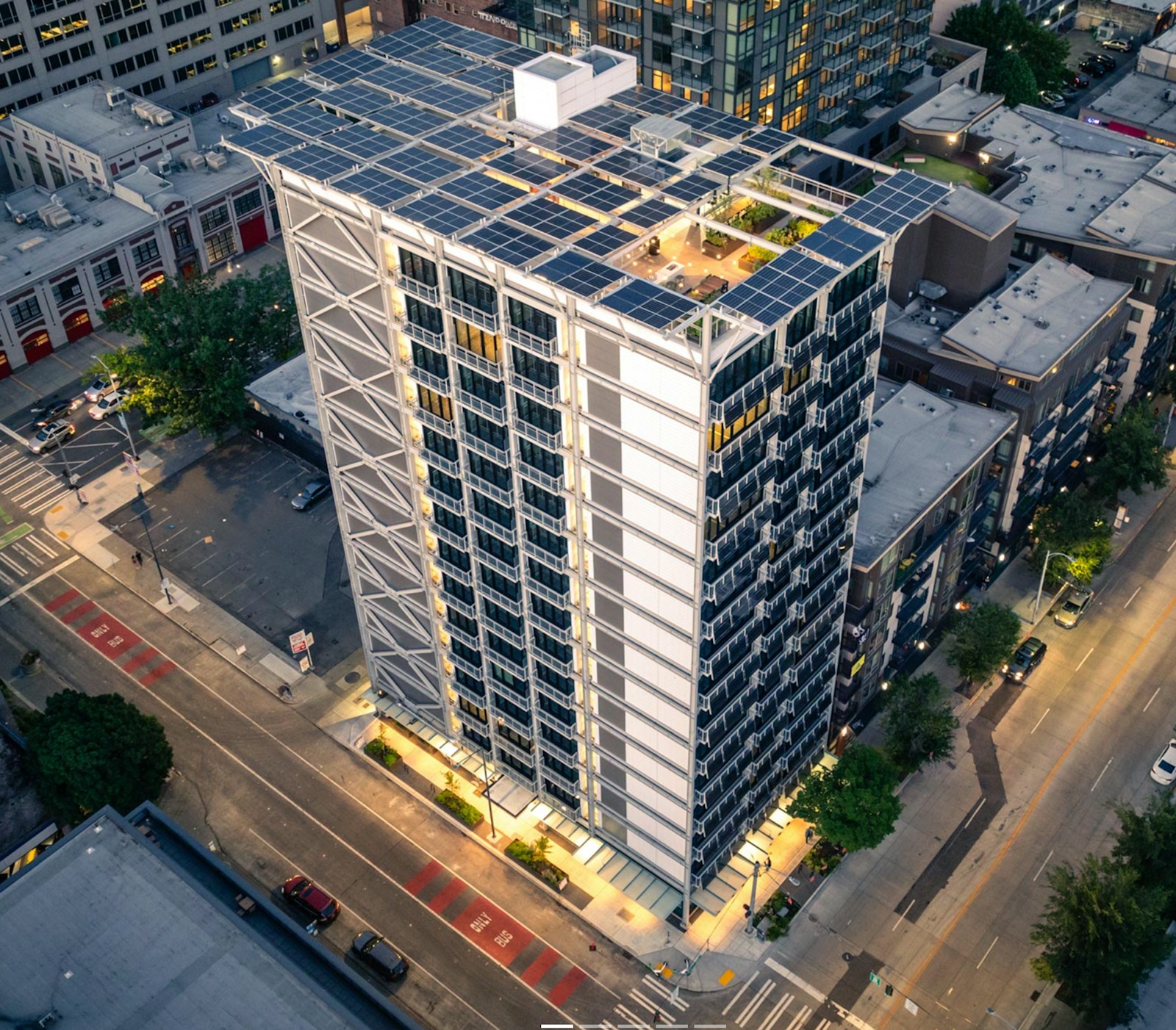
At the corner of Third Avenue and Battery Street in Seattle, a 15-story apartment tower looks as if somebody left the machine visible. White steel braces cross its flanks. Solar panels occupy the roof, balcony rails and parts of the facade. Behind the glass are 112 apartments, 27 priced as affordable homes. Underneath nearly everything is an argument: an apartment building should be a product, not a fresh improvisation performed in the rain.
The company making that argument is Sustainable Living Innovations, or SLI, founded in 2008 by Seattle architects Arlan Collins and Mark Woerman. Its product is not a tiny home, a shipping container or a finished room craned into place. SLI manufactures flat wall and floor panels. Plumbing, electrical wiring, mechanical equipment, fire-safety infrastructure and network systems arrive already integrated. Crews fit the pieces into a steel structure in a planned sequence, closer to assembling an aircraft than coordinating the usual parade of trades.
That distinction matters because SLI is solving two expensive problems at once. Construction is fragmented, slow and exposed to weather, labor shortages and rework. Buildings also produce a large share of Seattle's greenhouse-gas emissions. Move repeatable work into a factory, the thesis goes, and you can shorten the site schedule while controlling waste and quality. Add all-electric systems, heat recovery, greywater reuse and solar generation, and the finished building should cost less to operate as well.
The first thing that failed was the parts
SLI's public product history is refreshingly specific about failure. Its first full-scale prototype, built in a warehouse in 2011, included studio and two-bedroom units. People liked the layout and the kit-of-parts concept. The problem was underneath the compliments: the components relied on conventional materials and labor, making them too expensive and impossible to scale.
So the company redesigned the panel-to-structure interface and tried again. Version 2 became 47+7, a six-story, 24-unit building in Seattle's University District. Developers had been reluctant to become the first customer, so the modest project served as proof. The partners paid $975,000 for its 6,420-square-foot site; a contemporary trade report described the building cost as roughly equal to conventional wood-frame construction. Its 136 integrated panels were built off site and inserted from top to bottom inside a steel exoskeleton. From the slab, the building rose in five months. It achieved above-market rents, won design and engineering awards and sold in 2017 for $8.8 million. What changed minds was a rentable, tradable building, not another rendering.
But Version 2 found the next bottleneck: field work was still too expensive. This is the recurring joke in construction technology. You squeeze complexity out of one stage and it bulges somewhere else. SLI's response was to keep versioning. A request for a 40-story tower pushed the team into aerospace manufacturing software, lighter floors and full-length balconies. Customer, contractor and regulator feedback reshaped Version 4. A 2018 challenge - make a net-zero residential tower for the cost of a conventional one - brought high-performance mechanical and data systems inside Version 5's panels.
“Sustainability is not decorations on the cake; it IS the cake.”Steve Moddemeyer, recalling a maxim from Collins and Woerman
One building, four synchronized layers
The transferable idea is the interface. Each discipline still exists, but its handoffs are designed before the truck reaches the site.
and costing
with MEP inside
installation
and controls
The customer is buying time - and transferring risk
SLI sits between a product manufacturer, a technology vendor and an integrated project-delivery company. Its customer is not the tenant downloading a smart-home app. It is the developer, apartment owner, housing agency or nonprofit that needs a finished building. Public counterparties include Equity Residential, which was lined up to acquire 3zero3; DESC, which owns and operates supportive housing; Alexandria Real Estate Equities; the Seattle Office of Housing; and Seattle Housing Authority.
The promise is broader than buying panels. SLI has designed the system, coordinated suppliers and installation, and at times carried development or general-contractor responsibilities before delivering a completed asset. An older case study described the model plainly: secure financing, build on the land, then sell the operational building to its owner. That can remove coordination pain for a customer. It also moves project risk and working-capital pressure onto SLI.
The money illustrates the appetite. SLI closed an approximately $53 million accelerated-growth equity round in January 2022, with investors including Goldman Sachs, Equity Residential, the Hunt Companies and i(x) Net Zero. Combined with a reported $28 million 2018 raise, the supplied funding record totals roughly $81 million. Separately, an energy-efficiency investor put $5 million of debt behind 3zero3's performance systems in 2021. This is not SaaS with a nicer hard hat. Factories, panels and projects drink capital long before rent arrives.
The schedule SLI sold
A 2018 city design presentation compared an illustrative 18-month conventional schedule with nine months using SLI. It was a model, not the eventual 3zero3 result.
The fast building that finished late
At 3zero3, the vertical assembly supplied the cinematic proof. SLI said 85 percent of the walls, floors, stairs and elevators were already complete in its Tacoma factory at the June 2021 groundbreaking. The panels could turn the structure from slab to roof in about 12 weeks. Nearly 1,000 pieces arrived with utilities packed inside. Fireproofing was applied off site because the tight Belltown parcel had no room for a temporary coating shop.
Then the clean diagram met Seattle. The tower was expected in summer 2022. Instead, a regional concrete strike, pandemic aftershocks, supply-chain trouble, construction difficulties and multiple liens slowed the job. SLI initially acted as its own general contractor. The project entered receivership in summer 2023 and received a temporary certificate of occupancy in spring 2024. The panels went up fast. The whole project did not.
The financing story bent at the same time. In March 2023, Churchill Capital Corp V disclosed a nonbinding plan to combine with SLI and take the company public. By October, the letter was terminated. An investor later blamed turbulence in new issues and acquisitions, and said SLI had significantly reduced corporate expenses and slowed its development pace. A separate stockholder suit filed in 2023 was dismissed with prejudice in December 2024 after a stipulated motion.

None of that erases the buildings. DESC opened Burbridge Place in December 2023: 124 supportive-housing studios for adults who had experienced homelessness and live with disabilities. Its load-bearing panels adapted SLI's system to a five-story structure. 3zero3 began leasing 112 homes in April 2024. Together with 47+7, SLI can point to 260 completed Seattle apartments across market-rate, affordable and supportive housing.
What founders can steal
Do not begin by making every outcome identical. Make the connections between specialists predictable.
SLI named the cost defect after each prototype, then changed materials, structure or field sequence.
47+7 changed minds because customers could tour, rent and eventually purchase the result.
A faster assembly is not a faster project if capital, permits and contracting remain bespoke.
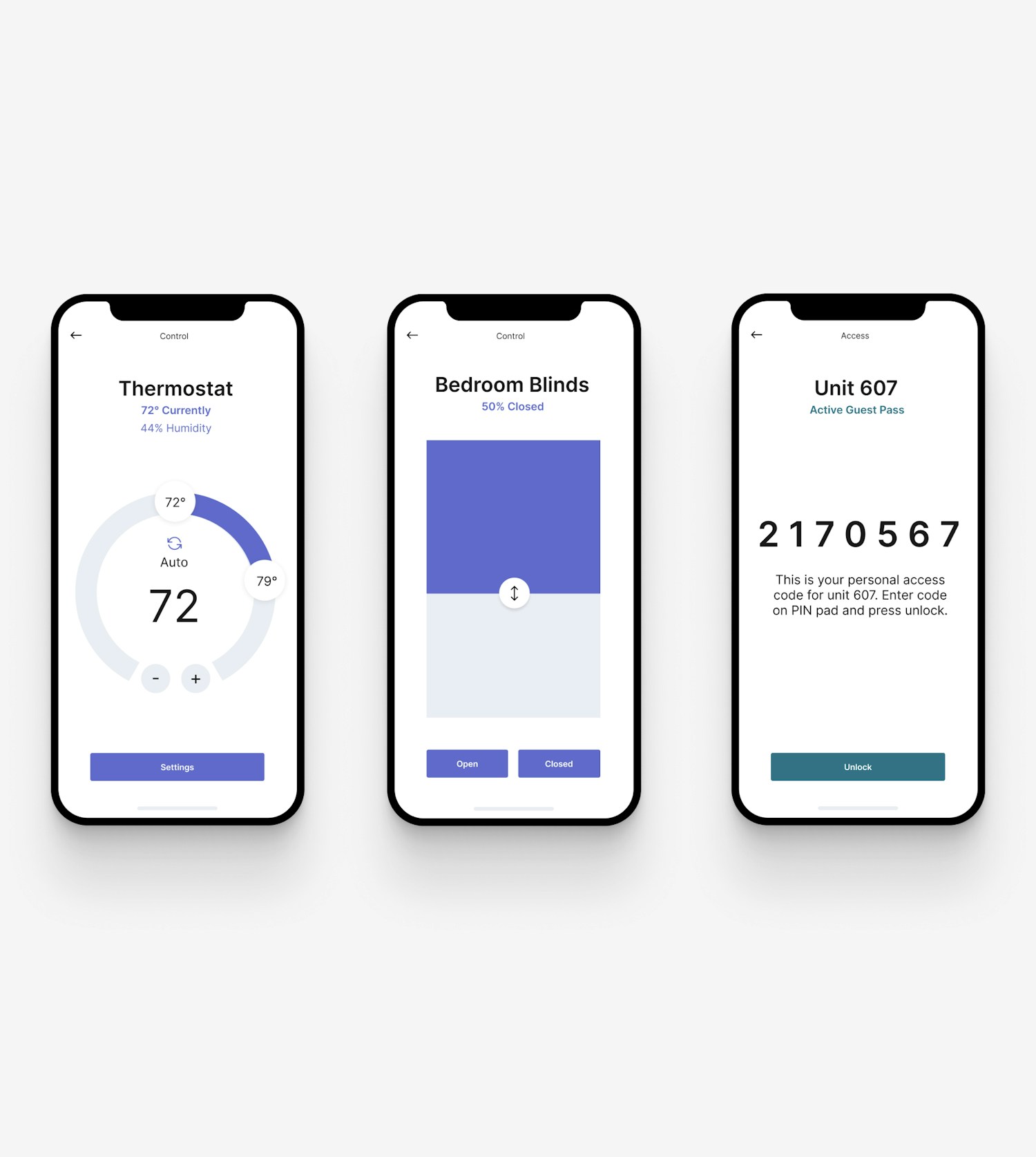
The less obvious lesson is to keep the market narrow enough for repetition. SLI focuses on multifamily housing, where kitchens, bathrooms and service runs recur floor after floor. Its software follows the same logic. Digital Twin is meant to track performance across a building's life. Configurator aims to join design, costing and feasibility. Track follows panels through fabrication and installation. Connect gives residents and facilities teams controls and consumption data. The ambition is a loop: design, manufacture, operate, learn, repeat.
Where the model works - and where it does not
SLI is differentiated from volumetric modular builders by shipping flat assemblies rather than room-sized boxes. It also reaches further than a component supplier by integrating structure, building services, sustainability systems and operating software. The practical alternatives remain formidable: a familiar general contractor using wood or concrete, panelized firms such as Plant Prefab, integrated steel systems such as Canam Hambro, and volumetric factories that complete entire rooms off site.
Conditions in its favor
- Repetitive multifamily floor plans
- High on-site labor and carrying costs
- Small, dense urban parcels
- Early regulator and trade involvement
- A committed buyer and secure financing
Conditions that break it
- One-off, highly bespoke buildings
- Cheap and abundant field labor
- Late design changes
- A thin pipeline that idles the factory
- Fragile project finance or unclear ownership
The market needs the experiment. Multifamily construction remains labor-intensive, while cities need housing that is cheaper to build and operate. Yet SLI's record suggests a useful correction to the usual disruption story. A building is not a large gadget. It is a temporary organization involving lenders, inspectors, utilities, unions, neighbors, suppliers and weather. Productizing the panels is a meaningful advantage. Productizing the entire delivery chain is the unfinished work.
That is why 3zero3 is more valuable as a complicated building than as a flawless press release. It proves that integrated panels can climb 15 stories, carry sophisticated energy systems and produce apartments people can occupy. It also records every stubborn dependency the factory did not remove. SLI's future depends on making those dependencies repeatable enough that the next building behaves less like a rescue mission and more like the product the founders sketched in 2008.