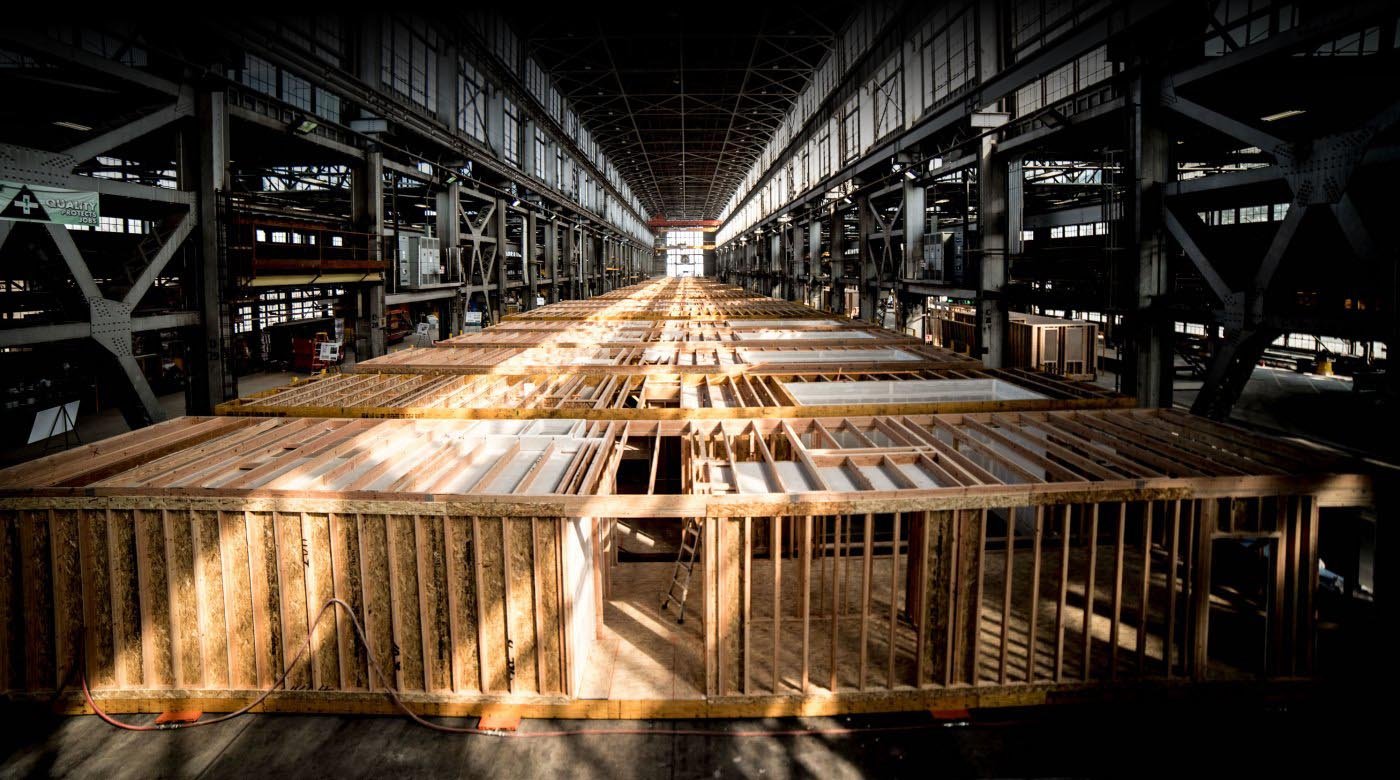
It is 6:42 a.m. in Vallejo and a wall is sliding past on rollers. Three union carpenters are nailing studs while a fourth tapes Tyvek to a header. By 7:15 the wall will be part of a kitchen. By Friday it will be a one-bedroom in West Oakland. The wall does not know any of this. The wall does not need to. It is on a line.
This is Factory OS, and the line does not stop. Inside Building 680 on Mare Island - a cavernous machine shop where the U.S. Navy once rebuilt the Pacific Fleet after Pearl Harbor - the company stamps out apartments roughly the way Toyota stamps out Corollas. Modules roll east through the plant, growing flooring, drywall, plumbing and cabinets as they go. At the far end of the building, finished apartments climb onto flatbeds. They are driven, fully framed, to construction sites in San Francisco, Oakland and Berkeley, where a crane stacks them like very expensive Lego.
It looks, frankly, like a magic trick. It is not. It is a bet about cost curves, labor, and one of the most stubborn problems in American economic life - and seven years in, the bet is still being argued.
01 / The problem they sawCalifornia's most expensive math problem
Anyone who has tried to rent a Bay Area apartment knows the punchline: there are not enough of them, and the ones that exist cost too much. Anyone who has tried to build a Bay Area apartment knows why. Site-built multifamily construction in California now runs north of $750,000 a door in much of the region. The labor pool is shrinking. The timelines are not. A mid-rise apartment building can take three to five years from entitlement to ribbon cutting, and most of that time is spent waiting - for permits, for weather, for a subcontractor who has gone to a more profitable job across town.
Factory OS started with a simple, slightly unfashionable observation: every other industry that wanted to lower the cost of complex goods stopped building them outside in the rain. Cars, planes, ships, kitchen appliances, semiconductors. All moved indoors, onto lines, decades ago. Housing did not. Housing kept building one-off prototypes, in mud, in February.
02 / The founders' betTwo old hands and a shipyard
Rick Holliday is not a tech founder in any conventional sense. He has spent four decades inside California's affordable-housing world, founding BRIDGE Housing, Eden Housing, and Holliday Development - three of the largest nonprofit and mixed-income developers on the West Coast. Larry Pace, his co-founder, is the construction half: a former president of Cannon Constructors North who has built more wood-frame multifamily than most people will ever see.
In 2017 they decided to start a manufacturing company. Their pitch was disarmingly literal. Take the apartments they had been building outside, anyway, in California. Build them in a building. Hire union carpenters - the same trades they had always worked with - and pay them union wages. Add software. Repeat.
It is the kind of plan that sounds boring until you notice what it isn't. It isn't a 3D-printed plastic dome. It isn't a shipping-container hack. It isn't a venture-funded plan to replace the construction trades. The cleverness is in how unclever the product looks. The wood is wood. The drywall is drywall. The factory is, in some sense, an enormous tarp - it just happens to be the size of an aircraft carrier hangar, because it used to house one.
03 / The productOff-site and operating system
The "OS" in Factory OS does double duty. Off-Site, because the work happens indoors at Mare Island instead of on the eventual construction site. Operating System, because what holds the whole thing together is software - Autodesk's BIM Collaborate suite tied into a custom internal toolchain that turns architectural drawings into per-station work orders for the line. A door knob is not just a door knob; it is a part number, an installation minute, a worker, and a station.
The result, on paper, is striking. Factory OS says it can erect a 100-unit apartment building in under 10 days once modules arrive on site. It says it cuts conventional multifamily build times by roughly 40% and total project costs by 20% to 40%. Independent press coverage from Inman, the San Francisco Chronicle and Forbes has generally backed the direction of those claims, if not always the exact percentage.
04 / The proofWho actually buys this?
A lot of people. Affordable-housing developers, supportive-housing nonprofits, university systems and - the line that always lands in the deck - Alphabet, Google's parent company, which placed a roughly 300-unit order in 2017 as part of its Bay Area housing commitment. That was Factory OS's first major contract. It is the kind of anchor customer founders dream about and rarely get.
More tellingly, the same names that placed orders eventually wrote equity checks. In November 2020, Factory OS closed a $55 million Series B led by Lafayette Square - with participation from Google, Facebook, Autodesk, Citi and Morgan Stanley. That investor list is unusual. Tech companies do not, as a rule, invest in carpentry. They did here because their own employees couldn't afford to live near their own offices, and someone in San Bruno had finally put the dollar problem on a spreadsheet.
Anchor Customer
Alphabet's ~300-unit modular order in 2017 - the first major contract and a useful credibility flag for everything that followed.
Equity Stack
Lafayette Square, Google, Facebook, Autodesk, Citi, Morgan Stanley. A list normally seen on a SaaS round, not on a wood-framing one.
Labor
Carpenters Union (NCCRC) wages and benefits on the production floor - the rarest detail in modular construction.
Research
Ongoing collaboration with UC Berkeley on industrialized building methods and cost reduction.
A short timeline of an unusually old idea
05 / By the numbersThe chart that started the conversation
Here is the cost argument, simplified to a single picture. Numbers are approximate and drawn from Factory OS's own published figures and independent press coverage. They are not gospel - they are an argument with axes.
Cost & time per unit, modular vs. site-built
06 / The missionHouses, jobs, both
There is a version of the modular-housing pitch that is not interesting. It goes: software eats construction, the trades lose, costs collapse. Factory OS does not tell that version. The factory pays Carpenters Union wages on the production floor. It recruits in Vallejo and surrounding Solano County, a part of California that lost its naval industry and never fully replaced it. The company's pitch to the union was that an indoor shift in a heated building, with predictable hours and a 401(k), is a better carpentry job than the one outdoors in February. The union agreed.
That detail - small, structural, easy to miss - is most of what separates Factory OS from the long graveyard of failed modular startups. Off-site construction has been tried in the United States since the Sears Roebuck mail-order house. It keeps almost working and then not working. The companies that have failed mostly tried to skip the trades. Factory OS tried to hire them.
07 / TomorrowWhy it still matters
As this profile goes to press, Factory OS is in the middle of one of the harder chapters a manufacturing company can have. The 2024 acquisition rebranded the operation as Harbinger Homes; a February 2026 WARN notice flagged the possibility of layoffs and a potential closure at the Vallejo plant absent new orders. The end of this story is not yet written - and honestly, it might be rewritten again before this paragraph stops being current.
What is durable is the lesson, which sits underneath whichever logo is currently on the building. California needs millions of homes it cannot produce at site-built cost or site-built speed. Someone, somewhere, has to industrialize multifamily housing. Factory OS spent seven years proving the mechanical, financial and labor pieces of that puzzle can in fact be combined. The harder question - whether the United States can buy housing the way it has learned to buy cars - is still open. It is open partly because Factory OS opened it.
It is now 4:48 p.m. on Mare Island. The wall from this morning is no longer a wall. It is part of a one-bedroom on a flatbed truck, easing onto Highway 37, heading south toward a building site that is, by California standards, almost on schedule. The truck does not know any of this. The truck does not need to. It is on a line.