Daniel Blank was standing on a wind farm, watching a crew place steel bars into a turbine foundation one at a time. By his count, it happened about 5,000 times - for a single turbine. Most people would have seen a hard day of labor. Blank saw a design problem that had never been solved.
That afternoon has become the origin story of Toggle, the construction robotics company Blank co-founded in New York in 2016. His job then was in a graphic design agency, and one of its clients built and operated power plants. A site visit put him face to face with the way big infrastructure actually gets made: by hand, repetitively, at enormous scale. "Seeing steel bars being put in place one at a time by hand 5000 times, over and over again, just for a single wind turbine foundation got my gears spinning," he later said.
What his gears turned toward was a simple reframing. The construction industry treats every project as a one-off. Blank started to see it as something else - a product manufacturing process that happened to be running without any of the tools manufacturing takes for granted. Robots, digital workflows, repeatable production lines. The pieces existed. They just had not made it onto the job site.
01 A designer's path to steel
Blank did not arrive at robotics through engineering. He grew up in a college town in Western Massachusetts, the son of a Filipino mother and a father from a New York Jewish community, both of whom worked in medicine. From an early age he was drawn to building and design in all its forms - graphic, industrial, architectural - and he had the entrepreneurial itch that tends to show up early. There were lawns to mow, driveways to shovel, lemonade to sell.
He studied Management and International Business at New York University, graduating in 2004, and that same year founded Bureau Blank, a design services agency that carried his name. For more than a decade he ran client projects there, developing the habit of looking at messy, one-off problems and asking how they could be made repeatable and well-made. It is a designer's instinct, and it turned out to be the same instinct a construction robotics company needs.
02 Why rebar, of all things
Toggle did not start with something glamorous. It started with rebar - the ribbed steel bars buried inside reinforced concrete. Blank's logic is hard to argue with. "Rebar is the basic building block of the whole built environment because reinforced concrete is by far the most consumed construction material," he explains. If you want to change how the world builds, you start with the material the world builds with most.
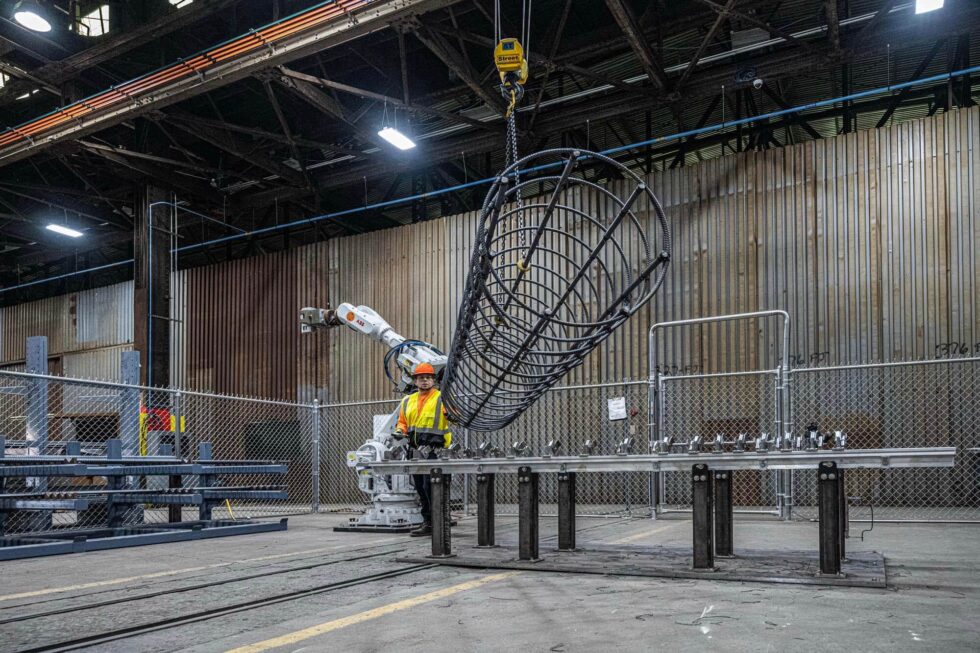
The company built a factory-style production system that pairs robots with software to fabricate and assemble rebar offsite, then ships the finished assemblies by truck. The pitch to the industry is concrete in every sense: halve labor costs, and increase output roughly fivefold compared with tying bars by hand. Toggle's system has gone to work on large-scale New York City civil infrastructure, commercial solar, and energy storage projects.
03 The industry that resists change
Blank is clear-eyed about why construction has been slow to modernize, and he does not blame the people in it. Each project carries high financial risk, which creates, as he puts it, "a very high incentive to stick with what works." Layer on the complexity of many trades coordinating at once, and you get an industry that has, in his words, "really not adopted a lot of technology or innovation to increase productivity" the way manufacturing, agriculture, or medicine have.
The timing, though, is on his side. "Global urbanization is driving demand for ever larger and more complex urban highrise and civil infrastructure construction," he said when Toggle announced its first outside funding. Demand is climbing while the skilled workforce to meet it tightens. That gap is exactly where a robotics company wants to stand.
04 The money and the believers
Investors came around to the thesis. In 2019 Toggle raised $3 million in seed funding led by Point72 Ventures' AI group, with Twenty Seven Ventures and Shark Tank investor Mark Cuban joining in. An $8 million Series A followed in 2021, led by Tribeca Venture Partners with Blackhorn Ventures, Point72 Ventures and New York State. In early 2023 the company added another $3 million, bringing its total to roughly $15 million.
Blank frames the opportunity in terms of scale rather than novelty. "At a time when global construction is accelerating to an unprecedented pace, Toggle offers a way to add capacity while saving time and cost on some of the largest types of projects," he said. Along the way the company earned its stripes in the right rooms, coming up through the URBAN-X accelerator and the Consortium for Research and Robotics at Pratt Institute.
05 Infrastructure, broadly defined
Blank lives in New York's Chinatown and volunteers with the Museum of Chinese in America. He describes cultural institutions as "a form of infrastructure" - as essential to a community as the concrete and steel Toggle helps produce. The work is personal: his wife is Chinese, and his children are half Chinese. It is the same worldview that runs through the company's stated mission, to make large-scale infrastructure more accessible to the communities that need it most.
More recently, the company has broadened its focus. Under the Toggle QC banner, it now offers automated feature verification for custom fabricators - systems that scan production parts inline and confirm that the right features ended up in the right place, without the need for a metrology lab. The operation now spans New York City and Zurich. The through-line from the wind farm remains intact: take work that people do slowly and imperfectly by hand, and make machines do it reliably.
For a founder who spent his first decade in design, it is a coherent arc. Blank has never really left the drafting table. He just traded typefaces for steel, and clients for concrete pours, carrying the same question from one to the next - how do you take something built one messy time and make it something you can build well, again and again.