A construction site produces a small blizzard before it produces a building. People arrive with different employers and qualifications. Trucks compete for gates. Permits change hands. A crane waits on a delivery that waits on a traffic marshal. Every trade promises to be somewhere tomorrow. By lunch, tomorrow’s plan has begun to wobble.
DataScope Systems makes software for this operational middle - the gap between the programme pinned to the office wall and the work that actually happens. The Chester company connects access control, time and attendance, inductions, permits, delivery booking, plant inspection, short-term planning and daily coordination. Its promise is not that construction becomes neat. It is that the mess leaves a usable record.
That distinction matters. General project-management suites are good at documents, drawings, RFIs and formal workflow. Point products can be excellent at one task. DataScope has spent about two decades tunnelling across the live site itself, starting with the gate and following the data inward.
The gatehouse was the beachhead
Founder and chief executive Adrian Butt describes an evolution from construction-site hardware to SaaS. The business dates its start to 2005; an early customer, MCG Construction, says it adopted the delivery system in 2007. The current legal company was incorporated in 2011. Those dates tell a more interesting story than a clean startup myth: DataScope grew beside working sites, one operational nuisance at a time.
Access control gave it a privileged first question: who is here? Add induction and competence data, and a turnstile can decide not only whether a badge is valid but whether its holder is cleared for the job. Add time and attendance, and the same record can support fatigue alerts, workforce analysis and local-labour reporting. Add permits and planning, and attendance stops being a headcount. It becomes context.
The product range now falls into six practical families: daily activity coordination through DataTouch; collaborative look-ahead planning; delivery and logistics management; workforce and access; digital health and safety; and plant and equipment management. DataScope configures the modules, connects them through APIs and dashboards, installs physical access equipment where needed, trains users and supports the deployment. It is software with engineers in vans - a less fashionable model than pure SaaS, and often a more credible one at a gate in the rain.
A five-minute meeting becomes an asset
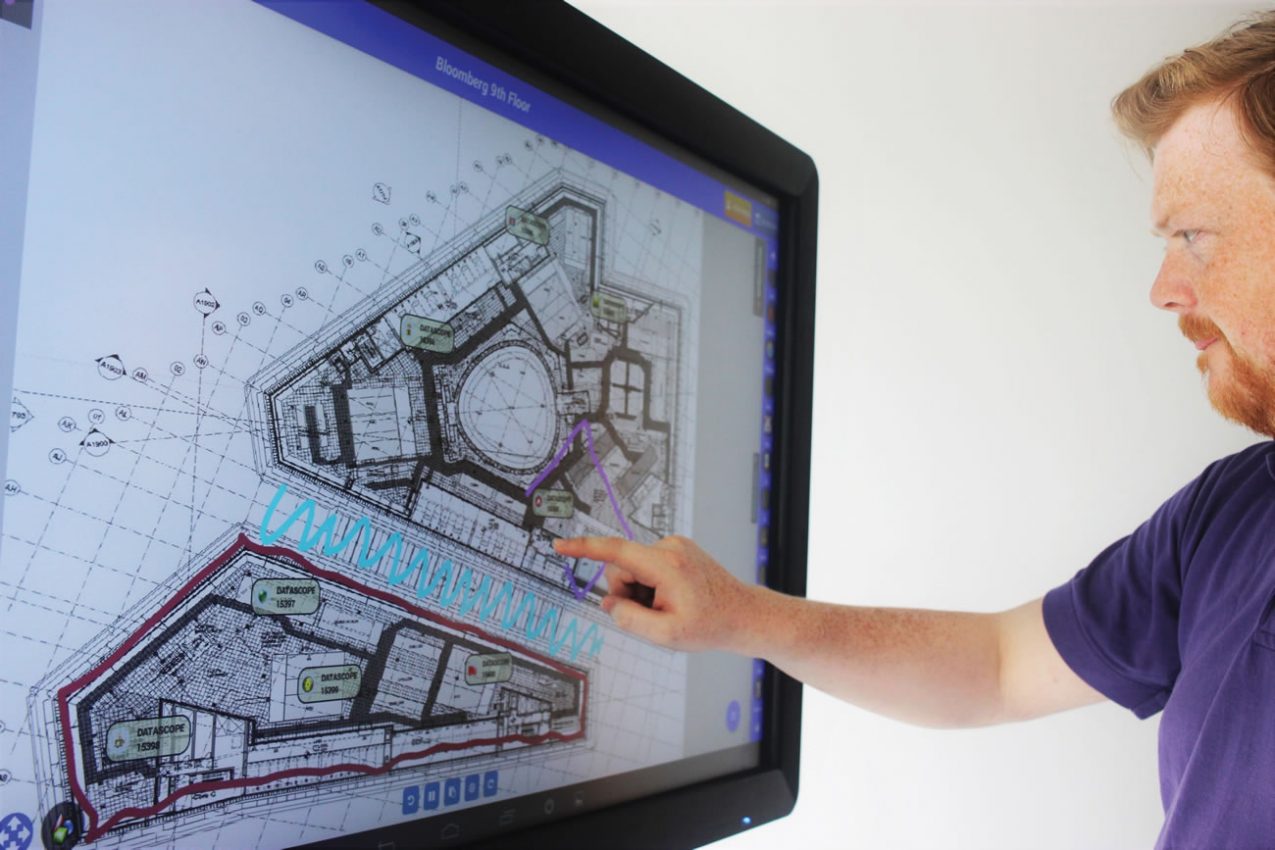
DataTouch shows the company at its best. Before the daily activity briefing, subcontractors mark their work areas, headcount, risks and needs on an interactive plan. In the meeting, teams can see overlapping work zones, material routes and high-risk activities. Afterwards, the system preserves the decisions and circulates the report.
On a Mace hyperscale data-centre project, the approach cut briefing time in half. The report went automatically to more than 100 stakeholders each day. The first failure in the old process was not usually a grand scheduling error. It was transcription: notes had to be written, scanned, reformatted and emailed, while the useful context cooled. DataTouch removed that handoff.
“Before DataScope, DABs meetings required someone to record and scan notes and manually email them out every day.”Jayson Mansell, Kier Construction
The copyable idea is almost comically plain: digitise the meeting at the moment decisions are made. Do not add a reporting chore after it. Put the plan where everyone can point at it, require each trade to declare its patch, then generate the audit trail from the conversation itself.
The truck is a data packet with wheels
Delivery management applies the same logic to logistics. Suppliers book a slot. The project controls which gates, times and vehicle types are available. Gate staff check arrivals in through an app. Driver training, vehicle standards and fleet accreditations can be checked before access. Reports expose lateness, volume, utilisation and estimated carbon impact.
At Oval Village, a large development beside the Kia Oval in London, MCG Construction recorded more than 26,000 planned delivery bookings, including 6,938 in 2024. The Gamuda Australia and Laing O’Rourke consortium logged almost 15,000 bookings across five Sydney Metro West sites after roughly a year. Those numbers are not glamorous, which is precisely why they persuade. A booking system proves itself one lorry at a time.
In August 2026, DataScope added Mission Zero accreditation to the booking workflow, alongside the established use of FORS and CLOCS checks. The change is strategically tidy: compliance stops being a spreadsheet the gate team consults and becomes a property of the booking. The company also joined CLOCS as a Delivery Partner in 2025.
The customer changes the product
DataScope’s case studies repeatedly begin with a customer bringing it a stubborn workflow. Berkeley Homes needed RAMS documents uploaded, reviewed, approved and tracked through project-specific routes. Mace needed social-value data from attendance records turned into a consistent monthly report across 18 projects. The latter saved up to two days of manipulation and analysis per month on some projects.
Mace also asked for an electronic riser-management system at Stratford Waterfront. BCEI’s relationship began with daily coordination in Santiago in 2020, then spread across data-centre campuses from Brussels and Frankfurt to Jakarta, Chicago and Austin. In March 2026, BCEI signed a global enterprise agreement for the full suite. The pattern is land, configure, prove, expand.
The familiar alternative
- Separate access, safety and planning tools
- Spreadsheets between systems
- Reports assembled after the event
- Support split across vendors
DataScope’s wager
- One worker and project record
- Workflows linked at the point of action
- Reports produced by normal use
- Software, hardware and service together
This is where DataScope sits in the market. Procore, Autodesk Construction Cloud and Oracle Aconex offer broad platforms with enormous ecosystems. Specialist vendors go deeper in individual categories. DataScope’s wedge is the connected operational layer: more site-specific than a general document platform, broader than a turnstile or delivery-booking point product, and backed by in-house deployment.
What buyers are really paying for
DataTouch packages run annually or for the term of a project, from a small-project tier through core and professional versions; enterprise deals are priced individually. Unlimited users feature across those tiers, while the number of subcontractors, projects, touchscreens and level of account support change. Hardware, setup, training and site service deepen the commercial relationship.
That makes the business a mixture of SaaS and managed operational infrastructure. BGF invested an undisclosed amount in September 2024 to support international growth, product development and sales. At the time, DataScope said it employed more than 120 people and had projects in 25 countries. The company now says it serves more than 700 customers, while its LinkedIn page lists about 125 employees.
The newer appointments reveal the next move. North American sales leadership arrived in late 2025. BCEI provided a global data-centre anchor in 2026. A Head of Product and a Product Lead for AI and Logistics followed. The sensible opportunity for AI here is not a chatbot wearing a hard hat. It is pattern detection: missed steps, unusual fatigue, recurring delivery delays, risky overlaps and exceptions worth a manager’s attention.
The product is not the dashboard. The product is a better decision made before the truck, trade or hazard arrives.
The difficult bit is still human
A connected system works only if the people nearest the work use it. DataScope’s Sydney case study credits an engaged project team and short training sessions for suppliers and subcontractors. That is the condition hidden beneath every shiny metric. If booking rules are optional, work zones are not declared, permits live elsewhere or managers tolerate parallel spreadsheets, the common record quickly becomes another partial record.
The model is also a poorer fit for small, simple sites that do not have enough coordination cost to justify configuration, training or hardware. It weakens when a contractor already has a deeply adopted platform covering the same operational workflows, or when connectivity, device access and data governance prevent consistent daily use. Bespoke configuration can be an advantage, but too much of it risks turning a shared platform into a collection of client exceptions.
Still, DataScope understands a durable truth about construction: the grand plan is rarely where the day is won. The day is won at the gate, in the briefing room, beside the loading bay and during the permit check. By making those ordinary decisions visible and reusable, the company has built a place for itself between the boots and the boardroom.