A construction company can know exactly how much concrete arrived on Tuesday and still be unsure what the project will earn on Friday. The delivery sits in one system, the purchase order in another, the subcontract variation in somebody’s inbox and the forecast in the commercial manager’s heroic spreadsheet. By month-end, finance is not closing the books so much as conducting an archaeological dig.
Xpedeon sells an escape from that dig. Its cloud software connects the awkward, consequential machinery of a construction business: budgets, job costs, contracts, procurement, inventory, plant, invoices, payroll, customer records and mobile site activity. It is ERP, but with the vocabulary of a quantity surveyor. Retentions, valuations, variations and cost-value reconciliation are not custom fields added later; they are the point.
The company behind it, Algorithms Software Private Limited, began in Mumbai in 1994. Founders Janak and Seema Vakharia still run the business as chief executive and chief operating officer. Its public footprint now stretches across India, Britain, Ireland and the Gulf, with a push into North America and Asia-Pacific. LinkedIn lists more than 20,000 users and a workforce in the 51-to-200 range. The supplied company estimate puts the team around 120.
The long buildThirty years is the feature
Vertical software has an unfashionable advantage: scar tissue. Xpedeon’s product reflects three decades of watching projects behave badly in familiar ways. Site teams move quickly; approvals do not. Materials arrive without clean paperwork. A variation is agreed operationally before it is priced commercially. Payroll knows who worked, but the project ledger learns the cost later. Each gap is small enough to tolerate until hundreds of them become a margin problem.
Xpedeon did not simply drag its 1990s product into a browser. The company says it rebuilt the platform from the ground up in 2006, added mobility in 2015 and accelerated a cloud-native SaaS transition during the pandemic in 2020. That chronology matters. Cloud delivery made international expansion and continuous updates easier, but the underlying selling point remained the accumulated model of how contractors actually buy, build, certify, bill and report.
For roughly 28 years, the company was bootstrapped. Norwest Venture Partners arrived in December 2022 as the first institutional investor. The announced Series A was reported at up to $10 million, with money earmarked for geographic expansion and deeper BIM and AI/ML capability. It was a late venture round by startup standards and an early one by the standards of a durable family-built software company.
The spreadsheet was first to fail
The sharpest explanation of Xpedeon comes from its customers’ “before” pictures. JN Bentley, the British civil-engineering contractor, had old systems and manual work that could not support a plan to double in three years. SRR Projects was operating more than 18 live sites while wrestling with slow payroll, invoicing and cross-department data handling. Sobha Group wanted its customer relationship system and finance operation to stop asking people to enter the same information twice.
What failed first was not usually a server. It was confidence. When procurement, site and finance records diverge, managers spend time checking the numbers before they can act on them. A late invoice is visible; the hours lost proving why it is late are not. Xpedeon’s intervention is basic in theory and demanding in practice: create one transaction path, configure it around the contractor’s approval rules, then make every downstream function reuse the data.
The reported results are customer case-study figures, not audited experiments, but they show what buyers hoped to purchase. JN Bentley says it doubled turnover in 24 months, a year ahead of its target, while reducing operational costs by 25 percent. Sobha reports that its CRM integration saved more than 100 person-days in one quarter, created more than 1,300 customer records automatically and processed more than 10,000 demand letters without manual entry. SRR reports fivefold productivity, 75 percent fewer invoicing delays and payroll turnaround that was 90 percent faster.
The recurring trigger was growth. Customers changed their minds when the cost of keeping familiar systems exceeded the disruption of replacing them. For Lovell Homes, the backdrop was limited spend visibility across £200 million in annual transactions. For Navayuga Engineering, separate finance and operations systems left budgeting, contracts and other work manual. For Greencore Homes, the attraction included reports that behaved enough like Excel to feel familiar without exporting the data back into a spreadsheet.
The product mapOne ledger, many hard hats
Xpedeon’s core buyer is not “construction” in the abstract. It serves general contractors, civil engineers, specialist contractors, housebuilders, property developers and engineer-to-order manufacturers. Their workflows overlap, but they do not match. A housebuilder cares about land, sales, handover and customer care. A specialist contractor cares about labour, packages, applications and retention. An offsite manufacturer needs bills of materials, revisions, production tracking and installation.
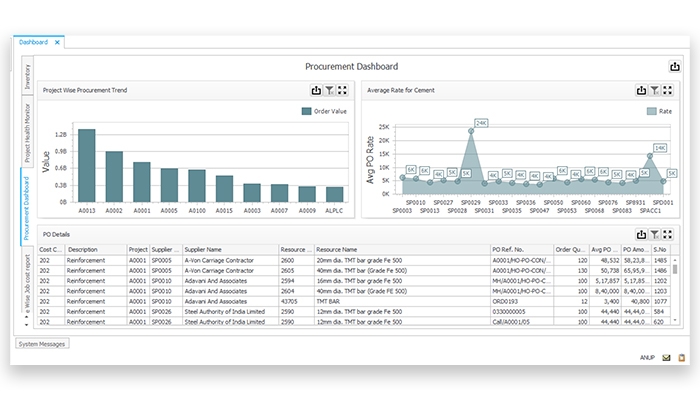
The platform stretches across those variants. Commercial teams get job costing, budgets, CVR, contracts, variations and valuations. Finance gets multi-company, multi-currency accounting and project-level reporting. Procurement teams can run requisitions, requests for quotation, purchase orders, goods receipts and three-way invoice matching. Site users get mobile forms, approvals and equipment records. HR and payroll share labour information with the job cost. Suppliers and subcontractors can trade through portals rather than email chains.
This breadth is Xpedeon’s clearest difference from point products. Procore is strongly associated with field collaboration and project delivery. Oracle Aconex is known for document control. Sage Intacct is finance-led. COINS, Trimble Viewpoint, CMiC, 4PS, IFS and Acumatica sit closer to Xpedeon’s all-in-one territory. Generic suites from SAP, Oracle and Microsoft bring scale and ecosystems, but often require construction-specific configuration or partners.
Xpedeon’s argument is that integration should be native enough to disappear. A goods receipt should update committed cost; a timesheet should reach payroll and the project; a variation should remain visible until it is priced, approved and billed. Fewer joins mean fewer support tickets and fewer opportunities for context to vanish between systems. The company backs the enterprise pitch with ISO 27001, 27017, 27018 and 27701 certifications, plus SOC 2 Type II compliance announced in 2025.
The economicsThe price is hidden; the work is not
Xpedeon does not publish a rate card. That is normal for enterprise ERP and still inconvenient for buyers. Cost will vary with users, companies, countries, modules, migration, integrations, configuration, training and support. The honest budget is larger than the subscription: internal process mapping, data cleanup, testing, champions on each team and the temporary productivity dip of changing how work gets approved.
The customer lesson worth copying is to begin with a costly broken flow, not a software catalogue. Sobha tied CRM records to finance. SRR attacked payroll and invoicing. JN Bentley standardised a system used by employees, joint ventures and suppliers. Greencore prioritised reports, approval flow, mobile use and training. Each case gave the implementation a practical test: did this remove re-entry, speed a cycle or reveal a cost earlier?
The copyable play
Map one transaction from site to ledger. Count every handoff, duplicate entry, approval wait and spreadsheet reconciliation. Set a baseline, name an owner and make the first rollout prove a measurable cycle-time or accuracy gain before expanding the platform.
The approach is a poor fit when a contractor is small, its processes are genuinely simple or its people will not change them. A lightweight accounting package plus focused project tools may be cheaper and faster. It also struggles when leadership demands heavy customisation but refuses to standardise data, when source records are too dirty to migrate, or when site connectivity and training are afterthoughts. One platform can remove technical silos; it cannot settle organisational arguments by itself.
That limitation explains Xpedeon’s market position. It is not a self-serve app for a five-person builder, and it is not trying to be a design suite. It sits where operational complexity has become expensive enough to justify an enterprise change programme - especially for contractors and developers running many projects, legal entities, currencies, subcontractors and compliance regimes.
Thirty-two years after its founding, Xpedeon’s idea is almost stubbornly plain: the numbers used to build should be the numbers used to buy, pay, forecast and report. Construction has plenty of spectacular technology at the edge - drones, models, scanners and cameras. Xpedeon works on the less photogenic middle, where an approval becomes an order, an order becomes a cost and a cost becomes the truth about a project. That is where the margin usually goes missing.