Richard Nelson sold his house to start a roofing business that would eventually ask people to spend less time visiting houses. There is a pleasing circularity to this. The asset he gave up was protected by the very thing he had spent years installing, measuring and selling. Roofr, the company he co-founded, would begin by helping homeowners find contractors, then turn toward the daily business of the contractors themselves.
For Nelson, known publicly as Richy, the roof had been a workplace long before it became a software opportunity. His grandfather, uncle and father were roofers. At 12, he joined the family trade. His professional education began with bundles of material and summer days on job sites. A roof was something you had to finish.
He would later describe a company that connected the business around that work: measurements, estimates, proposals, and eventually the steps through to payment. The ambition grew considerably. Its starting point remained familiar. He had done the job, and then he had tried to sell it.
A family business, with altitude
Nelson progressed from carrying bundles to installing roofs. In his mid-twenties, he took a sales position at a larger roofing company. That move changed his view of the trade. An installer works on the roof in front of him. A salesperson also encounters the machinery around it: the information needed for an estimate, the proposal a homeowner must understand, the time that disappears before anyone agrees to the work.
The larger contractor was in Toronto. Nelson had spent nearly 12 years in the family business before joining it. His account of this period returns to inefficiency, and to the cost of that inefficiency for both sides of a sale. Homeowners struggled to identify good roofers. Contractors lacked straightforward digital tools. Knowing how to put on a roof did not automatically make the business surrounding it run smoothly.
There was an awkward early audience for his proposed solution. Some members of his own roofing family were skeptical. Familiarity with the trade gave him insight; it did not grant him automatic agreement. The future software founder still had to explain why someone accustomed to a tape measure should change a working habit.
Selling the house, learning the pitch
His personal commitment was considerable. “So I decided to quit my job, sell my house, and put everything I had into RoofR.” It is an unusually literal answer to the question of whether a founder has invested in the business.
Roofr dates its beginning to 2016. Nelson partnered with Kevin Redman, the technical co-founder and CTO; an early account also names Zach Melo among the founding partners. The initial service was a marketplace, matching homeowners with contractors. Nelson brought his knowledge of roofing into a company that now needed to learn the habits of another industry: venture-backed technology.
Toronto’s DMZ helped with introductions to investors and preparation for Y Combinator. Other founders rehearsed interviews with the team. Roofr entered Y Combinator’s Summer 2017 batch. The connection between the two programs matters more than the badges alone: preparation preceded the meeting, and experienced people made themselves useful before the outcome was known.
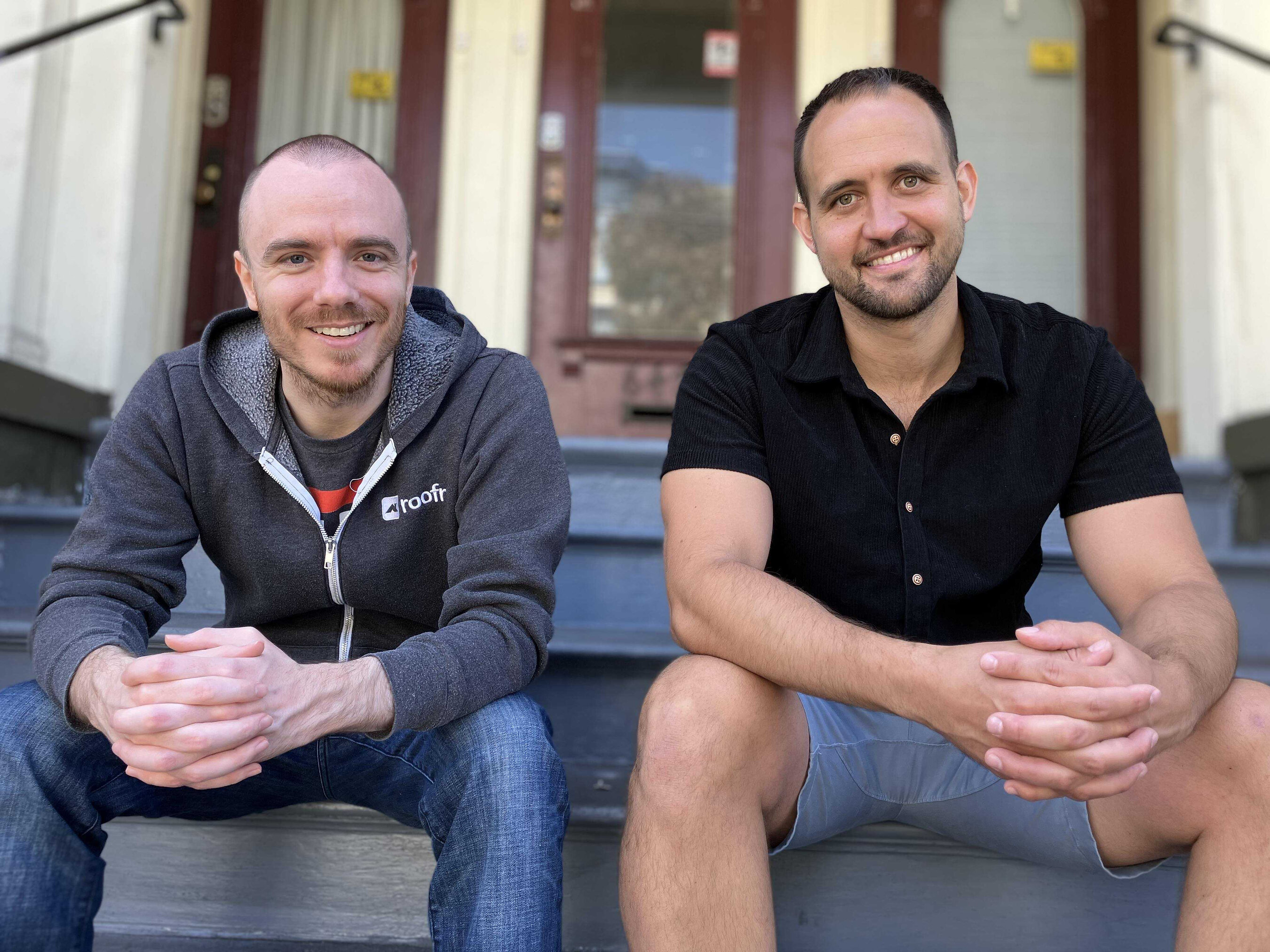
In its early Ontario operation, Roofr offered homeowners free access and charged contractors after a job. The company was reporting $200,000 in gross merchandising volume in an October 2017 account. California was the next intended market. Those figures belonged to an early marketplace, a useful reminder that the company Nelson runs today was reached through several versions of the original idea.
The free tool that changed the question
By February 2019, Roofr had announced $4 million in seed funding led by Crosslink Capital. The service used aerial imagery to produce an initial roofing estimate, then connected the homeowner with a vetted contractor. A visit and inspection still followed before the final proposal. Software helped open the conversation; the physical roof continued to have the last word.
The marketplace had a practical problem. It was finding homeowners without enough roofers to meet the demand. Nelson’s team offered contractors a reason to come closer: a free tool for measuring roofs from aerial imagery. Acquiring the supply side of the marketplace led them toward something contractors could use independently of the homeowner introduction.
Roofr announced that measurement tool in May 2019, following a demonstration at the International Roofing Expo in Nashville. Contractors could trace edges, assign slope and identify roof features. They could also upload drone images or blueprints. The resulting report recorded area, pitch, direction and edge lengths, information needed to calculate materials and prepare a quote.
The offer addressed a recognizable expense. Nelson said roofers were spending thousands of dollars a year on measurement software. A free alternative gave them something concrete to evaluate. It also changed Roofr’s relationship with the contractor: the company could help with work already on the desk, regardless of where the customer had come from.
Follow the contractor’s day
- 01Find the jobThe original homeowner marketplace
- 02Measure the roofAerial imagery and roof reports
- 03Make the proposalEstimates and digital signatures
- 04Connect the businessCRM, invoicing and payments
Following the job beyond the estimate
In May 2021, Roofr announced a further $4.25 million, led by Bullpen Capital. The announcement described the company’s move toward software as a service for roofers. It said customer retention and satisfaction had improved after that change in focus. Nelson and Redman were building a sales toolbox: measurements, estimates and proposals that belonged together.
This was a consequential adjustment for someone whose original business had helped arrange a match. A successful introduction is one event. A contractor’s business contains many more. Roofr’s opportunity expanded as it attended to those adjacent tasks, each of which had to fit the pace and practical requirements of the trade.
“Our vision is to become the end-to-end operating software for a roofer where they can manage their entire business”
Richard Nelson, on Roofr’s direction
The CRM arrived in 2023. That October, Roofr announced $23.5 million in Series A+ funding led by Vertical Venture Partners, with ABC Supply among the participants. Job boards, tasks, workflows and analytics were part of the newly launched product. Payment processing and material purchasing were on the development agenda.
A supplier’s involvement added a particular connection to Nelson’s software plans. ABC Supply sells roofing materials, the physical goods that estimates eventually have to become. Its investment linked the platform’s development with a company already involved in contractors’ purchasing. The proposal on a screen and the order for a job were becoming parts of the same commercial conversation.
A larger company, the same conversation
In January 2025, Roofr announced a Series B led by TCV, with ABC Supply participating again. The company reported more than 12,000 roofing companies using its platform and a team of more than 150 people. Those are dated milestones: a picture of the business at the announcement, rather than a running counter.
Roofing companies using Roofr when it announced its Series B.
The announcement described customer conversations in roofing Facebook groups, calls for feedback and trade-show meetings. Nelson’s public posts show a similar emphasis. He has written about meeting a contractor at the International Roofing Expo and about the value of doing extra work for individual customers, even when the financial justification is less immediately obvious.
“We go above and beyond with our customers at Roofr,” he wrote. In an expanding software company, that belief has an operational consequence. More customers mean more conversations to organize, more product requests to weigh and more opportunities for an apparently small inconvenience to become someone else’s recurring afternoon problem.
Nelson has also returned to the founder community that helped him. By 2021, he was a DMZ Alumni-in-Residence, advising other startups. He described helping Turing Labs with its Y Combinator journey. Experience acquired in a roofing company and then a software company had become something he could pass to the next founder.
The mission in Roofr’s Y Combinator profile reaches beyond the contractor: access to an affordable roof for every family. That goal gives the expanding software business a demanding test. Improving a workflow has to matter somewhere outside the workflow. A contractor needs to understand a job, explain the cost and carry it through. Nelson’s company can supply tools for those steps; its customers still supply the judgment and the work. His years in the trade give him plenty of reason to understand the distinction.
The homeowner at the other end
In his 2026 industry outlook, Nelson described contractors facing pressure on margins, material costs and labor availability. He pointed toward automation and software that connects more of a business. His interest in AI concerned practical work, including voice agents and measurements, rather than an abstract contest over who could attach the newest term to a product.
Then, in July 2026, he published an essay about the homeowner experience. Roofr had surveyed 292 people who had recently hired a roofer. Nelson used the responses to argue that technology should improve proposals, responsiveness and payment. This was company research, presented by the CEO of a software vendor. It also revealed where he wanted the argument to land: with the person hiring the roofer.
Trust reaches beyond the shingles
A homeowner may never see the software behind an estimate. They will see whether the proposal makes sense and whether someone replies. That is where Nelson’s earlier job in sales meets his current one. A tool has to travel through the contractor’s working day before its value reaches the household paying for the roof.
He began by joining a family business. He later sold a home to build a different kind of business around the same trade. The distance between those two decisions contains the thread of his career: learning the work, noticing what delays it, and persuading people that a familiar job can be organized another way. There are still shingles to install. Nelson has given himself the considerable task of improving what happens around them.