In the most useful corporate pivots, the first business leaves behind a clue. ECI Software Solutions began in 1999 as an online shop for reams of paper, pens and the other beige necessities of office life. The retailer worked. But its founders saw more leverage in the machinery behind the storefront: software that could help independent office-products dealers sell online and run their businesses. The inventory moved offstage; the operating system became the show.
That reversal explains the ECI of today. Based in Westlake, Texas, the private company is not one monolithic ERP suite. It is a cabinet of specialized systems for the parts of the economy that still quote jobs, schedule crews, count pallets, cut metal, deliver lumber, service refrigeration units and chase warranty claims. ECI says 25,000 customers and 250,000 users in more than 90 countries now depend on those systems.
The pivot also came with a useful bit of humility. OnlineOfficeSupplies.com had entered the dot-com race with a consumer storefront, but independent dealers wanted access to the technology. Selling them software meant ECI could stop competing with the very businesses it hoped to serve. Early purchases of the DDMS and Progress software companies gave the new strategy a base in office products. The company cycled through names, from eCommerce Industries to ECI2 and finally ECI Software Solutions, while the original retail identity faded. The customer stayed roughly the same: an owner-led company trying to keep up with a much larger rival.
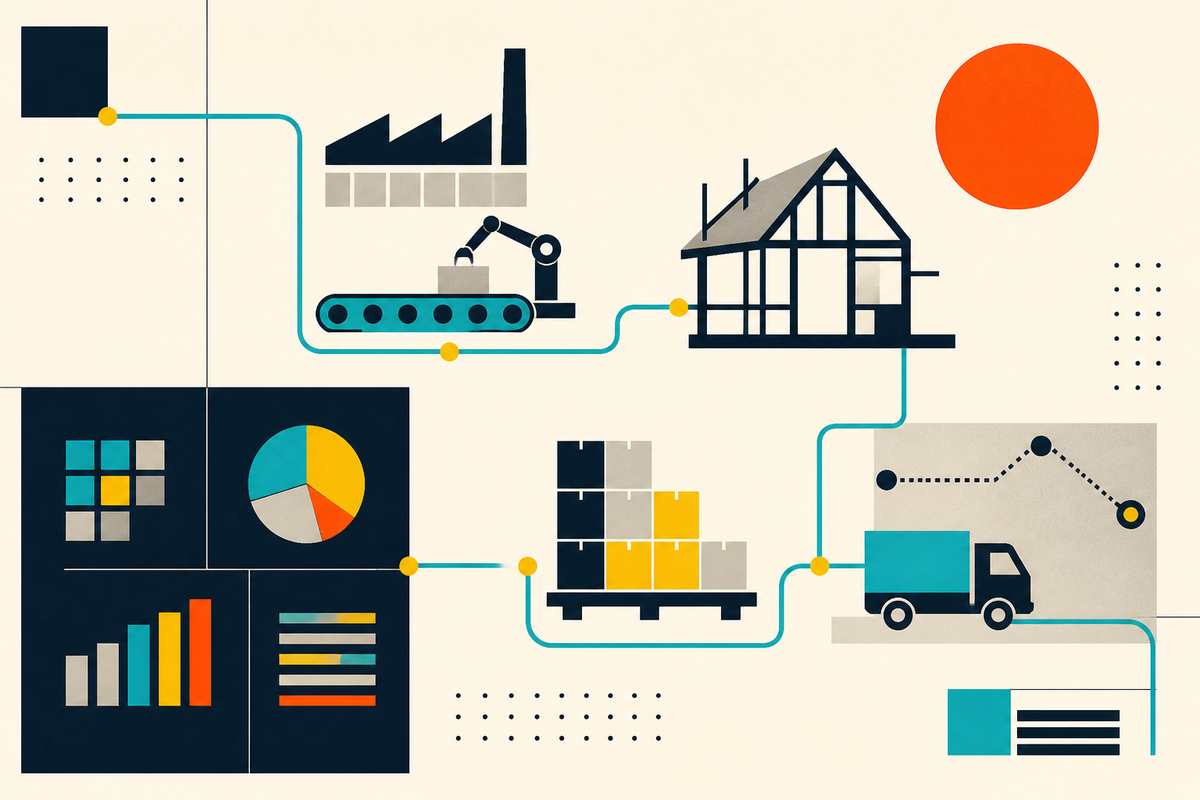
A portfolio, not a product
Ask what ECI sells and the honest answer starts with another question: What kind of work do you do? A high-mix machine shop may meet JobBOSS², with quoting, scheduling, shop-floor control and real-time job costing. A discrete manufacturer may be pointed to M1. A food, chemical or cosmetics producer, where batches and traceability matter, is closer to Deacom. None of these is merely a different skin on the same generic application. They have separate histories and assumptions about how work moves.
The same pattern repeats beyond the factory. MarkSystems manages production homebuilding; Bolt organizes trade contractors; Lasso CRM, LotVue, Insearch and AvidCX follow a buyer from inquiry to lot selection and post-sale feedback. Spruce knows lumber and building-material supply. e-automate handles the contracts, meters and service calls of an office-technology dealer. GlobalEdge connects field-service dispatch, parts, job costing and financials. EvolutionX puts a B2B storefront in front of distributors.
This breadth changes what “customer” means. The daily user might be a controller closing the month, an estimator deciding whether a job can make money, a scheduler staring at machine capacity, a dispatcher rerouting a technician or a salesperson checking which lots remain in a new community. The buyer is usually not shopping for technology as an abstract improvement. The business has outgrown QuickBooks and spreadsheets, inherited a dated system, opened another location or lost confidence in its numbers. ERP enters when coordination becomes the constraint.
Around the industry products sits a connective layer: payments, ecommerce, business intelligence, automated alerts, proof of delivery, advanced planning and scheduling, and manufacturing execution. The ambition is end-to-end coverage without forcing every customer into an end-to-end replacement on day one.
“ECI is singularly focused on and dedicated to helping our SMB customers get business done.”Trevor Gruenewald, chairman and CEO
The problem is the exception
ERP sounds like accounting with more tabs. In practice, its value appears when ordinary work stops being ordinary. A rush order steals material from another job. A homebuyer changes a cabinet selection after purchasing has issued the order. A technician discovers the wrong part in the van. A lumber delivery arrives without a clean signature. Each exception can split information among a spreadsheet, an inbox, a whiteboard and someone's memory.
ECI's products try to put the operational and financial versions of the business in the same place. Inventory changes can reach purchasing. A production delay can affect a promise date. A completed service call can become an invoice. A homebuyer complaint can be measured across communities. The result is less duplicate entry, earlier warnings and job costing that reflects what happened rather than what the estimate hoped would happen.
This is also why replacing ERP is uncomfortable. The system accumulates years of prices, parts, customers and odd local rules. ECI competes partly on the promise that industry expertise lowers the translation burden. A buyer does not need to explain from scratch what a bill of materials, lot release, meter reading or proof-of-delivery workflow means.
Consider the machine shop. A generic finance package can record what steel cost, but it may not know the difference between estimated setup time and actual setup time, or why a queue at one work center threatens three delivery dates. JobBOSS² is meant to carry that context from quote through production. In a process plant, Deacom must instead preserve lot genealogy, quality records and formulas. In homebuilding, MarkSystems coordinates a structure that is sold before it is finished and assembled by a shifting cast of trades. “Industry-specific” is not decoration here; it is the data model.
The acquisition machine
ECI's breadth was assembled as much as it was coded. The company reports 57 acquisitions. Under CEO Trevor Gruenewald, who joined in 2009 and took the top job in 2021, mergers and acquisitions remain part of product strategy. Apax funds first invested in 2017. Leonard Green & Partners bought a majority stake in 2020. In 2025, Apax increased its holding to become a co-control owner with Leonard Green, while GIC made a substantial new investment. Terms were not disclosed.
The logic is visible in recent deals. Amper, acquired in December 2025, adds real-time shop-floor monitoring. Drypowder, acquired in March 2026, adds accounts-receivable automation and digital payment workflows. In August, Prima brought cloud ERP and ecommerce for office-supply dealers in Britain, Ireland and the United States. That last deal loops back neatly to ECI's first trade.
Earlier acquisitions supplied many of the names now printed on ECI's product map: Shoptech and its E2 line, residential-construction specialist BuildTools, process-manufacturing vendor Deacom and device-management businesses that eventually fed Printanista. Each deal offers a shortcut into a customer community and a store of domain expertise. It also creates a long integration list. Authentication, reporting, payments, cloud hosting and data exchange become corporate responsibilities even when the application remains proudly specialized.
A portfolio strategy has a built-in tension. Buying a specialist preserves knowledge and customer trust; integrating it can produce a more useful ecosystem. But too much variety can confuse buyers and create technical seams. ECI's manufacturing catalog alone includes actively sold products and systems retained for existing customers. The company has to modernize the estate while keeping the workflows that made each product valuable.
AI with work boots on
ECI calls its approach “practical AI,” a phrase designed to lower the temperature. The use cases are narrow: help create a bill of materials, answer questions from ERP data, automate a manufacturing workflow, diagnose a service problem, identify homebuyer sentiment or generate ecommerce content. In April 2026, it expanded embedded capabilities in Deacom and JobBOSS². In May, it introduced AI assistance for GlobalEdge technicians and an insights layer for AvidCX.
That positioning fits the customer. A 40-person shop does not need an AI manifesto. It needs to quote faster without destroying margin, train a new planner, find a late order and keep a machine fed. ECI's advantage is access to structured operational context inside the system of record. Its risk is the same one facing every incumbent: useful automation depends on clean data, careful permissions and an interface employees will trust.
The company is also pushing AI into customer-facing work. AvidCX Insights looks for patterns in homebuyer feedback before a reputation problem spreads. The Homebuilder Sales & Marketing Suite connects Lasso CRM, LotVue, Insearch and AvidCX; ECI says products in that bundle have supported more than 300,000 closings. In field service, AI Assist is designed to help GlobalEdge technicians troubleshoot equipment. These are modest jobs compared with the promise of an autonomous enterprise, but they are measurable. A first-time fix, a recovered lead or a warning caught before shipment has a dollar value.
The edge
Deep trade vocabulary, sticky workflows and a wide set of adjacent applications make ECI difficult to replace once it becomes operational memory.
The test
Turn dozens of acquired products into a coherent cloud and AI ecosystem without flattening the specialization customers came for.
Where ECI sits
At one end of the ERP market are horizontal suites such as Microsoft Dynamics 365, Oracle NetSuite and Sage. They offer broad platforms, large partner networks and familiar corporate tooling. At the other end are point solutions that solve one job exceptionally well. ECI occupies the busy middle: a scaled owner of vertical systems, broad enough to cover a business end to end but specialized enough to know why a job shop is not a process plant.
Its most direct comparisons change by aisle. Epicor and Infor meet it across manufacturing and distribution. Global Shop Solutions, ProShop and DELMIAWorks appear in factories. Buildertrend and Buildxact appear in construction. ServiceTitan and Acumatica can enter field-service conversations. ECI's case is not that one corporate brand beats every alternative. It is that one of its purpose-built products may require fewer compromises for a particular trade.
There are costs to that choice. A broad suite may be easier to recruit for, easier to connect to a corporate data stack and familiar to an outside accountant. A point solution may feel newer and faster. ECI sits between them with decades-old product roots, modern cloud ambitions and a private-equity-backed appetite for consolidation. Prospective customers should look past the parent logo and evaluate the actual product: whether it is actively sold, how upgrades work, which modules are native, what integrations cost and how data can be exported. “ECI” describes the owner; JobBOSS², M1, Deacom, Spruce or e-automate describes the working relationship.
The business model follows the software: recurring cloud subscriptions, implementation, training and support, with more revenue available from payments, ecommerce and specialized add-ons. The private company does not publish audited revenue or a valuation. What it does publish is scale: 2,100 employees across 20 offices, a footprint in 90-plus countries and a portfolio that keeps widening.
Inside that expansion, ECI uses the acronym CODE for four stated values: Crave Greatness, Own the Outcome, Deliver Awesome and Embrace Community. Corporate slogans deserve skepticism, but there are external signals: the company reported Great Place to Work certification in eight countries in 2026, including an eighth consecutive U.S. recognition. Its Ambassador Community gives selected customers access to roadmaps and peers, a practical way to keep industry voices near product decisions as the organization grows farther from its startup roots.
There is a pleasing circularity to the story. The internet retailer that once tried to help independents compete with office superstores now sells software meant to help independent businesses compete with larger enterprises. The products are less visible than the businesses they run. That is the point. When an ERP works, the lumber gets delivered, the machine stays scheduled and the homeowner receives an answer. The software disappears into a day that went according to plan.