BREAKING Michael Ding raises $35M Series A to power how the world gets built Bobyard 2.0 launched April 2026 - Multi-Measure AI now live for contractors Automates 70% of construction takeoffs with proprietary computer vision Stanford dropout. Teenage contractor. Blueprint whisperer. Customers add $1.1M average annual revenue per estimator using Bobyard 8VC leads Series A - investors who looked to build this themselves found Ding doing it first BREAKING Michael Ding raises $35M Series A to power how the world gets built Bobyard 2.0 launched April 2026 - Multi-Measure AI now live for contractors Automates 70% of construction takeoffs with proprietary computer vision Stanford dropout. Teenage contractor. Blueprint whisperer. Customers add $1.1M average annual revenue per estimator using Bobyard 8VC leads Series A - investors who looked to build this themselves found Ding doing it first
Founder Profile • Construction AI
Michael Ding

"Got his contractor license as a teenager. Dropped out of Stanford. Now teaching machines to read blueprints - one $35M fundraise at a time."

Founder & CEO Bobyard Computer Vision AI San Francisco PearX S23
$35M Series A
70% Takeoff automated
5x More bids won
Michael Ding, Founder & CEO of Bobyard, with Pejman Nozad at Pear Studio
$35M Series A
Dec 2025
Cover Story

The Blueprint Whisperer

Somewhere between Cupertino and a construction jobsite, Michael Ding figured out that the hardest problem in a $1 trillion industry wasn't pouring concrete or managing crews - it was the spreadsheet. The hours-long, error-prone ritual of measuring drawings by hand and counting symbols one by one. He was still a teenager when he decided to fix it. So he got his California General Contractor license - not to build anything, but to understand everything.

That instinct - to go where the friction is, not where the glamour is - defines how Ding operates. When he applied to the Pear Competition as a Stanford freshman, he was 19 and already had a clearer picture of construction workflows than most industry veterans. Investors noticed. Pear VC noticed harder.

He dropped out of Stanford, joined PearX's S23 cohort, and started building Bobyard: an AI platform that uses computer vision and natural language processing to read blueprints the way an experienced estimator would - except in minutes, not days. His team includes computer vision PhDs and engineers that, by investor accounts, rival the best AI companies anywhere. He didn't just find people who could code; he found people who could teach machines to see.

By December 2025, Bobyard had raised $35 million in a Series A led by 8VC - the firm that had explored building something similar themselves before discovering Ding was already doing it, and doing it better. By April 2026, Bobyard 2.0 was live, introducing Multi-Measure (draw once, get area, perimeter, and volume simultaneously) and a unified AI workbench that finally let estimators stop bouncing between spreadsheets and blueprints. Hundreds of contractors were already using it. They were bidding five times more work. Adding over a million dollars a year in revenue per estimator.

The pitch isn't complexity. It's simplicity at scale. Ding has spoken at FutureScape USA about where technology and the built world converge - not as an outsider looking in, but as someone who already earned his place on the jobsite before he wrote a single line of production code.
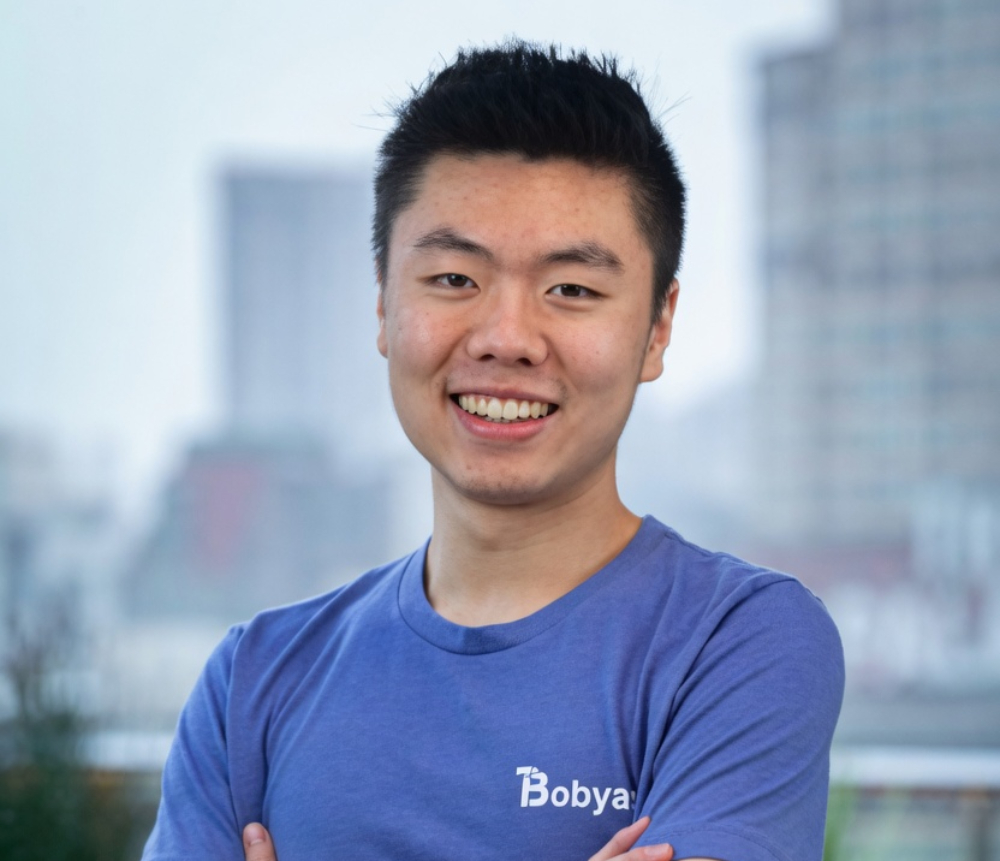
"We're solving some of the hardest problems in computer vision by teaching machines to understand blueprints."

- Michael Ding, Founder & CEO, Bobyard
Career Arc

From Cupertino to Constructor

Teenage Years
Earned his California General Contractor License - not to build, but to understand the workflows he'd eventually automate. Most teenagers were getting their driver's licenses.
2022
Enrolled at Stanford University as a computer science and AI student. Became one of the youngest to complete the university's advanced AI coursework. Already an award-winning mathematician. Already thinking about construction.
2022-2023
Applied to the Pear Competition as a Stanford freshman at 19. Investors described him as someone with a "walk through walls" mentality - remarkable ambition, focus, and technical depth. The kind of founder you back immediately.
2023
Dropped out of Stanford. Founded Bobyard. Joined PearX S23 accelerator cohort. Started teaching machines to read blueprints. Raised $3.5M seed round from Primary Venture Partners and Pear VC after Demo Day.
2023-2025
Built Bobyard's customer base to hundreds of contractors. Assembled a team of CV PhDs, top engineers, and high-performing salespeople. Customers started reporting 65% faster takeoffs and 5x more bids.
December 2025
Announced $35M Series A led by 8VC, with participation from Pear VC, Primary, Tishman Speyer, RXR, Caffeinated Capital, and Merrick Ventures. 8VC had explored building this themselves - they chose to back Ding instead.
April 2026
Launched Bobyard 2.0 - the platform "we always wanted to build." New Multi-Measure tool, unified AI workbench, material-centric takeoff. Expanding beyond landscaping into drywall, electrical, HVAC, plumbing, and framing.
By The Numbers

What Bobyard Actually Does

70%
Of quantity and material takeoff processes automated by Bobyard's computer vision
65%
Average reduction in takeoff time reported by Bobyard customers
5x
Increase in bid volume - contractors submit more work with the same team
$1.1M
Average additional annual revenue per estimator using the platform
How Michael Ding Built a $35M Company in 3 Years
🔧
Teenage years
Get contractor
license
🏫
Stanford
AI coursework
+ Pear entry
🚀
2023
Drop out.
Found Bobyard.
🫲
$3.5M
Seed round
Demo Day
📈
100s of
contractors
onboarded
💵
$35M
Series A
led by 8VC
🏗
2026+
All trades.
Full scale.
In His Words

What He's Actually Said

"We're solving some of the hardest problems in computer vision by teaching machines to understand blueprints."

Michael Ding - Bobyard Series A announcement

"Bobyard 2.0 is the platform we always wanted to build. Every change we made was driven by what our customers told us they needed to move faster, stay in control, and spend less time doing work that software should be doing for them."

Michael Ding - Bobyard 2.0 launch, April 2026

"Construction is one of the largest industries in the world, and it's been massively underserved by technology."

Michael Ding - LinkedIn, Bobyard 2.0 announcement

"This is an opportunity to push the boundaries of AI in a field that directly shapes the built environment."

Michael Ding - on Bobyard's mission and vision
Analysis

Why This Matters

The construction industry spends more than $1 trillion in the US alone, and the preconstruction phase - the bidding, measuring, estimating - has been almost entirely manual for decades. A landscaping contractor looking to win a new commercial project still sits down with a printed blueprint, a scale ruler, and a spreadsheet. Hours of careful counting. Days before a bid is ready. And if the measurements are off, so is the profit margin.

Ding identified something the industry had normalized: the bottleneck wasn't talent or capital. It was the front-end of every project. Before a single shovel hit the ground, someone had to translate static drawings into structured quantities. That someone was human. That process was slow, expensive, and error-prone.

What Bobyard does is specific: it trains computer vision models on trade-specific blueprints. Not generic document AI - actual models that know what a planting symbol looks like, what a drip irrigation line means, and how to distinguish pavers from concrete in a site plan. That specificity is the product. It's also the moat.

The 8VC Endorsement

Before backing Bobyard's Series A, 8VC had explored building a similar solution themselves. They looked. They couldn't find the right founder. Then they found Ding. The fact that one of the most technically sophisticated VC firms in the world considered building this - and instead chose to back him - says more than any fundraising announcement.

The choice to start with landscaping - rather than, say, commercial real estate or large-scale infrastructure - was deliberate. It's a fragmented, owner-operated market. Contractors are price-sensitive and time-strapped. The pain is acute. The tool-switching cost is low. And the word-of-mouth spreads fast when something actually works. By the time Bobyard announced its Series A, hundreds of these contractors were submitting bids five times faster.

Ding describes himself through action, not title. He's the founder who went to the jobsite first, who earned the credential before building the software, who worked at Pear Studio at 10pm while investors took notice. The '8VC obsesses over details that conceal enormous value' framing 8VC used to describe him reads less like a VC compliment and more like an observation: here is a person who found the thing everyone else walked past.

Bobyard 2.0 is the articulation of what all that attention to detail produces. Multi-Measure is the kind of feature that sounds simple but required years of model training to make reliable - draw one polygon and immediately get area, perimeter, and volume, already tied to material quantities. The unified AI workbench keeps human judgment in the loop for validation before anything commits to a bid. It's not trying to replace estimators. It's trying to make each estimator worth three.

The next frontier is obvious: every trade that still does this manually. Drywall. Electrical. HVAC. Plumbing. Framing. Each one a different set of symbols, a different type of drawing, a different workflow. Each one a new model to train. That's the work ahead - and it's the kind of work Ding trained for before most people knew construction tech was a category.

Field Notes

Six Things Worth Knowing

Contractor Before Coder

Got his California General Contractor license as a teenager - not to build houses, but to understand every workflow he'd eventually automate. Primary research before primary school was over.

Math Before Machines

Award-winning mathematician. History scholar. One of the youngest people to complete Stanford's advanced AI coursework. He came to computer vision from the theory side - which may be why his models actually work.

The 10pm Photo

The image of Ding with Pear VC's Pejman Nozad - taken at Pear Studio at 10pm - became a small piece of startup lore. Evidence of the grind, documented. Pear called it out specifically in their Series A post.

Cupertino Kid

Grew up in Cupertino, California - the city that birthed Apple. He chose not to make consumer products. He chose to make tools for people who pour concrete and plant trees. Deliberately unglamorous. Wildly effective.

8VC Almost Built This

Before backing Bobyard, 8VC had explored building a similar product themselves. They were looking for the right person. They found Ding. They invested instead. That's a different kind of validation.

Started with Landscaping

When you're building AI that reads blueprints, you could start with office towers or stadiums. Ding started with plant symbols and irrigation lines. The least glamorous entry point in construction. The fastest path to product-market fit.

Stack

Technology at Bobyard

Computer Vision NLP AI/ML React Django PostgreSQL Amazon AWS Google Cloud Platform Heroku Terraform AWS Analytics Google Analytics 4 Looker Segment HubSpot Procore IBM ILOG CPLEX Google Workspace Slack LinkedIn Marketing Google Ads Meta Ads
Spread It

Share This Profile