Imagine a subcontractor on Friday afternoon. The work is done, the invoice approved, the payroll approaching. On paper, business looks healthy. At the bank, the story is less charming. Construction has a peculiar talent for separating the moment a company earns money from the moment it can spend it. Constrafor has built its business around that separation.
- General contractors get contracts, insurance checks and invoice workflows in one place.
- Subcontractors can exchange eligible approved invoices for earlier cash, for a fee.
- Cru adds accounting automation and job-level financial visibility.
The interesting part is the combination. A document platform knows whether an agreement has been signed. A financing provider cares whether an invoice will be paid. Constrafor places those concerns within one business. Its bet is that the back office contains information useful enough to organize, and a payment delay costly enough to finance.
The paperwork that keeps the money waiting
For general contractors, Constrafor handles the administrative relationships surrounding a project: prequalification, contracts, certificates of insurance, invoices, payments and diversity procurement. The customer is a builder; the daily user may be the person chasing the builder’s missing documents. There is very little glamour in that distinction, which is precisely its appeal.
Contract management accepts existing templates, tracks versions and redlines, and collects electronic signatures. Prequalification uses a master form that can be adapted to different contractors’ requirements; subcontractors can use that service free. These are modest conveniences until someone must repeat them across dozens of trade partners. Then modest begins to look rather valuable.
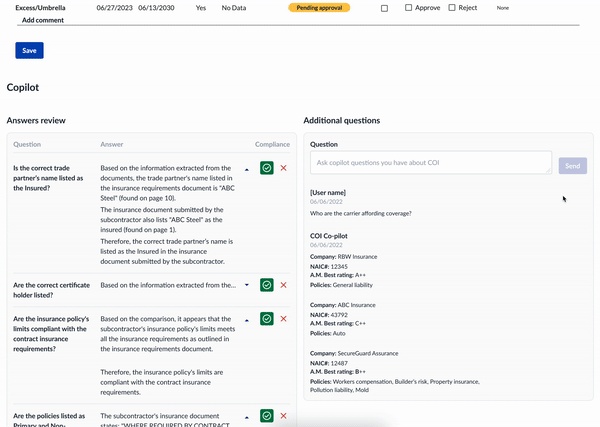
Insurance CoPilot, launched in July 2023, adds AI to the insurance workflow. Users choose the questions and requirements against which documents should be checked. The assistant returns compliance findings with supporting information, and people can correct its answers. There is a telling condition in the instructions: without requirements, CoPilot cannot run. Even artificial intelligence needs somebody to say what satisfactory looks like.
Customer evidence is appropriately untheatrical. McHugh’s published testimonial describes tailored contract workflows and better visibility. On Constrafor’s webinar page, M. B. Kahn risk manager Brad H. praises its willingness to “engage, listen and help solve our business specific challenges.” Those words suggest a product sold through accommodation as much as automation. Construction firms arrive with existing habits, templates and systems.
Constrafor accommodates those systems, too. Its integrations include Procore, Viewpoint Vista, Sage 300, Autodesk Construction Cloud and CMiC. Procore contract and insurance data can move between the platforms; matching contract numbers matter. This places Constrafor beside established construction software, where a new purchase must justify itself without asking everyone to start their working lives again.
“I needed a change and a way to make a difference.”
Anwar Ghauche / April 2022
Buying back the weeks
For subcontractors, the proposition is more immediate. Early Pay turns general-contractor-approved pay applications into working capital. The advertised sequence is a request, a reviewed offer, an electronic contract and a deposit within 48 hours after signing. Constrafor then works with the general contractor to collect payment. A receivable changes hands; the underlying construction payment cycle continues.
Speed has a tariff. Published Blue pricing lists a 0.4% weekly fee and a 1% upfront platform fee, without a monthly subscription. Gold and Platinum reduce those rates in return for subscription payments. The sensible question is how much time a contractor expects to buy, and what that time permits: payroll, materials, mobilization, perhaps another job.
What would the wait cost?
Simple illustration on the selected advanced amount. Excludes reserves, contract-specific adjustments and other possible charges. This is not an offer or an APR.
At an assumed $100,000 advance outstanding for eight weeks, that simple calculation produces $4,200 in fees. The arithmetic is illustrative; a signed financing offer determines the actual bill. If the extra cash earns less than it costs, haste has become an expensive hobby. A contractor with cheaper available bank credit has a comparison to make.
Eligibility narrows the proposition further. Early Pay requires approved invoices on active jobs. The GC partnership page says it excludes retainage invoices and currently does not operate in California. Approval and underwriting still matter. The service cannot make an unapproved bill eligible merely because its owner needs cash urgently.
There is an incentive on the other side of the table. Constrafor’s general-contractor partnership program advertises rebates, no startup charge and no required technology integration. The GC can offer faster payments without supplying the advance itself. As business design, that is useful: give the larger buyer a reason to help the smaller supplier participate.
A software company with a credit facility
Anwar Ghauche’s background combines civil engineering and operations research with financial-services experience and a Stanford MBA. Co-founder Douglas Reed brought construction-software experience. That pairing helps explain why Constrafor treats document management and working capital as neighboring problems. The company’s stated values include empathy, ownership and taking calculated risks - fitting aspirations for a business asking builders to trust both software and credit decisions.

Ghauche reported a revenue setback and revised origination; weak fintech valuations informed the 2023 SAFE choice. That episode makes the subsequent funding structure worth reading carefully.
In November 2024, Constrafor announced $14 million in Series A equity led by NFX alongside a $250 million credit facility from Wafra and Crestline. Equity supports the company; credit capacity supports financing. Treating the combined $264 million as an ordinary venture round would obscure what this business actually needs.
Credit capacity is not revenue, valuation or cash already lent.
The funding also creates an operational obligation. Writing useful software and deciding which receivables to finance require different skills. A product team can improve a confusing screen; a credit team must assess repayment risk. Constrafor’s leadership includes a chief credit officer as well as technology and product executives. That organizational choice follows the money.
From approved invoice to accurate books
Cru extends the approach into subcontractor financial operations. Its accounting product describes transaction categorization, reconciliation, job costing and cash forecasting, with people reviewing flagged work. Published pricing starts at $500 a month. The ambition is to understand the contractor’s finances continuously, rather than appear only when an invoice needs advancing.
For a reader, the idea to copy is concrete: connect a document to the decision it enables. Write the insurance requirement before automating its review. Match the contract identifier before syncing systems. Price the payment delay before financing it. Constrafor’s appeal rests on making those connections useful enough that a builder can return to building.