A recruitment agency can look prosperous on a spreadsheet and feel broke every Friday. Its contractors have done the work. Their timesheets have been approved. Payroll is due. The agency's corporate client, meanwhile, may not settle the invoice for another 45, 90 or even 120 days. Growth makes the mismatch worse: every new placement adds revenue, but also another wage that must leave the bank before the corresponding cash arrives.
Sonovate lives inside that delay. The Cardiff fintech advances money against eligible invoices, then wraps the loan in the clerical machinery needed to turn work into cash: client credit checks, contracts, online timesheets, billing, worker payments, collections, reconciliation and reporting. Its customers are recruitment agencies, consultancies, statement-of-work providers and labour marketplaces. They range from founders making their first contract placement to multinational groups with subsidiaries, export receivables and debtor books in the tens of millions.
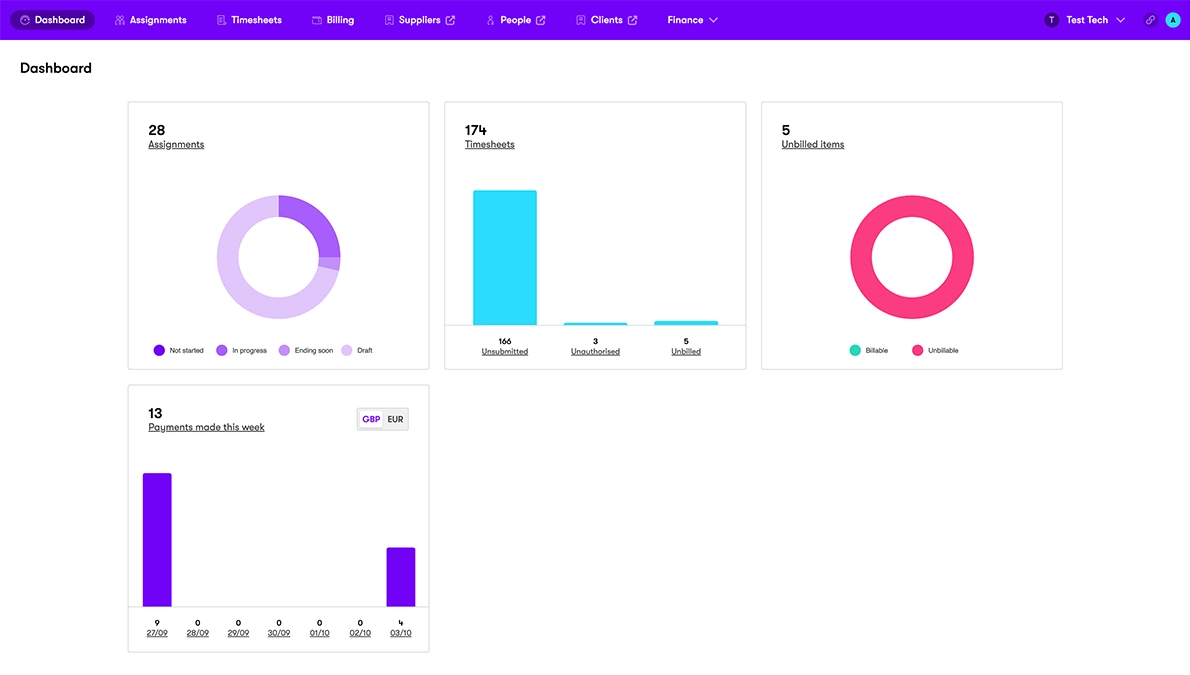
The company's proposition is not mysterious. It is useful because the problem is stubborn. A bank may see a young agency with no accounts, a concentrated client list and irregular weekly liabilities. Sonovate has spent a decade learning to see approved work, the creditworthiness of the end client and an invoice that can be financed. That specialist view is the product as much as the purple dashboard.
The first idea failed usefully
Richard Prime and Damon Chapple met the problem from inside recruitment. They left senior jobs at a large staffing firm and launched what Prime described in 2012 as a cloud platform for experienced recruiters starting independent companies. Sonovate dates its company story to 2013, when technology entrepreneur Paul Birch invested £4 million. The package tried to do everything a new agency needed.
It did not remain the plan. By 2014, the founders had concluded that the scalable opportunity was not another bundle of startup services. It was technology-driven funding. In Chapple's later account, the team realised it could deliver more value by building financial solutions around the people placing contractors. Put less politely: the original offer was broad; the cash-flow pain was acute. They followed the pain.
That decision answered what failed first and what changed their minds. Recruitment founders did need help launching, but the repeating constraint appeared after they won business. Traditional lenders did not understand the rhythm, while separate systems for timesheets, invoicing and payroll created more seams for mistakes. Sonovate narrowed its market and deepened the workflow.

The financing arrived in layers. PNC Bank supplied £10 million in 2015. Sonovate records £20 million across Series A and B rounds in 2016. A £110 million debt-and-equity package followed in 2019, led by M&G Investments and joined by MXB Holdings, Dawn Capital and Rocket Internet. By then, the company had financed more than £1 billion of invoices.
Money with an operating system attached
Invoice finance alone is old. Sonovate's differentiation is how narrowly it is fitted to contingent work. An agency uploads or creates a placement, checks the client, gathers an approved timesheet, raises the invoice and draws cash. The platform can pay the worker, track the receivable and handle collection. Customers can sync accounting data, see liabilities and cash allocations, and reconcile transactions. Xero certified the integration in 2023; Sonovate said more than 40 percent of its small and midsize customers used the accounting system.
For eligible facilities, Sonovate advertises advances of up to 100 percent, access to funds within 24 hours and 95 percent bad-debt protection. It supports international and multi-currency payments. Unlike a generic overdraft, capacity can rise with approved invoices. Unlike a pure software subscription, the platform brings the balance sheet needed to make the workflow consequential.
The business model combines funding economics and software-enabled service. Sonovate buys or advances against receivables and deducts a quoted fee or discount margin when an invoice is funded. Pricing is tailored rather than posted as a universal rate. Its materials stress transparent, usage-linked charges; some current customers also mention a platform fee. That distinction matters. A buyer should compare the total bill with the internal salaries, separate payroll tools, collection work, reserves, concentration limits and unused-facility charges that an alternative arrangement may require.
“With Sonovate, we don't need to hire 4-5 fixed salaries in back-office.”Ashley Lawrence, Trinnovo Group
Trinnovo illustrates the pitch. The recruitment group said its previous bank would advance only 60 percent in some situations and did not understand the broader business. After moving, its live contractor count rose from nine to 170, while its contract consultants grew from four to 36. This is a customer story, not a controlled experiment, but it identifies where the economics can work: the financing prevents growth from consuming cash, and the operating service prevents growth from consuming administrators.
At the other end, defence consultancy RC Fornax lacked the trading history banks wanted but quickly landed large orders with 90- or 120-day terms. Sonovate assessed the invoices and end clients, providing a bridge while the company grew from a standing start to £5 million in its first year. The first thing to break in these businesses is rarely demand. It is the working-capital structure beneath the demand.
The lender is becoming the work layer
Sonovate kept widening after it found the core. A Funding Only option arrived in 2018 for customers wanting more control of administration. In 2023 it released a rebuilt cloud-native, API-first platform and added finance for permanent-placement invoices. The reason for the latter was wonderfully untheoretical: customers asked. Agencies often run permanent and contract desks together, so funding only one side left an arbitrary hole.
Institutional capital enlarged the pipes. BNP Paribas and M&G backed a £165 million securitisation in 2022. The facility grew to £240 million in 2023 when Lloyds Bank joined. In March 2026, Sonovate announced a new £210 million, three-year facility supported by DZ BANK and M&G, with capital available across nine currencies. The facility is not revenue or valuation; it is lending capacity. That difference is easy to lose in startup funding headlines and essential to understanding this company.
Now comes a more ambitious extension. Wallets sit between funding and payout, showing what is available, committed and incoming. Agencies can schedule releases, retain eligible balances and potentially earn rebates. The Skills Marketplace, opening in phases, packages automation and AI-assisted “digital workers” around tasks such as onboarding, missing-timesheet chasing, credit monitoring, invoice exceptions, compliance and management reporting. Sonovate is explicitly avoiding the crowded promise of an AI recruiter. It wants the repetitive work behind the recruiter.
That move has logic and risk. Sonovate already sees the timesheets, invoices, payment behaviour and funding limits that make those tasks useful. But a funding relationship creates high expectations for accuracy, evidence and human review. An incorrect social post is embarrassing. An incorrect worker payment or compliance verdict is operationally expensive. The marketplace's emphasis on exception flags and review points suggests the company understands the difference.
What a founder can steal from the playbook
The copyable lesson is not “start an invoice-finance company.” It is to inspect the lag between value being created and cash being received. Prime and Chapple knew recruitment well enough to notice that the sale was not the end of the workflow. Winning more placements increased the need for capital, credit judgment and administration. They built around the constraint that intensified with success.
There are conditions. The model needs verifiable business invoices and creditworthy end clients. It fits sectors where payment timing causes a real capital gap and where process data can reduce risk. It is less compelling for a company outside contingent labour, a cash-rich agency that can self-fund cheaply, or a business whose invoices are disputed, old or concentrated in unacceptable debtors. The promise of “up to 100 percent” is not a guarantee that every receivable qualifies.
Cost can also outrun convenience. The buying list includes broad invoice-finance providers such as Bibby and Close Brothers, recruitment specialists such as Calverton and Quba, and software-led options such as Satago. Specialist finance may appear more expensive than bank funding, and the fairest comparison includes the fee, any platform charge, borrowing margin and operational work retained by the customer. A small permanent-only recruiter with short client terms may not save enough time or working capital to justify the stack. A sprawling group with weekly payroll, several currencies and slow-paying enterprise clients faces different arithmetic.
Sonovate's strongest achievement is therefore not a round number, even the more than £8 billion its founders reported in 2026. It is the transformation of an awkward interval into infrastructure. The company began by helping recruiters open the door. It grew when it noticed that, once business walked through, somebody still had to fund Friday.