Somewhere inside a large healthcare system, an expensive copier was producing as few as 40 pages a month. Elsewhere, medical staff were trying to work out which toner to order. Across the organization sat more than 5,000 devices, representing 181 models. The operations team processed over 50 invoices every month. This is the wonderfully unglamorous territory of FlexTG: a business built around the distance between owning a printer and having printing under control.
- FlexTG manages equipment, repairs, supplies, software, and billing across mixed printer fleets.
- Its national network combines local dealerships with centralized oversight.
- The practical idea: understand what you have before deciding what to replace.
The hospital with 181 models
The healthcare example comes from FlexTG’s own customer account. Its most revealing detail concerns who had inherited the work. A nurse practice manager described the supply-ordering process this way: “often times we order the wrong toner”. An ordinary consumable had become a clinical distraction.
What had become difficult was coordination: leases scattered among vendors, equipment scattered among departments, and costs scattered among invoices. FlexTG’s account describes a system employing more than 13,000 people. It gives a five-year forecast of $2.5 million to $4 million in hard cost savings after adopting managed print. That is a forecast, rather than a completed five-year result.
“often times we order the wrong toner”
A nurse practice manager, in FlexTG’s healthcare account
Here is the commercial opening. A copier can work perfectly while the organization around it wastes time. FlexTG sells a way to manage the whole arrangement: what exists, what it costs, who supplies it, and who turns up when it breaks.
A national network, assembled locally
Frank Gaspari founded FlexPrint in Mesa, Arizona, in 2005. He already knew the office equipment trade, having co-founded two earlier businesses later acquired by Global Imaging Systems. In 2015, FlexPrint became the platform for the wider FlexTG group, working with investment firm Oval Partners.
The acquisition proposition matters. Dealership owners can obtain liquidity, retain their business names and market approach, and reinvest in the wider group. FlexTG gains local relationships and service capacity. Owners gain access to resources beyond their own territory. A national network grows through businesses whose customers already know them.
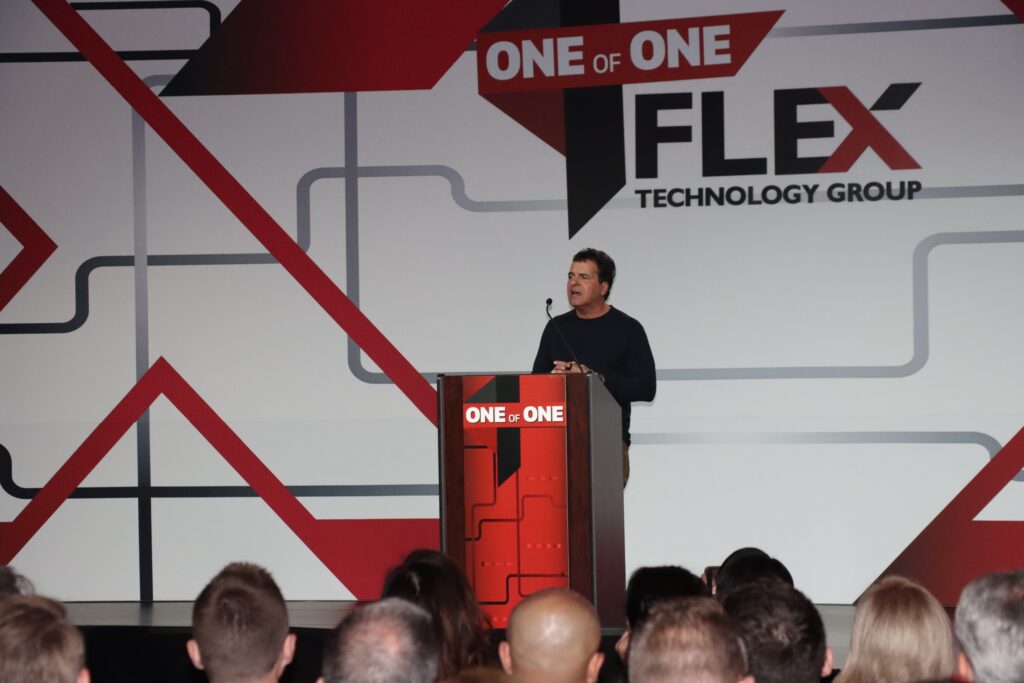
That arrangement also shapes the culture. Local companies keep their identities while sharing resources and practices. FlexTG publicly offers paid volunteer time and charitable donation matching. These are concrete details of how the group operates, alongside the less photogenic work of coordinating service, supplies, and billing.
The local identity remains visible in newer developments. In June 2025, FlexTG announced a Visalia, California office through Caltronics. In September 2026, it partnered with Cincy Sports Partners on a local-business sweepstakes offering basketball-season marketing exposure valued at more than $25,000. Both developments show the same operating shape: a wider organization reaching customers and communities through a particular place.
The software sees. The technician fixes.
FlexTG describes itself as manufacturer-neutral. Its named suppliers include Canon, Ricoh, Konica Minolta, HP, and Lexmark. For a buyer, the useful question is whether an existing machine can keep doing its job. The assessment can begin with installed assets, then identify where replacement or standardization makes sense.
FlexVision, its proprietary platform, brings monitoring and fleet information into that process. FlexTG describes automated supply management, usage analytics, and predictive issue detection. Software makes an environment easier to inspect; servicing equipment still requires people, parts, and a practical route to the office.
In its report on 2024, FlexTG said it serviced more than 330,000 assets from 37 vendors across 27,000 ZIP codes. It reported 97% customer retention that year. Those are company-reported operating figures. They give the promise some dimensions: a fleet dashboard has to connect to a service organization with considerable reach.
Put the invoice beside the promise
The business model is recurring B2B service, alongside equipment and software solutions. Consider FlexTG’s luxury automotive case: a 60-month Total Print Management Agreement refreshed the fleet with 234 standardized HP devices. Equipment, service, supplies, and maintenance came together on one monthly invoice.
FlexTG reports $39,000-plus in annual savings and $195,000 across the agreement’s full term. Those numbers describe savings, not the fee paid to FlexTG. A buyer still needs to compare the proposed payment, included volumes, service terms, and obligations with the existing arrangement.
Nor does manufacturer neutrality always mean preserving a mix of brands. In another published case, a title provider moved to an all-HP environment, while its real estate affiliate used HP and Konica Minolta. The two organizations had different needs. Neutrality leaves room to choose a narrower fleet when that helps.
The agreement also included automated supply fulfillment and regular business reviews. That makes the relationship a continuing management job. Someone must review usage, service activity, and changing requirements after installation. The buyer’s task is to make those reviews useful: agree on the measures, examine exceptions, and check whether the proposed changes solve the problems that prompted the contract.
Count first. Buy second.
The customers most likely to recognize this problem have multiple locations, distributed purchasing, or costly interruptions: retailers, hospitals, law firms, schools, and construction businesses. FlexTG also assesses production print, where ordering, finishing, outside vendors, and delivery deadlines influence the economics alongside the press itself.
In the market, buyers can choose manufacturer-led service programs, regional dealers, internal management, or a national provider such as FlexTG. The comparison should turn on the actual work: supported equipment, local response, contract terms, and whether finance can finally see the total bill.
The approach is useful to copy even before hiring anyone. Inventory the machines and contracts. Establish usage and all-in costs. Find out who orders supplies. Measure response times. Then decide what to keep, move, or replace. These are buying lessons drawn from the cases, rather than promised savings for every organization.
A small, efficiently managed fleet may offer less room for improvement. Existing leases may constrain changes. Specialty workflows may justify equipment that appears underused. Consolidation earns its keep when it reduces a real burden without damaging necessary work. That is the test behind FlexTG’s proposition: whether the next person standing at the printer can simply collect the pages and leave.