At Inco Ships, updating a safety manual once meant posting loose-leaf pages to vessels and trusting someone aboard to replace the old ones. Sometimes that last step went wrong. The document had travelled across the ocean. Its authority had not quite made the crossing.
- M-Files connects documents to clients, projects, and approval rules.
- Its APAC examples range from Australian ships to Philippine invoices.
- The useful starting point is one troublesome workflow.
The Sydney shipping company’s experience offers a useful introduction to M-Files Asia Pacific, the regional presence of the global software business. Forget, for a moment, the grand vocabulary of enterprise information management. Consider a crew consulting a manual. The important question is whether it is the approved one.
The page that missed the boat
In M-Files’ account of the deployment, Inco moved its safety and quality manuals to electronic publication, accessible to vessels through communications links. Managers could track reviews and approvals. The company later extended the system to personnel information. A recurring distribution chore became a controlled process.
There is something wonderfully unglamorous about this. Office software often promises to change how people think. Here, the immediate ambition was to stop asking people to replace pages correctly, every time, indefinitely. That is a respectable ambition.
A document needs an identity
M-Files’ central proposition is metadata: information describing a document and its relationships. A contract can belong to a customer, concern a project, await approval, and carry access restrictions. Those properties become useful handles for finding it and deciding what happens next.
Imagine looking for every approved contract for a particular client. A folder location supplies only part of the answer. M-Files makes relationships, version history, permissions, and workflows part of the system’s organizing logic. Its expertise sits where information retrieval meets the rules governing everyday work.
The company’s own history traces development to Antti Nivala in Tampere, Finland, in 2002, followed by an initial software release in 2005. The APAC operation brings that global platform to regional customers; the founder and product history belong to the wider business.

One team, one useful change
At South Australia’s Hood Sweeney Securities, the trigger was an aging document system. The firm considered a companywide approach, then chose around the financial planning team’s requirements. It tested M-Files in a development vault before deployment. The customer account reports 15-20 minutes saved per Statement of Advice.
That sequence is worth copying: identify the team’s actual work, test it, adjust it, then expand. A tool can be perfectly capable and still disappoint when the purchasing decision treats every department as interchangeable. The practical unit of improvement is often a process small enough for someone to understand completely.
The practical unit of improvement is often a process small enough for someone to understand completely.THE TAKEAWAY
The scanner meets the invoice
A Philippine agricultural equipment distributor supplies another example. Working with Fujifilm Business Innovation Philippines, it introduced OCR and automated workflows. Invoice details could be extracted and indexed; an unpaid invoice could enter an approval process. Training and configuration were part of the deployment.
Here the regional partner matters. Knowing the software is one skill. Translating the customer’s existing habits into fields, permissions, and sensible handoffs is another. The customer story describes both. It is also a reminder that automation contains quite a lot of human preparation.
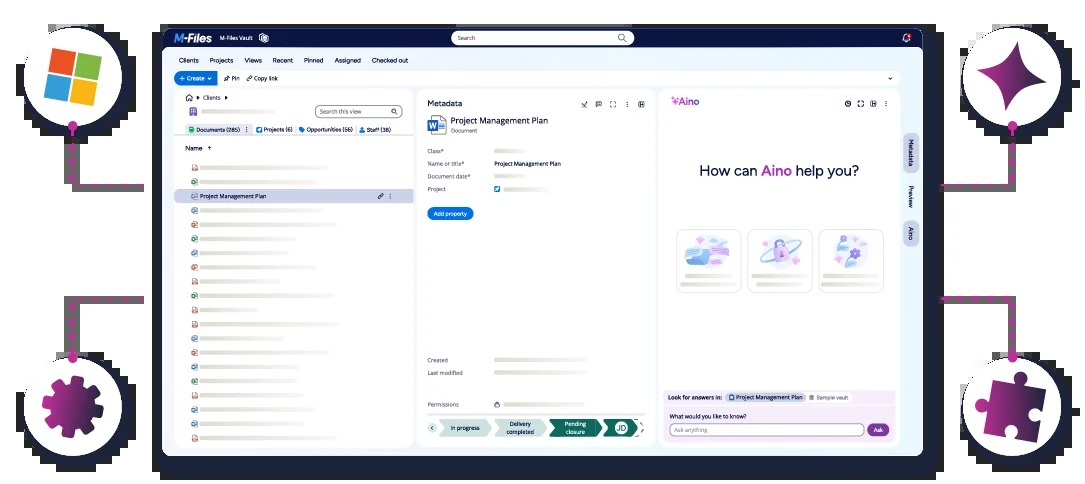
The product family covers several stages of that work. Ment provides visual document automation and reusable clauses. Hubshare supports controlled external collaboration. Aino adds AI assistance, including document summaries and questions about content. Together, these tools extend the platform from organizing records into producing, sharing, and using them.
Microsoft moves inside
In July 2025, M-Files and Microsoft deepened their partnership around SharePoint Embedded. This lets M-Files content reside natively within Microsoft 365, bringing Microsoft collaboration and governance capabilities closer to the M-Files experience. For businesses already working in Teams, Outlook, and Office, that is a consequential architectural choice.
It also complicates the usual competition story. SharePoint is an option buyers may consider, while Microsoft supplies technology underneath this M-Files offering. Other alternatives include Box, Laserfiche, and OpenText. M-Files’ argument rests on metadata and document-driven processes; the useful comparison is how each system handles your actual approvals, records, and access requirements.
The latest manufacturing offering, announced September 29, 2026, makes that positioning concrete. It connects engineering changes and supplier document exchanges to controlled revisions and acknowledgment records, alongside PLM and ERP applications. The recurring question remains familiar: which document was approved, and who received it?
Buy the process, too
M-Files sells subscriptions. Its global pricing page currently lists Essentials at $65 per seat per month, typically billed annually, with Enterprise quoted individually. As an illustration, 20 seats at that listed rate equal $15,600 a year. Regional terms, services, and configuration require their own calculation.
Illustrative list-price arithmetic. Excludes implementation and other charges.
The company fits businesses where documents carry obligations: financial services, engineering, consulting, manufacturing. For a small team needing simple file sharing, the extra structure may be unnecessary. For a complex organization, success still depends on agreeing what the metadata means and who owns the workflow.
AI adds another condition. Aino’s user guide says it processes textual information; scanned documents need OCR into searchable PDFs first. It cannot process images, audio, or video. Buying the assistant does not remove the work of making information usable.
Begin with one troublesome document journey. Record who creates it, who approves it, and who needs the finished version. Test whether those people can find and use it. Somewhere aboard a ship, the difference between a file being delivered and a procedure being current is already easy to understand.