Somewhere in every company lives a folder named Final. Inside it: Final_v2, Final_v2_JKcomments and Final_FINAL_use-this-one. M-Files has built a business on the proposition that this small office comedy is actually an expensive systems failure. A document should not depend on a coworker remembering which digital corridor somebody filed it in. It should announce what it is, whom it concerns, which rules apply and what must happen next.
That is the company’s central trick. A contract can belong simultaneously to a client, a project, an account owner and a renewal workflow without four copies of the file. M-Files stores those relationships as metadata and generates views around them. Search can span connected repositories. Permissions and retention can follow the document’s context. Version history stops “final” from becoming a creative-writing prompt.
It is not glamorous software. It is software for the moment an auditor asks for the approved procedure, an engineer needs the right drawing, or a lawyer discovers that the clause library and the signed agreement have drifted apart. More than 6,000 organizations in over 100 countries now use M-Files, according to the company. Its customer roll includes industrial groups, professional-services firms, financial advisers, health businesses and media companies - people for whom the wrong file is more than an annoyance.
The original sin was location
Founder Antti Nivala began developing the product with a small team in Tampere, Finland, in 2002. The first version arrived in 2005; a Dallas office followed in 2009. Early development was bootstrapped with revenue from an earlier product. By the time M-Files took institutional capital in 2013, Nivala has said the business had reached roughly $9 million in revenue. That sequence matters. The metadata thesis met paying customers long before it met a venture deck.
The product evolved from document management into a broader system of work: an embedded workflow engine, automated permissions, audit trails, external portals, no-code document generation and, eventually, generative AI. M-Files acquired AI specialist Apprento in 2017, client-portal company Hubshare in 2021 and document-automation maker Ment in 2023. That last year, it also passed $100 million in annual recurring revenue - the less adorable cousin of unicorn status known as a “Centaur.”
The line captures both the appeal and the hard part. Automatic compliance only appears automatic to the end user. Somebody must first define document classes, owners, states, access rules and retention policies. The performance is a swan: calm in Word, furious administrative paddling below.
The competitor moved from across the aisle to under the floorboards
For years, M-Files and Microsoft executives saw one another at industry events as competitors. The customer reality was less theatrical: most M-Files users already lived in Word, Outlook, Teams and Excel. Specialist document controls were useful, but forcing people to abandon familiar tools was a poor adoption strategy.
In July 2025, the companies expanded their partnership. M-Files became the first announced specialist document-management system to use SharePoint Embedded for native storage inside a customer’s Microsoft 365 tenant. That unlocks Microsoft co-authoring, Purview policies and Copilot while M-Files supplies the metadata, workflows and industry logic. The alliance removes a choice buyers disliked making: Microsoft standardization or a purpose-built document system.
It also shows what changed M-Files’ mind. The battle was never truly M-Files versus Microsoft. It was context versus scattered content. Once Microsoft offered an API-only storage layer that could stay invisible beneath another application, partnership became more useful than platform combat. M-Files could occupy the business layer while Microsoft kept the tenant, collaboration tools and compliance boundary.
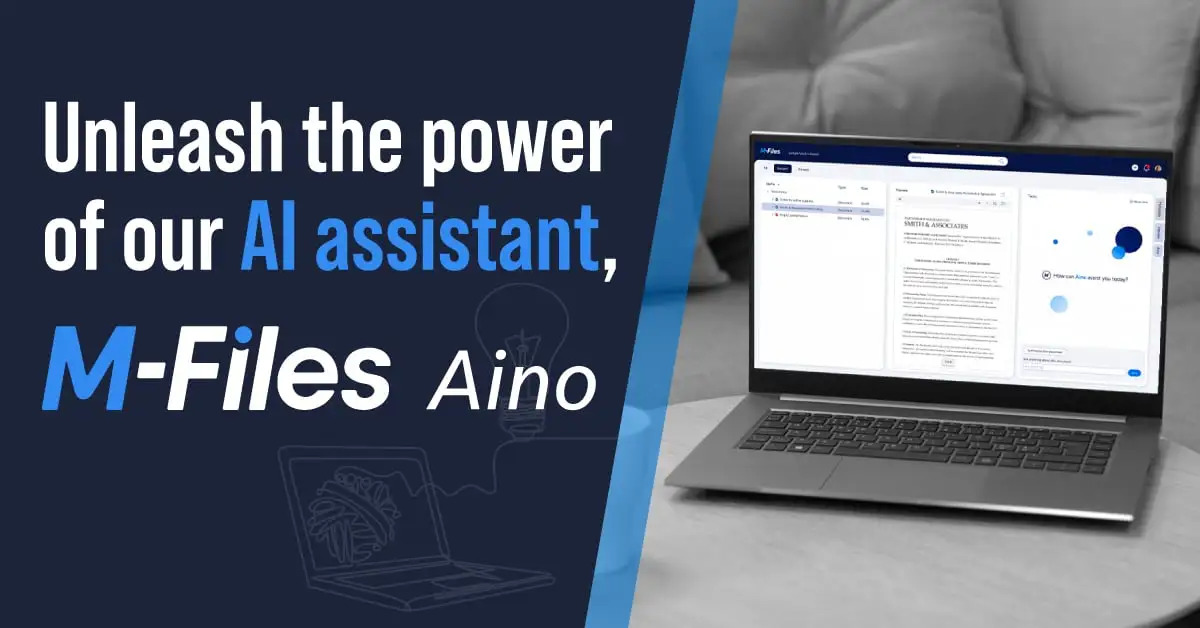
Aino is only as clever as the filing cabinet beneath it
M-Files Aino summarizes documents, answers questions across permitted content and extracts metadata. It can compare contracts or surface a deadline without training on a customer’s files. Its most important feature may be scope: the assistant sees what a user is allowed to see, works from vault content and can point back to the material behind an answer. That is a narrower job than a general chatbot, and narrowness is the point.
There are limits. Standard Aino document Q&A expects machine-readable text; scans need OCR, although a multimodal metadata feature can analyze images and handwriting in supported formats. The product guide warns that answers may be incomplete or inaccurate. Native Microsoft Copilot integration requires M-Files Cloud, so an on-premises buyer cannot simply switch on the full 365 experience.
The financial case deserves similar boundaries. M-Files now publishes Essentials at $65 per seat per month, generally billed annually. Enterprise pricing is tailored to user count, content volume, AI usage, governance, external collaboration and workflow complexity. Implementation, migration, consulting and managed services can add cost. A 2026 Forrester Consulting study commissioned by M-Files modeled 301 percent return over three years and $8 million in net present value for a composite organization. Useful input, yes. A universal promise, no.
That pricing reveals the business model. M-Files is recurring enterprise software, but the subscription is only one layer. Direct teams and more than 350 partners sell, configure and support deployments; professional and managed services handle migrations, custom work and long-term administration. The land is often a specific regulated workflow. The expansion comes when the same information model reaches another department, external client portal or document type. It is a sensible motion because metadata becomes more valuable as connected objects accumulate. It can also make switching painful, which is why buyers should insist on clean exports, documented configuration and administrators who understand the model rather than merely the interface.
What fails first is rarely search
The first failure is usually design. Teams import a decade of clutter, reproduce the old folder tree as metadata, add fields for every edge case and wonder why filing feels like tax preparation. Reviewers like M-Files’ flexibility and retrieval, but recurring criticisms include a learning curve, demanding setup, dated corners of the interface and slower performance in large or complex environments. G2 currently reports an average four-month implementation and a 20-month return window from reviewer data.
Where the metadata bet breaks
- No accountable owner for the information model
- Every historical field is treated as sacred
- Users are trained on screens, not actual work
- Simple sharing is dressed up as compliance
- Workflows encode exceptions instead of the common path
- Cloud latency or giant vaults go untested
This is also where M-Files does not work. A small, low-risk team that needs shared drafts and basic search may be happier with OneDrive, Google Drive or Box. An organization unwilling to simplify its taxonomy will merely make chaos queryable. And if employees can bypass the system without consequence, the authoritative record slowly becomes an aspirational record.
The useful thing to copy costs nothing
M-Files’ most portable lesson is not its product. It is the decision to separate identity from location. Before buying software, a team can ask five questions of its twenty most important document types: What is this? Who owns it? What other business object does it concern? What must happen next? Who is allowed to see it? Those answers expose whether the real problem is storage, process or governance.
A one-week folder rebellion
- Choose one costly workflow, not the whole company archive.
- Define no more than five required metadata fields.
- Make the happy path visible from creation to retention.
- Test with the people who do the filing, not only administrators.
- Measure search time, rework, missed handoffs and audit effort before automating.
That discipline explains M-Files’ market position. Against OpenText and Hyland, it offers a more pointed metadata-first story. Against Box and ordinary cloud drives, it brings deeper workflow and governance. Against iManage or NetDocuments, it stretches across more industries. Against SharePoint, it now chooses coexistence: M-Files provides context and document logic while Microsoft provides the workplace beneath it.
The company itself has followed the same rule. It kept the identity of its bet - documents need context - while changing where the product lives, how it is sold and who controls the storage. Majority investors Haveli and Bregal closed their recapitalization in late 2024; Jay Bhatt became chief executive, while Nivala shifted to chief innovation officer and remained chairman. In 2025, M-Files said it added nearly 500 customers and shipped more than 240 innovations. In 2026 it extended the context model into agents that can enrich metadata, retrieve knowledge and trigger governed work.
Folders will survive. They are understandable, cheap and strangely comforting. But the more consequential the document, the less “where did we put it?” sounds like a reasonable operating system. M-Files has spent 24 years turning that irritation into software. Its Microsoft deal makes the idea easier to adopt - and harder for buyers to dismiss as a Finnish eccentricity.