The first Laserfiche was born because a lawsuit had become a filing problem. In 1987, Honda faced motorcycle product-liability litigation and needed thousands of pages digitized and searchable. Nien-Ling Wacker, a physicist turned software entrepreneur, built the system. It was a gloriously narrow beginning: not a platform, not a transformation strategy, just a faster way to find the right page before someone on the legal team lost an afternoon.
That origin explains the company better than its modern category labels do. Laserfiche is called enterprise content management, document management, process automation and, lately, intelligent content management. Underneath the vocabulary is one durable job: take institutional information out of cabinets, inboxes and shared drives, then give it structure, permissions and somewhere useful to go.
Today the privately held Long Beach company sells a cloud platform and a self-hosted edition. Customers capture documents, extract data, build digital forms, route approvals, apply retention schedules, search repositories, integrate other business systems and inspect audit trails. Governments use it for permits and public records. Colleges use it for enrollment and student files. Healthcare organizations use it for intake, contracts and court orders. Credit unions use it for signatures and wire transfers. Manufacturers use it to control the documents that move between finance, suppliers and the factory floor.
Laserfiche makes the paperwork around consequential work searchable, routable and governable. The AI is new. The obsession with what a document is, who may touch it and what happens next is not.
The cabinet learned to move
Laserfiche's corporate roots reach to 1976, when Wacker founded Compulink Management Center from her California home. The first branded document-management product arrived in 1987, which is why public profiles sometimes disagree about the founding year. Both dates matter: 1976 marks the company; 1987 marks the product wedge.
The early pitch was retrieval. Scan the paper, index it, find it again. Then the product followed the document outward. Audio and video joined scanned pages. Electronic forms replaced the paper that would otherwise need scanning. Workflow software pushed a file to the next person. Records controls determined when it could be destroyed. APIs and integrations connected the repository to Microsoft 365, Salesforce, DocuSign, databases and line-of-business systems.
This is the important expansion. Storage by itself becomes a commodity. A repository that knows the approval path, retention clock and access model becomes operational infrastructure. Laserfiche's differentiation is not one spectacular feature. It is the combination of content, process and governance, delivered in a tool that business operators can configure without turning every form change into an IT project.
What failed first? The handoff
Laserfiche customer stories repeat the same scene with different stationery. The process works until a document moves from one person to another. An incident report travels between buildings. A court order is printed, signed, scanned and emailed. A permit arrives without a required field. A contract waits in a leader's inbox. A shared drive contains five spellings of the same street. Nothing is dramatically broken; everything is slightly late, untraceable or dependent on the one employee who knows the ritual.
At the Harris Center for Mental Health and IDD in Texas, paper forms created inaccurate data, misplaced documents and invisible status. Contract approvals could take 30 to 90 days. The organization replaced handwriting and manual routing with Laserfiche forms and workflows. It reports that contract approval fell to about an hour, 479 working hours were saved in that process, and automation now saves more than 50 hours a week across the organization.
New Caney Independent School District offers the cost answer in unusually clean numbers. Facing rapid growth across 22,000 students and 2,700 employees, it digitized more than 370,000 HR records and two million student records and enrollment items. The district says it saved more than $330,000 compared with outsourcing scanning and storage, cut paper use 40 percent, and reduced enrollment processing from two hours to less than 30 minutes.
Tompkins County, New York, put a larger price on the old habit. Its analysis estimated that spending $400,000 to $500,000 on scanning, software upgrades and IT infrastructure could save as much as $5.5 million. The first attempt still hit an impasse when employees returned to paper. Technology had arrived; behavior had not. That is the less flattering and more useful detail: a repository does not automatically create a digital operation.
“We started out as a very efficient and high-performance alternative to the file cabinet.”Chris Wacker, former CEO and current chairman
What changed their mind
Adoption often turned after a small workflow worked in public. A north-central Texas healthcare provider initially used Laserfiche for medical-record scanning, then automated simple tasks such as business-card creation. Relieving HR staff of handwritten forms made the benefit visible. More difficult processes followed. At Mount Pearl, a Canadian city of 22,000, one successful departmental workflow created requests for the next one. The internal sales pitch became a colleague asking, “What can we do next?”
Mount Pearl also shows what moved a long-time customer from self-hosting to cloud. The subscription price was similar, but the comparison changed once the city counted local servers, storage, patching, backups and monitoring. A managed environment also meant current software, better availability and more time to deploy processes. The spreadsheet changed their mind when it included work, not just licenses.
The cloud decision worksheet
Conceptual chart - the lesson from Mount Pearl is to include infrastructure and maintenance labor, not to treat bar length as audited cost data.
Now the file cabinet talks back
Laserfiche's current product push adds generative AI without abandoning the old controls. Smart Fields uses natural-language instructions to extract invoice lines, handwriting, contract terms or student transcript tables, then classify and tag documents. Smart Chat answers questions over a document or folder and points users back to relevant content. Summarization creates briefs from meeting notes or contracts.
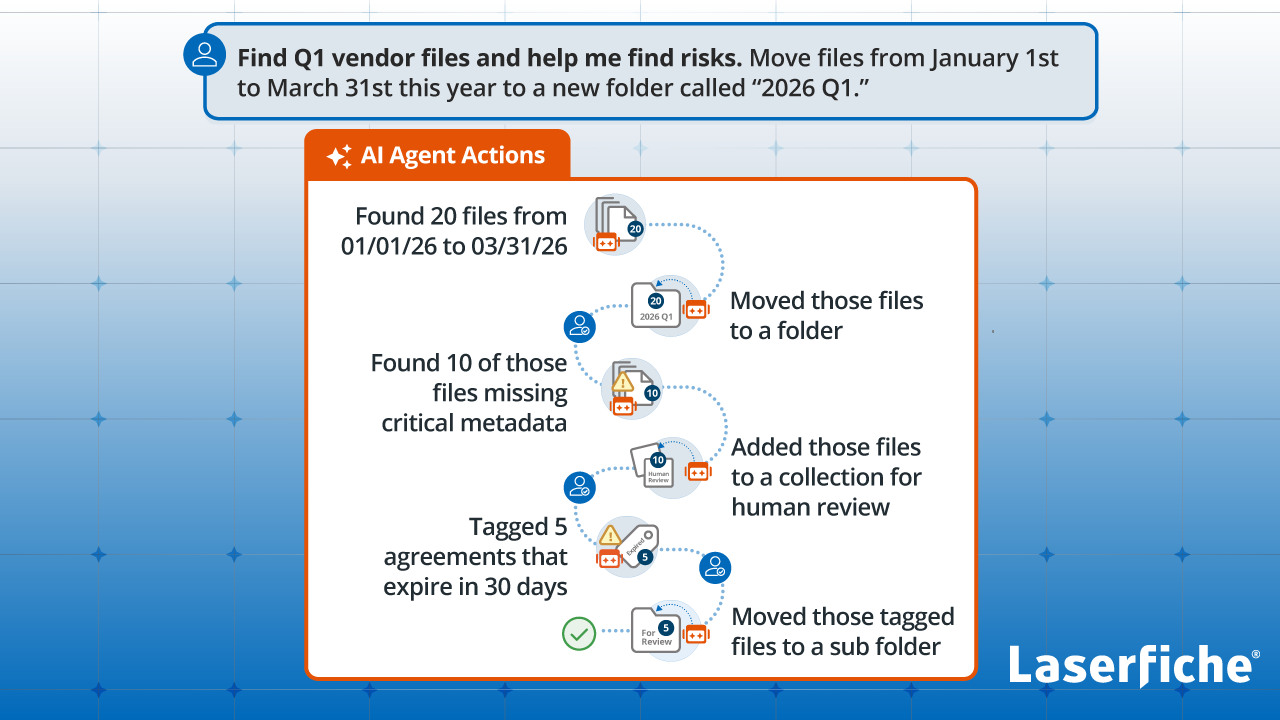
AI Agents, released to Laserfiche Cloud users in May 2026, go one step further. A user can ask an agent to find a class of files, detect a condition and take actions such as tagging or moving them. The consequential design choice is permissions: an Agent inherits the access restrictions of the person who starts it. It does not get a magical all-access badge because it speaks fluent prompt.
That gives Laserfiche a credible position in the AI document race. Newer tools may offer a cleaner chat box. Microsoft can bundle SharePoint and Power Automate into an enormous installed base. OpenText, Hyland, Box, M-Files, DocuWare and Newgen all attack portions of the same market. Laserfiche's case is that AI becomes more useful when the repository already understands retention, redaction, audit and granular access. In regulated work, the answer to “Can it find this?” is inseparable from “May this employee see it?”
A business sold by seats, risk and patience
Laserfiche makes money from annual software subscriptions, add-ons, support and a global channel of solution providers that configure systems for specific industries. Its public cloud pricing in August 2026 lists Professional at $73 per user per month billed annually with a five-user minimum, Business at $93 with a 25-user minimum, and volume-priced Business+ at $42 with a 500-user minimum. The cheaper-looking enterprise number is a volume threshold, not a secret bargain for a five-person office.
This model fits organizations where a badly routed document has a measurable cost: delayed service, an audit finding, duplicated data entry, an expired contract or a citizen waiting at a counter. It is less compelling for a tiny team that needs simple shared folders, has few repeatable processes and can live comfortably inside the tools it already buys. Implementation skill matters, too. A badly mapped workflow merely digitizes confusion at subscription speed.
What builders can steal
- Enter through pain, not category. “Search these lawsuit files” is a better wedge than “transform enterprise content.”
- Automate one visible nuisance. Small wins create internal demand more reliably than a giant launch.
- Attach action to storage. The repository gets stickier when documents trigger approvals, reminders and rules.
- Package customer know-how. Templates and a solution marketplace turn one deployment into a repeatable starting point.
- Make governance part of the AI. Permission inheritance is product design, not legal copy buried after the demo.
When the playbook does not work
If nobody can define the approval path, exceptions and outcome, software will preserve the argument in higher resolution.
Training, migration and change management are part of the system. Tompkins County's return to paper is the warning label.
A small team with light compliance requirements may get enough from a shared drive, e-signature tool and existing office suite.
AI that inherits access controls is only as safe as those controls. Messy roles and excessive access remain messy.
Laserfiche's recent moves make its market position plain. It joined AWS Marketplace in June 2026, making procurement and consolidated billing easier for AWS customers. In August it launched Enterprise Security, including multi-region disaster recovery and controls designed around GovRAMP and criminal-justice requirements. The company is not trying to be the assistant for everyone's grocery list. It wants to be the place where an institution's most procedural information can be trusted enough to act.
The amusing twist is that a company built to kill the file cabinet may benefit from how file-cabinet-minded it remains. Names, folders, access, retention and audit trails sound antique beside autonomous agents. They are also the conditions that keep an autonomous agent from becoming the intern who reorganized legal's shared drive at 2 a.m. Laserfiche's wager is that the future of enterprise AI still needs a very good records clerk.