An approval worth more than $5 million is a peculiar thing to entrust to a paper trail. Yet that was the problem facing Audi Japan’s Finance and Administration division: sensitive requests, multiple departments, and documents that needed to be found after the decision. The company needed a reliable route through the organization, with a record of who had done what. The car could be beautifully engineered. The paperwork still needed engineering of its own.
- Bizagi turns visual process designs into applications that route work between people and systems.
- Its Modeler is free; enterprise process execution is a paid cloud service.
- Customer results point to a useful habit: solve one workflow, then reuse the pieces.
- Its AI tools work inside processes, with defined permissions and options for human review.
The approval that stopped travelling on paper
Audi Japan used Bizagi to automate its Request for Approval process for 20 departments in 14 days. The published case study describes a paperless workflow that complemented SAP, centralized documentation and gave non-financial users a more convenient way to obtain approvals. It was a bounded intervention: a particular decision, a particular route, a particular set of people.
The initial success encouraged six further finance processes. Across the resulting seven, Audi’s case study reports 60 hours of work saved each week and reductions in internal processing time of up to 75%. These are customer results published by Bizagi, rather than a promise about what every installation will achieve. Their attraction is the sequence. A useful first project made the next project easier to justify.
This is the corner of business that Bizagi inhabits. Between the database and the decision sits work: someone gathers information, someone checks it, someone approves it, someone updates a system. Bizagi gives that sequence an executable design. A request can acquire an owner, a deadline, rules and a visible history, instead of becoming another email with “just following up” in the subject line.
First draw the work. Then make it run.
The first doorway is Bizagi Modeler, a free desktop application for drawing, documenting and simulating processes using BPMN, the standard notation for business process diagrams. A team can map the present arrangement, inspect possible routes and share the diagram. Simulation supports what-if analysis. It lets people examine their assumptions before those assumptions become an application.
Studio takes the design toward execution. Builders define data, forms, business rules, assignments and integrations. Bizagi Automation runs the process; application tools give different users appropriate interfaces and actions. The distinction matters: drawing a loan approval does not connect the bank’s systems, establish access rights or launch a production service. The map is an agreement about the work. The application has to honour it.
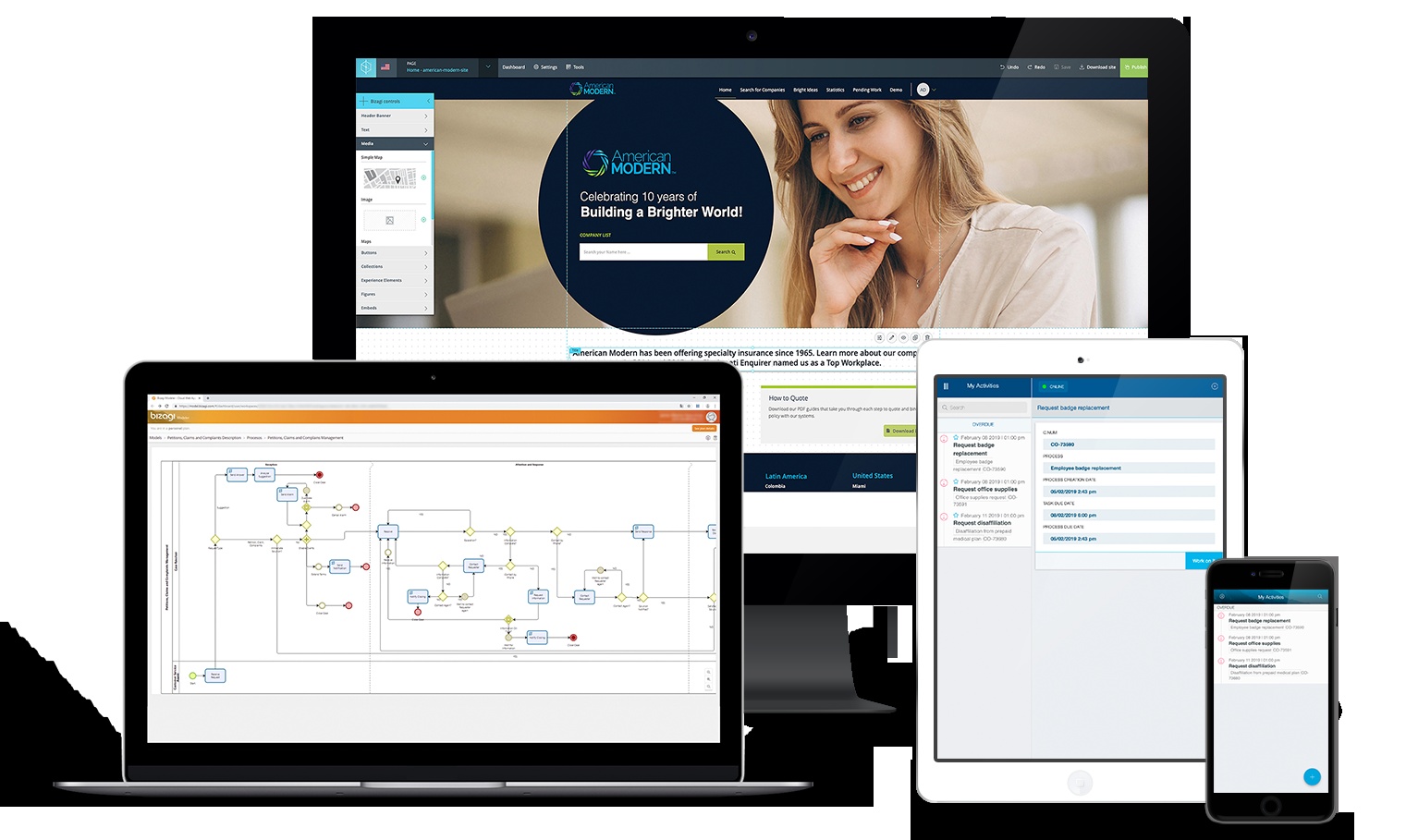
Bizagi’s expertise lies in joining these layers: process design, low-code development, integration, execution and monitoring. Its stated architecture wraps around existing systems, connecting databases, APIs and legacy applications. It can also coordinate robotic automation through integrations with tools such as UiPath, Blue Prism and Automation Anywhere. A bot performs an action; the process determines how that action fits the wider job.
A long apprenticeship in business agility
Gustavo Gómez founded the business in Bogotá in 1989. Co-founder Marcel Manser remains on its leadership team, leading solutions consulting. Bizagi’s own history describes an early consulting and custom-software business, followed by a strategic turn toward dedicated BPM software in 2002. The name compresses “business” and “agility” into one word. It is an ambitious name for a company concerned with approvals, but approvals are often where agility goes to sit down.
In 2017, Invus invested $48 million for a minority stake. The announcement named US and European expansion as the purpose of the capital. Later came a cloud-only version in 2022 and successive AI additions. The continuity is more interesting than the changes in vocabulary: Bizagi keeps returning to the question of how an organization moves work across its internal boundaries.

“Bizagi was created to help businesses create better processes.”Gustavo Gomez / Bizagi
The company describes its culture through collaboration, innovation and responsiveness, with remote or hybrid working and colleagues representing more than 16 nationalities. Those are employer statements. They fit a product that expects business specialists and technical specialists to work together, although a shared diagram alone cannot make those groups agree.
The savings were hiding in the second project
One revealing customer story concerns an unnamed global consumer-goods manufacturer. It created a center of excellence to roll out sales and marketing processes, using reusable components. Its case study reports a reduction of more than 70% in the cost of building new workflows, 50% faster delivery and $800,000 saved in eight months. The company said the project paid for itself in less than a year.
The practical lesson is reuse. If every workflow begins with an empty canvas, teams repeatedly solve permissions, integrations and common approval patterns. A governed library lets later projects inherit useful work. The reported savings belong to that customer and its implementation; they are not Bizagi’s list price. But the mechanism gives a reader something to copy: measure the second project as carefully as the first.
saved in eight months, reported by an unnamed manufacturer using reusable process components.
For Eigen Haard, a Dutch housing organization managing around 60,000 affordable homes, the bottleneck was a complicated rental process. It brought tenant departures, arrivals, maintenance and checks into clearer workflows. Its published story reports about €200,000 saved annually and people housed an average of two days faster. The measure of an improved process can be a person receiving a key sooner.
At Bunzl, the work stretches beyond employees to customers and suppliers. Its case study describes a standardized product-lifecycle process handling 4,000 cases a month, plus a sustainability hub for suppliers to provide product-composition information. Different industries, similar difficulty: information must travel with enough context that the next person can act.
Give the AI a desk, a task and a supervisor
Bizagi’s AI tools occupy specific places in that journey. AI Agents can summarize, categorize, translate or prioritize information. Builders configure their inputs, outputs and error handling inside Studio. AI Workers prepare editable form fields using contextual information and documents. A worker might extract details from an expense receipt, leaving an employee to inspect the proposed entries.
The supervision choices are concrete: supervised operation, autonomous operation, or an expression rule that determines when autonomy is allowed. Ask Ada provides natural-language access to business information. These features make more sense when described as parts of an application than as a promise that a company can hand its operations to a chatbot.
The Summer 2026 release, issued on July 21, added Kafka event integration, Ask Ada Charts and more visibility into AI usage and performance. Bizagi also announced a global alliance with YASH Technologies in March and Microsoft AI software designations for financial services and manufacturing during 2026. The product direction is toward connected execution with more inspection and control.
The invoice follows the workload
Bizagi earns its money through commercial cloud subscriptions, with services and partners helping organizations implement them. Its pricing page advertises consumption-based pricing and unlimited users and applications within a subscription. Free modeling is therefore an entry point, while the economics of running production work depend on the commercial agreement and actual usage.
For a buyer, the useful calculation includes workload, integration effort, implementation, support and the cost of changing the process later. More users need not mean a separate seat charge under the advertised model, but more automated work still has economic consequences. A pilot should measure elapsed time, exceptions and operating cost, alongside the satisfaction of seeing a form move automatically.
Bizagi sits among enterprise process and low-code platforms, with overlapping alternatives including Appian, Pega and Camunda. Its particular appeal is the route from visual process design to governed execution across existing systems. That is positioning, not a claim of exclusive capabilities. The company currently reports more than 400 enterprise customers and over 10,000 processes across more than 50 countries.
The sensible place to begin is one troublesome approval with a clear owner and accessible data. Map the current handoffs, remove unnecessary steps, test the connections and establish a baseline. That recommendation follows from the customer stories. If ownership remains disputed or the required systems cannot be connected, a faster builder will have little useful work to build. For a small task contained in one team, the broader platform may also be more machinery than the job warrants.
Bizagi’s most persuasive proposition is wonderfully unglamorous: make it possible to see where the work is, who has it, and what must happen next. An organization that can answer those questions has a better chance of improving the answers. Even an approval deserves a life outside the inbox.