The bot had a name: Suzie. At Atlassian, it also had a familiar office problem. Work could be automated and still spend too long waiting. Scheduled triggers introduced delays. People outside the technical team struggled to see the entire workflow. Changing business rules was harder than it needed to be. A bot could perform a task; getting the whole request through the organization was another matter.
Camunda entered that gap. In the company’s account of Atlassian’s automation work, its software connected Suzie to sales and finance systems, people and bots from different suppliers. The reported result included ticket turnaround reductions of up to 93% in some cases. The revealing part is what changed: the coordination around the automation.
That is Camunda’s business in miniature. It sells software for keeping a process moving across the applications and people needed to complete it. Today, AI agents are joining that queue. Camunda’s pitch is that companies need a way to give those agents useful work while keeping approvals, rules and accountability intact.
Suzie needed a traffic controller
The distinction sounds fussy until a customer is waiting. One system holds the order, another handles payment, and a person must approve an exception. Completing any single step says little about whether the customer gets what they asked for. Someone needs to know what has happened, what is blocked and what should happen next.
Camunda calls this process orchestration. Its platform connects existing tools through a shared process, with software tasks and human decisions represented together. In its Atlassian case-management presentation, Camunda reports a 93% reduction in quote turnaround and 30 times return on technology spending. Those are results from a particular customer initiative, not a forecast for the next buyer.
Reported reduction in Atlassian quote turnaround.
Customer example published by Camunda. Results depend on the process.The useful question is where the delay lived. Suzie’s early design depended on schedules rather than responding immediately to events, while its surrounding workflow lacked visibility and flexible decision rules. The lesson readers can borrow is straightforward: examine the pauses between automated tasks before buying another tool to speed up the tasks themselves.
The consultants who kept the developers
Jakob Freund and Bernd Ruecker founded Camunda in 2008 as a consulting business. Workshops and customer projects gave them repeated exposure to process-management software. In Ruecker’s retelling of the company’s early years, the established products were centralized, complicated and uncomfortable for developers. Available open-source frameworks had the opposite problem: too much useful tooling still had to be built around them.
“When Bernd and I started Camunda back in 2008, we just wanted to run our own consulting business.”Jakob Freund · December 2018
Customer feedback helped persuade them to become a software vendor. Camunda BPM launched in 2013 with developers central to the design. That was a deliberate wager against the promise that business users could automate complicated operations while largely bypassing software engineers.


The financing came later. Camunda announced its first outside investment, €25 million from Highland Europe, in December 2018, describing itself as profitable since inception. In March 2021, Insight Partners led an €82 million Series B, with Highland participating. Camunda put that round at approximately $100 million at announcement. This was a business with customers before it became a venture-funding story.
A diagram with a job to do
Camunda’s central idea is unusually literal: the process diagram can run the process. BPMN, short for Business Process Model and Notation, supplies a standardized visual language. DMN, Decision Model and Notation, handles decisions and rules. Business specialists and engineers can discuss the same model, although a readable diagram still needs sound implementation behind it.
The Camunda 8 toolset divides the work. Modeler creates process and decision models. Zeebe executes the workflow. Operate helps teams inspect running processes and investigate trouble. Tasklist brings human work into the flow, while Optimize provides analytics. Connectors reach external systems. Together, the tools cover designing, running and improving a process rather than just drawing it.
the claim
and documents
about exceptions
and notify
The engine has its own long backstory. In 2012, CTO Daniel Meyer proposed an event-streaming approach instead of the traditional relational-database model. Camunda pursued the idea alongside its existing product; the work became Zeebe. Freund’s account of the ten-year development journey explains how it eventually became the foundation of Camunda 8 in 2022.
Camunda now offers that platform as hosted SaaS or self-managed software. Its market position sits between business process management and developer infrastructure: a business-readable workflow with the engineering tools needed to connect it to a complicated technology estate.
The five-month lesson from Vodafone
Vodafone Germany offers a concrete example of that complication. Its OTELO and branded reseller businesses had multiple monolithic systems and tightly entangled channels. Without an effective API layer, the company could not establish an urgently needed online partner channel. The existing architecture was constraining the business.
According to Camunda’s Vodafone case study, the team built a cloud-based infrastructure on AWS and used Camunda to orchestrate channels and backend services. It demonstrated a minimum viable product within three months and reached its first go-live after five. LionGate and WDW eLab managed the project.
The migration proceeded task by task and then process by process, while service continued. A monitoring model helped the team take over work gradually. Regulatory changes still arrived during the transition; the process-based approach helped Vodafone respond. The practical lesson is the sequence: choose a manageable slice, observe it, move it, then expand.
That approach needs clear ownership and a way to connect the old systems. A diagram cannot repair a missing interface by itself. For a team planning similar work, the first deliverable should include exception handling and operational responsibility, alongside the happy-path demonstration.
Free to build. A license to operate.
Camunda’s commercial terms deserve attention because its open-source history can create outdated expectations. Starting with Camunda 8.6 in October 2024, its Self-Managed distribution required a production license. Development remained free. Source availability and permission to run a business on the software are separate questions.
In explaining the change, Camunda pointed to a unified distribution and funding continued investment. This was a commercial decision as well as an architectural one. A team evaluating an old tutorial should check which version and license it describes before treating the installation as a production plan.
The current pricing page routes both hosted SaaS purchases and self-managed production licensing through sales. SaaS has a 30-day trial. Buyers also need to budget for integration, modeling, testing and ongoing operations. Hosting it themselves adds infrastructure responsibility; purchasing SaaS transfers that hosting work to Camunda. Neither arrangement eliminates the work of defining the business process.
There are alternatives. Temporal emphasizes durable execution through code; AWS Step Functions provides serverless workflow orchestration with AWS integrations. The editorial distinction is who needs to understand and maintain the workflow. Camunda makes a stronger case when engineers and business process owners need a shared model. A small, isolated automation may not justify adopting a full orchestration platform.
AI gets a bounded job
Camunda’s current AI proposition extends its existing approach. Its agentic orchestration documentation describes agents working inside BPMN processes alongside human tasks and deterministic rules. An agent can choose how to tackle a piece of work while the surrounding process controls the larger sequence.
Consider an illustrative insurance claim. An agent might examine submitted material and request more information. A rule can determine whether a human must approve the outcome. The distinction matters: useful discretion within a task does not automatically justify discretion over payment, escalation or the entire customer relationship.
The Camunda 8.9 release notes date the minor release to April 14, 2026. They include a built-in Model Context Protocol server through which compatible AI clients can discover and invoke operational capabilities. The same notes list patch 8.9.19 on September 4. This is product development around agents’ access to real work, with authentication and operational controls in the picture.
The limitation follows from the design. Process boundaries can constrain where an agent acts, but a model still needs suitable tools, reliable inputs and evaluation. A plausible answer can still be wrong. Teams should test the exception route as seriously as the automated route, especially where a decision carries consequences.
A company built around the handoff
Camunda says it serves more than 700 enterprises; Atlassian, ING and Vodafone are among its named customers. Its SAP ecosystem relationship reflects the same strategy of working across existing systems. The partner directory includes firms such as BP3 and Cognizant that can help customers implement the software.
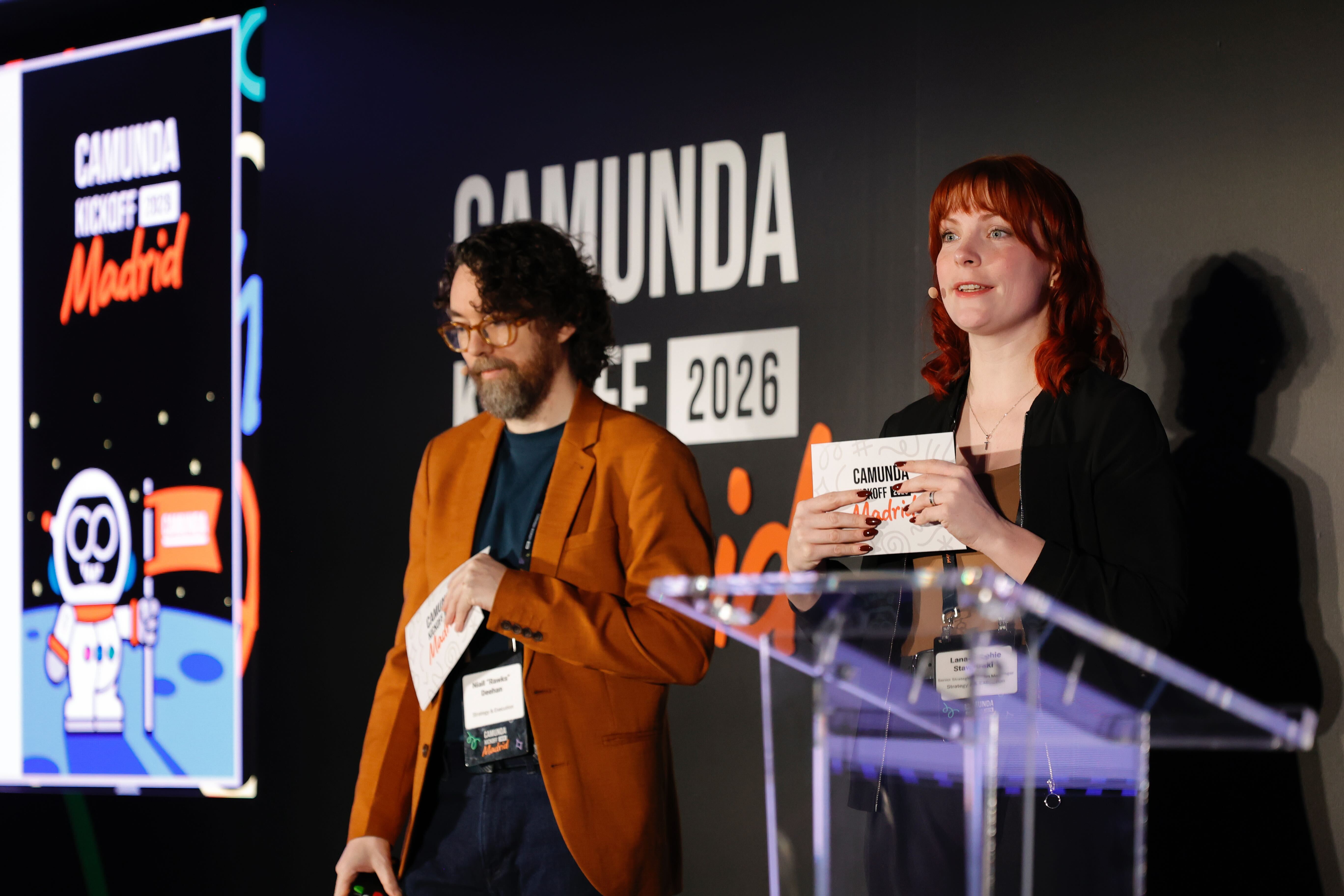
The organization has grown with the product. Its careers page lists more than 600 employees and describes a fully remote company. Staff are called Camundi, and its published values spell FAITH: Focus, Ambition, Integrity, Talent and Humor. A company devoted to orderly processes has, at least, reserved an official place for jokes.
On August 4, 2026, Camunda said its annual recurring revenue was nearing $200 million, with the threshold expected before year-end. It also reported net retention above 120%. ARR is a recurring revenue run rate, not annual recognized revenue, and the announcement described a milestone approaching rather than already crossed.
The company’s next test is whether enterprises will apply its process discipline as AI systems acquire more responsibility. The customer problem remains easy to recognize: a request has arrived, several tools are involved, and someone needs to get the job finished. Camunda has spent years making that someone a piece of software.