Ten years before Camunda crossed $100 million in annual recurring revenue, Jakob Freund took his company to San Francisco and received a fairly clear verdict. The mentors he met, former operators and angel investors, did not think it would ever become a $100 million business. Camunda had no American customers. Freund was still learning how to build a software company. The skeptics had reasons.
When the milestone arrived in September 2024, he remembered their assessment without turning them into villains. He understood where they had been coming from. His satisfaction lay in the intervening work: “we figured it out.” There is something appealing about a founder who can celebrate being right without insisting that everyone else was foolish.
Freund’s career invites that kind of reading. Its decisive moments involve changing a working business, explaining an unfashionable technical idea, and attending to the awkward places where one person’s finished task becomes somebody else’s problem. The glamorous part, apparently, comes after you have sorted out the handoffs.
A software ambition, a consulting start
Growing up in Berlin, Freund taught himself to program on his father’s computer. His mother ran a law practice; his father was a teacher. A Bill Gates biography gave his childhood interest a destination. “I wanted to be a software entrepreneur,” he recalled. He has also acknowledged that the prospect of money appealed to him. A large house was a perfectly understandable attraction.
He earned a master’s degree in computer science at HTW Berlin. Before Camunda, he worked for another vendor in business process management, then considered consulting independently. Bernd Rücker, already freelancing as a Java developer working on workflow automation, became his co-founder. In 2008 they started a business around the subject they knew.
The initial plan was a consultancy. That distinction matters. Freund’s eventual software business grew from direct exposure to customers’ difficulties. The founders were paid to understand how organizations worked, including the bits that a tidy departmental diagram could politely leave out. A process might cross several systems and several teams. Each part could function while the whole remained cumbersome.
For Freund, this became a separate problem worth solving: coordinating the complete process. Think of an order passing from purchasing to a warehouse, through delivery and into invoicing. The customer sees a purchase. Inside the company, several groups have to agree on what has happened and what happens next. The interesting work lives between the boxes.
The risk of leaving a good business alone
By 2012, the consultancy had roughly ten people and about €1 million in services revenue. It had been built without outside investment. There was a business to preserve, which made the next decision consequential. In 2013, the founders launched their own software. Consulting continued alongside it, but the center of gravity began to move.
Freund later explained the transition to new colleagues in one of his CEO 101 sessions. The company narrowed its consulting work toward advice connected to its technology, reducing unrelated assignments and avoiding competition with implementation partners. Services became a deliberately small share of revenue. The experience of consulting remained useful; accepting every available consulting engagement did not.
His account includes resistance inside the team and lessons learned through difficult change. He offers a blunt rule for transformations: spend most of the effort making the new approach succeed, with a smaller portion answering reservations. “Demonstrated success is the most convincing argument,” he wrote. It is a demanding prescription. A founder pursuing it still has to deliver that success.
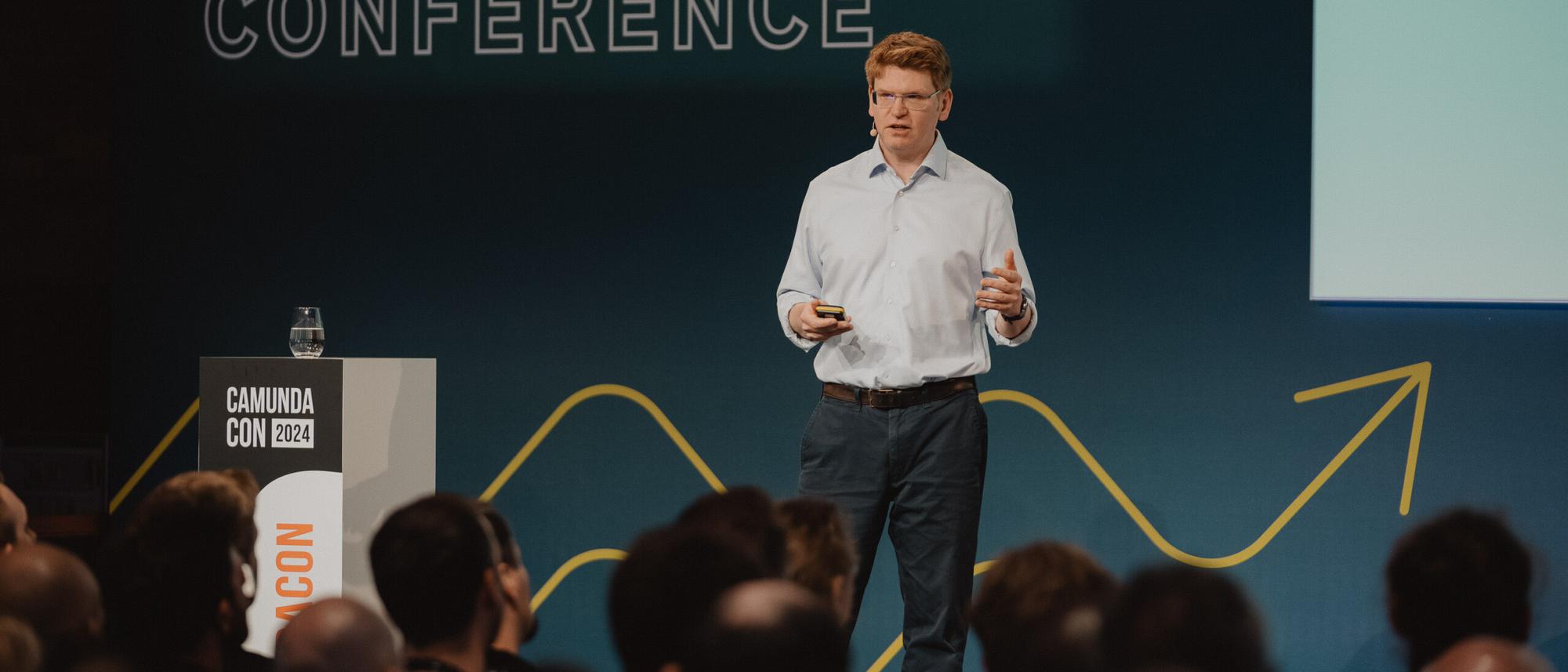
The software also embodied a disagreement with established vendors. Freund objected to the idea that businesses could automate complicated processes while largely bypassing developers. Camunda BPM offered a developer-friendly approach. At its 2013 launch, some observers thought the founders should have stayed with consulting. The product asked them to defend both a business decision and a technical conviction.
Five years later, Freund could point to a team that had grown from 13 to 100, with people in Germany and the United States. He said the company had remained profitable throughout that period. In December 2018, Camunda took its first external funding: €25 million from Highland Europe. The money arrived after a decade of trading.
- 2008Co-founds the consultancy
- 2013Launches the software
- 2018First outside funding
- 2024Crosses $100M ARR
Selected events, not a revenue growth chart. ARR is annual recurring revenue.
Writing the manual, selling the subscription
Alongside the company, Freund and Rücker built a body of practical instruction. Their book, Real-Life BPMN, explains Business Process Model and Notation, the shared visual language used to describe processes. Its audience spans developers, architects, analysts and process owners. A company cannot coordinate work effectively if the people discussing it understand the diagram differently.
When the fourth English edition appeared in 2019, Camunda reported more than 35,000 copies sold across English, German and Spanish editions. The revision addressed microservices: smaller, independently maintained pieces of software that still have to cooperate. The book’s continuing revisions reflect a recurring challenge in Freund’s work. New ways of building individual components keep renewing the need to coordinate them.
The commercial model required another kind of translation. In a 2019 podcast, Freund described developers adopting the open software and then proposing its use in production. Managers had further questions about support, maintenance and operational tools. Enterprise subscriptions bundled additional capabilities with support. At that point, he put subscriptions at about 90 percent of revenue, with consulting supplying the remainder.
That is a useful window into his work as a founder. An engineer’s willingness to try something and an organization’s willingness to depend on it are different decisions, made by different people. Camunda had to serve both. By March 2021, a €82 million Series B led by Insight Partners, with Highland Europe participating, supplied funding for product development and international expansion.
Twenty-five minutes means twenty-five minutes
Freund’s interest in coordination extends to the calendar. In 2022, he published Camunda’s remote-meeting guidelines. They favor meetings in which everyone joins remotely over gatherings where a group in one room talks to a few distant faces on a screen. The point is equal participation. A meeting can technically include everyone while still giving some people a worse seat.
The instructions are wonderfully specific. A half-hour meeting takes 25 minutes. An hour takes 50. Start on time, finish early, and give people room before their next appointment. Presentations should generally be shared beforehand, leaving the meeting for questions and discussion. “Meetings should be for conversations,” he wrote. Many calendars could use a copy editor with that sentence pinned above the desk.
“Meetings should be for conversations.”
Jakob Freund, remote-meeting guidelines, 2022
The rules reveal an operating preference: specify the arrangement instead of hoping goodwill will compensate for it. They also give a concrete shape to his responsibility for company culture. Remote work needs decisions about who speaks, who moderates and how information travels. Even a relatively small recurring meeting can consume a considerable amount of collective attention.
Berlin remains part of his story without requiring a grand headquarters. In early 2025, Camunda had a small office in the city and a largely home-based workforce. Freund said he had never had a private office during the company’s first 16 years. His explanation for starting in Berlin was equally plain: he had been born there.
AI gets a place in the process
As AI became central to Camunda’s product strategy, Freund kept returning to organizational design. In October 2024, he argued that adding AI point solutions to an already tangled collection of systems could create another layer of technical debt. He wanted an architecture capable of incorporating useful new tools while remaining adaptable when the next technology arrived.
By May 2025, he was describing agentic orchestration: combining predictable workflow rules with agents able to handle less predictable work. He pointed to exceptions in financial processes, where people traditionally investigate a transaction that falls outside the ordinary path. His argument made room for AI judgment inside a broader process that still had boundaries, oversight and a record of what happened.
workflow→Bounded
AI task→Review
& record
Illustrative sequence. Human approval belongs wherever the process requires it.
His October 2025 writing sharpened that proposition. Enterprises should be able to adjust an agent’s freedom, insert human review and enforce governance while allowing the agent to respond to circumstances. The ambition is substantial, but the underlying question is familiar from his consulting years: how do several different participants complete one piece of work together?
In May 2026, he pushed further with ProcessOS, presented as a way to discover and redesign processes using organizational knowledge and operational information. His argument was that companies should reconsider how work is arranged around AI capabilities. Faster execution of an inherited sequence may leave its unnecessary steps perfectly intact. Redesign requires asking why those steps exist.
The caution remained tangible. Discussing control at CamundaCon that month, Freund described placing a destructive action, such as deleting a customer, behind a defined workflow requiring human approval. Whatever an agent can reason about, the permitted actions still need an enforceable boundary. A persuasive suggestion and permission to act are rather different things.
Still learning, beyond the diagram
Freund’s public persona includes room for being a beginner. Outside work, he is learning guitar and surfing, activities for which he cheerfully claims little natural aptitude. He enjoys persisting anyway. His stated interest in continuing to grow as a leader carries a similar sense of unfinished work. Running the company still asks him to develop.
There is a fitting connection between those pursuits and the career he has built. A consultancy became a product company; a founder became the leader of an international organization; a familiar automation problem acquired new participants called agents. Each change has demanded another round of learning. The early San Francisco verdict has long since been answered. Freund still has work he wants to understand.