The Company That Automates the Boring Parts of Your Job
It started as a plug-in that let office workers drag boxes into a workflow instead of begging IT for a script. Two decades and a shopping spree of acquisitions later, Nintex is betting its process platform can put AI agents to work without setting the whole building on fire.
Somewhere right now, a purchase order is moving through a company without a single person emailing another person to ask where it is. A form got filled in, a rule checked it, a document got generated, a signature landed, and the whole thing filed itself. Nobody will ever thank the software that did it. That software is very often Nintex, and being unthanked is more or less the business it is in.
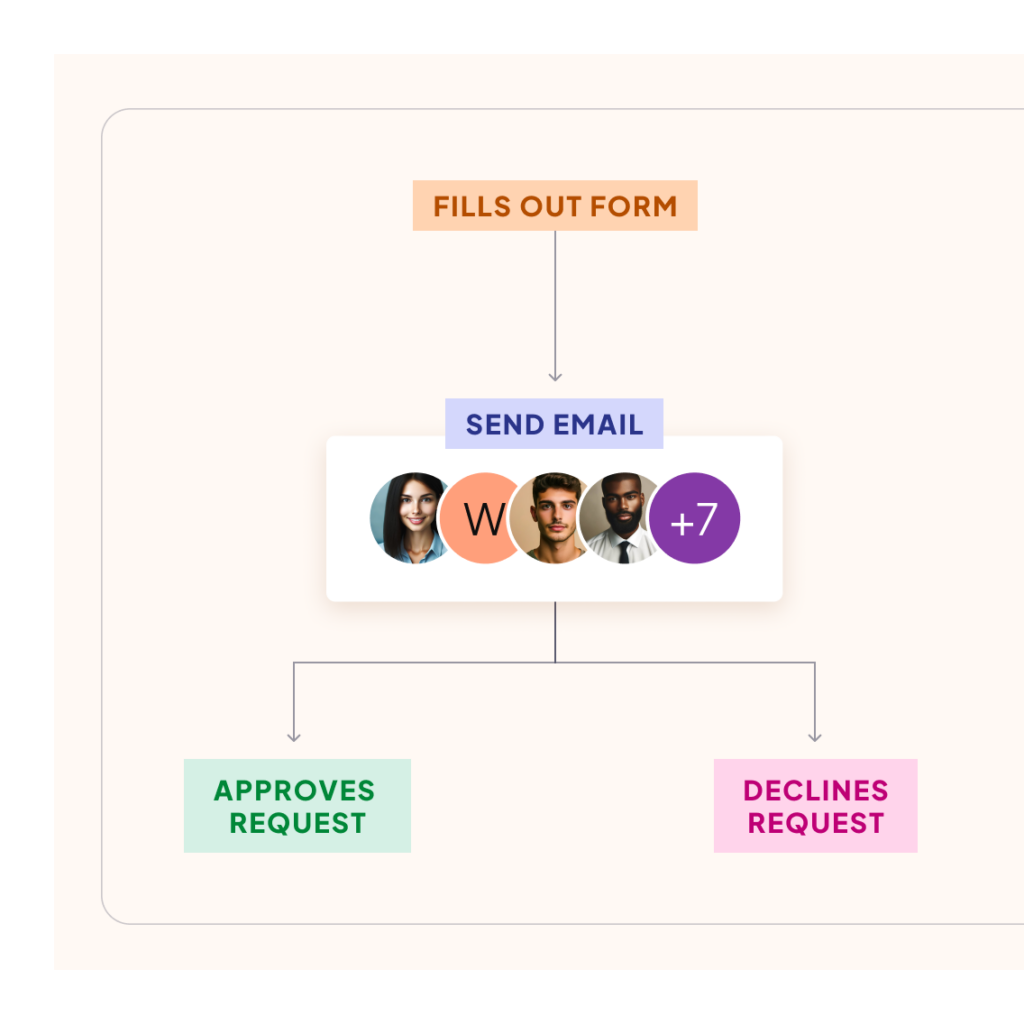
Nintex sells process automation. In plain terms: it lets a company describe how a piece of work is supposed to happen - who does what, in what order, with which approvals - and then it runs that description as software. The people building these workflows are usually not engineers. They are the operations manager, the HR coordinator, the person in finance who owns the expense policy. Nintex's original promise, back in 2006, was that those people could drag boxes around a screen instead of filing a ticket with IT and waiting three weeks.
That promise turned out to be durable. Almost twenty years later, the vocabulary has changed - "workflow" became "digital process automation" became "agentic business orchestration" - but the core job is the same one: take the repetitive, rule-bound work that keeps an organization running and make it visible, then make it run itself.
01 / THE ORIGINA SharePoint plug-in with global ambitions
Nintex was founded in Melbourne, Australia by Brian Cook and Brett Campbell. The first product was a workflow tool bolted onto Microsoft SharePoint, which in the mid-2000s was where a lot of corporate document life happened. If your files lived in SharePoint, Nintex let you wrap process around them - route a contract for review, escalate an approval, notify a manager - without writing code.
The company moved its headquarters to the Seattle area within about a year, chasing the enterprise buyers who set the tone for that kind of software. Today it is based in Bellevue, Washington, though the Australian DNA lingers in its customer base and its product names. One of its most-used tools, Promapp, came out of New Zealand.
02 / THE STRATEGYBuy the adjacent problem, then stitch
Here is the part worth studying. A company can automate a workflow, but a workflow is rarely the whole job. It needs a form to collect data. It needs to generate a document. That document needs a signature. Some of the steps touch old systems that have no API and can only be operated by clicking, like a person would. Each of those is a separate piece of software, and for years customers bought them separately and glued them together themselves.
Nintex decided to own the glue. Between 2019 and 2023 it went on an acquisition run, buying the companies that solved the adjacent slices and folding them into one platform: EnableSoft for robotic process automation, K2 for heavy-duty low-code app building, AssureSign for e-signatures, Kryon for process discovery, and Skuid for low-code interfaces. Same customer, wider footprint.
Funding history reads like a background hum to all this. TA Associates and Updata Partners put in roughly $135 million in 2013. Thoma Bravo took a majority stake in 2018 at about $460 million. Then in 2021, TPG bought the majority in a deal valued at more than $2 billion including debt, with Thoma Bravo keeping a minority position. Private equity bought Nintex twice - and rather than the usual cost-cutting story, both owners used it as a platform to keep acquiring.
03 / THE PRODUCTSWhat's actually in the box
Automation Cloud
No-code and low-code workflows that route work, approvals and data across systems.
Forms
Drag-and-drop digital forms with business logic and validation built in.
DocGen & eSign
Generate quotes, contracts and invoices, then send them for signature.
Process Manager
The Promapp tool for documenting how work actually gets done, collaboratively.
RPA
Software bots that click through legacy systems that have no clean API.
K2 & Skuid
Low-code app building for the heavier, more custom enterprise cases.
Process Manager is the one that tends to surprise people. It is not automation at all - it is a shared, plain-language map of how an organization does things. Toyota, McDonald's, Coca-Cola and Audi have all used it. Think of it as corporate memory that does not walk out the door when someone quits. Before you can automate a process, you have to be able to see it, and a lot of companies genuinely cannot.
Every process, decision, and action, whether manual or automated, flows seamlessly from trigger to outcome - enabling compliance, auditability, security, and oversight.
04 / THE CUSTOMERSWho's actually running on it
Nintex reports more than 10,000 customers, spread across mid-market and large enterprise, in food and beverage, financial services, healthcare, manufacturing and government. The named ones include Sonos, Carfax, Vera Bradley, Virgin Atlantic, L'Oreal and Coca-Cola Beverages Florida - the last of which is a useful example because it runs close to the full platform: workflow, forms, process mapping, document generation and RPA all at once.
That "full platform" pattern is the whole point of the acquisition strategy. A customer that starts with one workflow and ends up running five products is expensive to replace and easy to grow. It is not a flashy business. It is a sticky one.
05 / THE MODELHow it makes money
The business is straightforward B2B SaaS: recurring subscriptions and per-user licensing for the cloud platform, plus licensing for on-prem and hybrid deployments like K2 and the older SharePoint tools. It sells directly to enterprises and leans heavily on a global partner and reseller network - the Nintex Partner Network - to implement and extend the platform. Consulting shops and system integrators build on top of it, which quietly widens its reach.
Deep integrations are part of the moat. Nintex grew up inside Microsoft's world and still connects tightly to SharePoint and Microsoft 365. It also plugs into Salesforce, including DocGen for Salesforce and its Agentforce AI agents - a hint at where the company thinks the next few years go.
06 / THE COMPETITIONWhere it sits on the map
Nintex lives in a crowded middle. Above it sit the enterprise heavyweights - Appian, Pega, OutSystems, Mendix - that court big custom builds and big IT budgets. Below and beside it are lighter, faster tools like Kissflow, Quickbase, ProcessMaker, Zoho Creator, Monday.com and Airtable that win on ease and price. On the robot side it bumps into UiPath and Automation Anywhere.
Its position is the breadth play: not the deepest developer platform, not the simplest form builder, but the one that covers workflow, forms, documents, mapping and robots under a single roof with a low-code front door. For a mid-market company that does not want to assemble five vendors, that bundle is the pitch.
07 / THE BETAgents that can act, but can be audited
The 2026 story is AI, but with a specific angle. Plenty of companies are shipping AI agents that can take actions on their own. Fewer are asking who is watching them, and what happens when an agent quietly does the wrong thing to a real invoice. Nintex's pitch, branded "agentic business orchestration," is to put agents inside workflows that are already governed - where every step, human or machine, is logged, permissioned and auditable.
In late 2025 it introduced the vision and added AI document processing. In March 2026 it shipped Agent Designer and Orchestration to select customers, letting them build AI agents natively inside the platform rather than as disconnected pilots off to the side. The through-line back to 2006 is intact: the value is not the agent, it is making the process the agent runs in visible and controllable.
Move beyond the clutter of software sprawl and the risks of disconnected AI pilots - into a future where every process is purposeful, adaptive, and outcome-driven.
There is a leadership question hanging over this chapter. Mathradas, who took the top job in 2023, departed in February 2026 to become CEO of Five9. Whoever runs Nintex next inherits a platform that has spent five years buying and integrating, and now has to prove that the sum can sell the AI story better than the parts ever sold workflow.
08 / THE TAKEAWAYThe quiet compounding of unsexy software
Nintex is a case study in a specific kind of durability. It picked a boring, universal problem - paperwork and process - solved one slice, then bought the neighbors. It survived two private-equity owners not by cutting to the bone but by using their capital to keep buying. And it stayed close enough to how work actually happens that when the AI wave arrived, it had something to sell that was not a demo: the governed workflow the AI would live inside.
Most people will never see its logo. Their purchase orders, expense reports and signed contracts will keep moving anyway.