A customer cancels an internet subscription. The account closes. The equipment, however, has its own itinerary. Somebody must ask for it, arrange postage, record its arrival and make sure the former customer is no longer charged for keeping it. A seemingly small administrative task has become a relay race. The baton is a device that costs money.
- SYDLE ONE connects processes, documents, customers and billing.
- Its Alloha case follows a physical outcome: equipment coming back.
- The lesson: automate the handoff, then measure what arrives.
At Alloha Fibra, the Brazilian telecommunications group, that relay had too many manual steps. Customer contact, collection tracking and receipt processing needed coordination. SYDLE’s published case puts the equipment-return rate before the project at 25%. Three out of four devices were failing to make the return trip.
The device that came back
The intervention was remarkably concrete. A cancellation sets a process in motion. A WhatsApp chatbot offers the customer a voucher to return equipment through Correios, Brazil’s postal service. The voucher comes from connected process and customer data. When the device arrives, staff check it, enter it into stock and update the contract.
There are branches in the sequence. A customer who misses the deadline gets a reminder. If the equipment still does not arrive, billing can issue a payment slip. The point is that each event has a next step, and the next step belongs to a system that can see what happened before it.
SYDLE reports that the first phase, including the Correios and WhatsApp integrations, took 45 days. By the second month of operation, more than R$6 million in equipment had been collected. Returns rose to over 70%. Between August 2023 and April 2024, Alloha recorded approximately 46,000 equipment collections.
Those numbers describe recovered equipment value and collection activity. They are not a profit figure. Still, they make an unusually useful demonstration of enterprise software: an asset that was outside the business came back inside it.
A platform with gravity
Founded in 2005 by Daniel Cataldo Zamagna, SYDLE is based in Belo Horizonte. Its central product, SYDLE ONE, combines business process management, enterprise content management, customer relationships, analytics and service requests. Billing and e-commerce extend that reach into collecting money and making sales.
The company calls its integration approach “gravitational architecture.” The astronomical language is playful; the practical proposition is straightforward. Keep business functions connected around a common platform while integrating other systems that the organization already uses. Alloha’s postal connection is an example of why the outside connections matter.
- 01Cancel
- 02Send voucher
- 03Receive device
- 04Update records
Each module contributes something distinct. BPM supplies collaborative modeling in BPMN notation, forms and process execution. ECM adds searchable documents, OCR, version history, permissions and digital signatures. CRM handles customer histories, sales funnels and lead scoring. Analytics turns operational information into dashboards. Service Desk gives internal and external requests somewhere to go.
That combination places SYDLE among enterprise workflow and business-application platforms. A buyer might also examine process specialists such as Appian or Pegasystems, a service platform such as ServiceNow, or separate CRM, document and billing products. This is a comparison of approaches: SYDLE’s proposition centers on bringing several of those jobs together.
The factory behind the factory
SYDLE says its technology reaches thousands of customers in more than 80 countries. Its customer page displays organizations including Petrobras, Carrefour, Bayer, Mater Dei and Stellantis. The breadth matters because cross-department work turns up almost everywhere, wearing a different uniform.
At Stellantis, the published case starts with administrative processes: standards, procedures and personnel administration. It then describes fleet tracking, legal deadlines and asset information used for certifications. These are the routines behind the finished vehicle, where an overlooked response or missing record can complicate everyone else’s work.
An asset that was outside the business came back inside it.The Alloha case, in one sentence
The case says Stellantis evaluated alternatives and wanted orchestration, governance and automation together. That is a useful explanation of the purchase decision. The appeal was a connected way to run operations, with flexibility to change the processes as the organization’s needs changed.
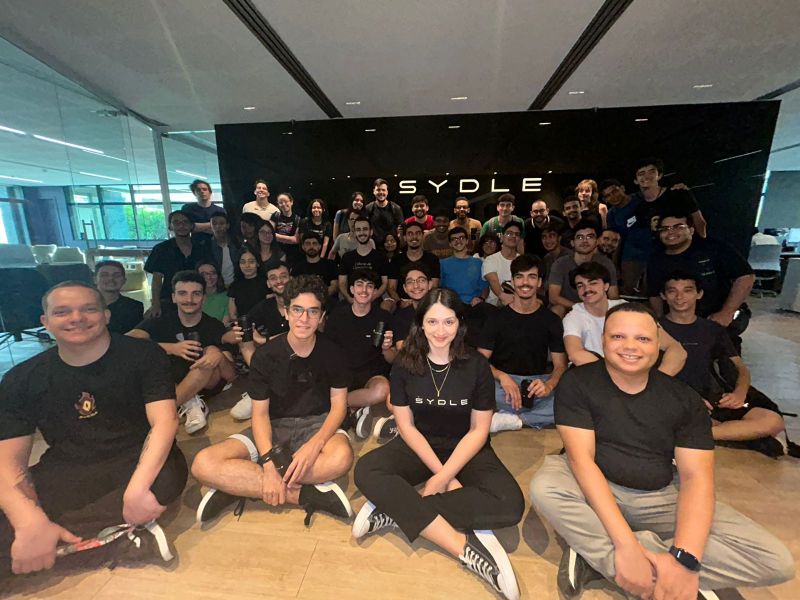
There is a cultural detail worth keeping alongside the product list. SYDLE describes its workplace as informal and receptive, with technical challenges and opportunities to develop. Its Brazilian LinkedIn profile emphasizes repeated workplace recognition. The university visit pictured here offers a smaller, more ordinary glimpse: students encountering the people and work behind a software company.
The price of joining things up
SYDLE sells subscriptions in tiers. On its Brazilian pricing page, Rocket lists R$99 per user per month with annual payment and a minimum of 20 users. That implies R$1,980 a month before other costs. Planet lists R$129 with annual payment and a 50-user minimum. Monthly payment carries higher per-user prices.
Star starts at 100 users and offers negotiated volume pricing, unlimited external users, and private-cloud or on-premise options. A Lab trial supports up to ten users. Implementation, storage and customization belong in a buyer’s budget alongside licenses. The Alloha recovery number should not be mistaken for a disclosed project return on investment.
The distinction between a departmental tool and a shared platform becomes important when evaluating these plans. A sales team may need customer records; a wider operation may also need service portals, document approvals and billing. Buying the broader package makes sense only when those connected functions solve an actual operating problem. The sensible demonstration therefore follows a complete piece of work, including the exceptions, rather than stopping at a polished dashboard.
SYBOX supplies ready-made solutions and templates for areas including HR and finance. Partners can provide deployment, development, consulting, training and support. The business model acknowledges something the platform diagram can hide: connecting work also takes people who understand it.
Follow one job all the way home
The practical lesson is available before anyone buys software. Pick one event, such as cancellation, and follow it through customer service, logistics, inventory and finance. Write down the owner of each step, the information required and the evidence that the step finished.
That approach depends on reliable records, functioning integrations and people recording physical events accurately. A workflow cannot register a device that nobody checks in. For organizations with substantial cross-department operations, SYDLE offers a way to make those connections executable. Alloha’s case leaves a satisfying test for the buyer: follow the device, and see whether it gets home.