At Yorozu’s automotive plant in Alabama, the problem was unusually ordinary. Quality records and forms were hard to track. Production was growing. The software came from several providers. Somewhere between making a component and finding its paperwork, the organization was losing time. In SoftExpert’s published account, quality director Kenny Reed describes a business whose information systems could no longer keep up with its work.
- What it does: connects quality, documents, risk and workflows.
- Who buys: organizations that need repeatable work and retrievable evidence.
- Why care: fewer disconnected approvals can mean less waiting, searching and rework.
SoftExpert’s answer was an integrated system: controlled documents, automated routines and tools for investigating problems. The company now reports that Yorozu Alabama reduced document approval times by more than 80%. That result belongs to one customer case. But the underlying question travels well: how much of your working day disappears between systems?
The trouble starts between systems
Ricardo Lepper founded SoftExpert in Joinville, Brazil, in 1995. Its early business centered on quality management and standardizing organizational processes. Isodoc Web arrived in 2002; an integrated Excellence Suite followed in 2008. The sequence matters. A document becomes more useful when it belongs to a process, with a responsible person and a record of what happened next.
Today, SoftExpert sells software for that connected world of work. It reports more than 3,000 customers and over 3 million users across more than 50 countries. A quality manager can control procedures. An auditor can examine evidence. A process owner can build forms and route approvals. A risk team can link controls to obligations. The company’s stated mission emphasizes organizational excellence and sustainability. In practice, its expertise sits in the machinery of accountability: versions, permissions, deadlines and traceability.
“We were having problems tracking quality records and forms for the products we manufacture and assemble.”
Kenny Reed · Quality Assurance Director, Yorozu
In SoftExpert’s customer account
The factory remembers
Endutex, the Portuguese technical-textiles producer, offers another view. Its quality and production work relied on Word files, Excel spreadsheets and paper records. Those tools were becoming difficult to manage as operations grew. The initial need included automotive quality methods; the implementation subsequently spread into other areas.

Operators entered information through forms at their workstations. Records carried operator identification and histories of control parameters. Dashboards connected production with quality and other performance measures. SoftExpert’s case describes traceability across more than 670,000 records. The appeal is specific: a manager can investigate an event through its recorded history, rather than reconstructing it from separate files and somebody’s recollection.
One workflow. A record that follows the work.
Breadth is the product
SoftExpert Suite is modular. Quality management sits alongside business process management, enterprise content, governance, risk and compliance. Other products cover assets, suppliers, projects, product development and environmental management. Customers can add functions as their requirements grow. The commercial promise is that these functions share an environment, reducing the work of joining separate applications.
That places SoftExpert across several markets. MasterControl is an alternative for quality and corrective-action processes; MetricStream overlaps in governance, risk and compliance. Both also connect related functions. SoftExpert’s distinction is its particular breadth across operational workflows, content and management disciplines. Buyers should test the connections their own work requires, rather than treating a long module list as proof of fit.
Its customer stories span automotive manufacturing, textiles and pharmaceuticals. At Covercraft, acquisitions created a need for common quality controls across facilities. At biotechnology company BIOMM, spreadsheet-based document flows were consuming staff time and inviting errors. Different products, different factories, a familiar administrative headache.
The price of getting organized
SoftExpert’s public plans use two inputs: the selected plan and the number of users. Billing is monthly by invoice. Enterprise purchases through AWS Marketplace use private offers negotiated with the vendor. Consulting, integration, training, validation and cloud services also form part of the company’s offering. A useful buying conversation therefore needs a defined deployment, including which systems and people must participate.
lower document management costs
Published customer case; an outcome, not a subscription price.BIOMM’s case reports a 40% reduction in document management costs after moving the work onto SoftExpert in the AWS cloud. That measures an operating outcome, not the software bill. Anyone evaluating a similar project should separate the purchase price from the time spent handling records, chasing approvals and maintaining the old arrangement.
AI meets the approval queue
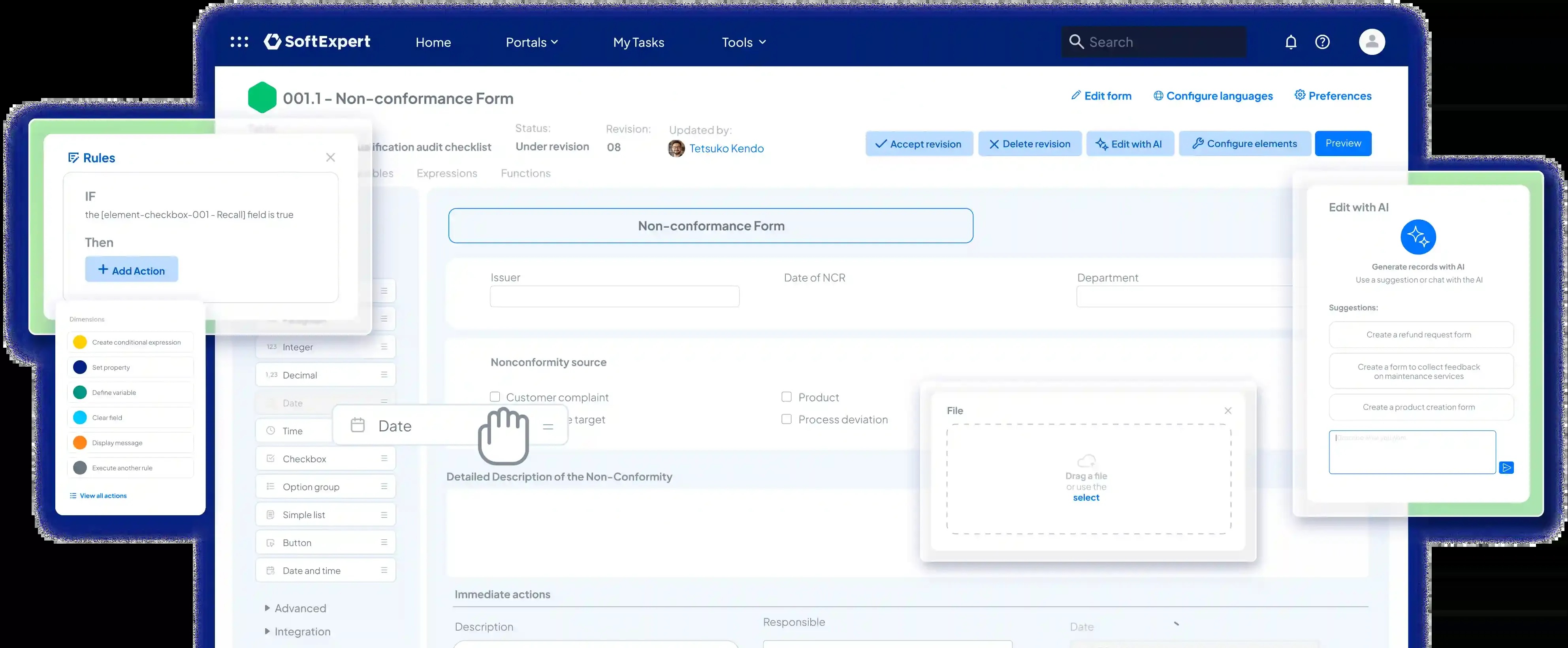
The June 2026 Suite 3.0 update takes aim at recognizable chores. AI can propose a project structure from a text description, turn recorded meeting decisions into an action plan, and summarize differences between document versions. A Compliance Reader extracts and organizes requirements from regulatory PDFs. These features put assistance inside existing work, where someone already has a decision to make.
The market is still expanding. In August 2026, SoftExpert announced that Vestel Mobility had adopted its technology for supplier quality management. A German referral partnership with Lead2Deal Consulting, announced the previous month, adds another route to customers and implementation partners. These are specific distribution and customer developments, rather than evidence that every implementation will produce the same savings.
There is a useful complication in SoftExpert’s own September 2026 governance report announcement. Among surveyed business leaders, 64% cited a lack of digital culture as a challenge, while 62% pointed to outdated or disconnected systems. This is the vendor’s research, with an obvious commercial interest. Still, the pairing captures the implementation problem: connecting the applications and changing everyday habits are separate pieces of work.
Start with one stubborn handoff
The practical lesson is to choose one recurring delay, name its owner and follow the evidence from start to finish. Measure approval time before expanding. This approach needs people willing to agree on a process and maintain its records. A team seeking only a simple task list may find little value in the wider suite. Software can preserve an agreed way of working; the agreement still has to happen.