The best reason to use n8n is not that it can connect one app to another. Plenty of software can notice a new spreadsheet row and send a Slack message. Choose n8n when the job gets nosy: when it must ask an API for more context, branch on the answer, call a model, wait for a human, retry politely, update three systems, and leave enough evidence for somebody to understand the mess on Tuesday morning.
That somebody is usually technical, or at least cheerfully API-literate. n8n is built for developers, IT and security operators, data teams, automation consultants, technical marketers, and solo builders who have graduated from two-step recipes. It gives them a visual canvas without confiscating JavaScript, Python, HTTP requests, webhooks, GraphQL, or the command line. The result feels less like a row of dominoes and more like a subway map drawn by the person who has to keep the trains running.
Our short verdict: n8n is a strong fit when control, complex logic, data location, or AI observability matter more than instant beginner comfort. If the task is simply “form submitted, send email,” Zapier is friendlier. If your workflow keeps growing clauses, n8n earns its keep.
Who should actually use it?
Start with the uncomfortable truth: n8n is often called no-code, but its happiest users know what JSON looks like. G2’s review summary praises flexibility, integrations, the visual builder, and self-hosting, then names the learning curve as a recurring complaint. Reddit users tell roughly the same story in less diplomatic language. One migration thread celebrates custom logic and self-hosting, while warning that organization, error handling, version control, and access management become real work.
That is useful friction if the alternative is hiding complexity. A support lead can build a triage flow that reads Zendesk, checks Salesforce and PagerDuty, asks a model to summarize the incident, then posts to Teams. A security team can enrich alerts while keeping deterministic checks outside the model. A founder can glue a form, database, billing system, and email service together before hiring a backend team. An enthusiast can run the whole contraption on a small home server, assuming they enjoy maintaining small home servers.
The useful middle: rules beside judgment
A canvas with trapdoors
Each n8n workflow is a graph of nodes. A trigger starts it. Other nodes fetch, transform, classify, merge, loop, wait, or act. You can inspect the data entering and leaving a step, pin sample data while building, and replay executions when something fails. Those mundane details are the product. Automation looks glamorous in a demo; in production, the winning feature is finding the bad field without reading 400 lines of logs.

The current repository materials advertise more than 1,500 integrations and 9,000 templates. The homepage gives a more conservative count of 500-plus integrations, which reflects a difference in how connections and actions are counted. Either way, the important node is the generic HTTP Request. It means an undocumented niche service is an inconvenience, not necessarily a dead end. Custom nodes provide a deeper route for repeated internal use.
| Capability | Why it matters | Where the work hides |
|---|---|---|
| Visual canvas | Branching logic stays readable and shareable. | Large workflows need naming, modules, and discipline. |
| Code nodes | JavaScript and Python handle transformations the UI cannot. | Now you own code quality and tests. |
| Self-hosting | Choose where credentials and execution data live. | Updates, backups, security, and uptime become yours. |
| AI agents | Models can use tools inside deterministic workflows. | Prompts, permissions, evaluations, and failure paths still need design. |
| Execution history | See inputs, outputs, tool calls, and errors. | Retention and advanced insights vary by plan. |
The AI part, minus the séance
n8n’s timely trick is placing probabilistic AI inside predictable software. A model may decide whether a support request sounds angry; a fixed rule can prevent it from issuing a refund over $100 without approval. Builders can swap model providers, expose sub-workflows as tools, add memory, demand structured output, pause before sensitive actions, and inspect what the agent called. The canvas makes uncertainty visible instead of pretending it disappeared.
“n8n was the big unlock. Tools like ChatGPT and Claude are great, but n8n is the thing that allows you to integrate AI into your work.”Ollie Scheers, Huel · n8n customer story
The platform also speaks MCP in both directions. One trigger can expose a workflow as a tool to an AI client. The first-party n8n MCP server, expanded in April 2026, lets compatible clients such as Claude, ChatGPT, and coding editors create, update, validate, and run workflows in an n8n instance. In August, n8n added OAuth connections to 70 MCP servers from the node panel. That removes credential plumbing for services including Notion, Stripe, GitLab, Airtable, Grafana, Miro, and New Relic.
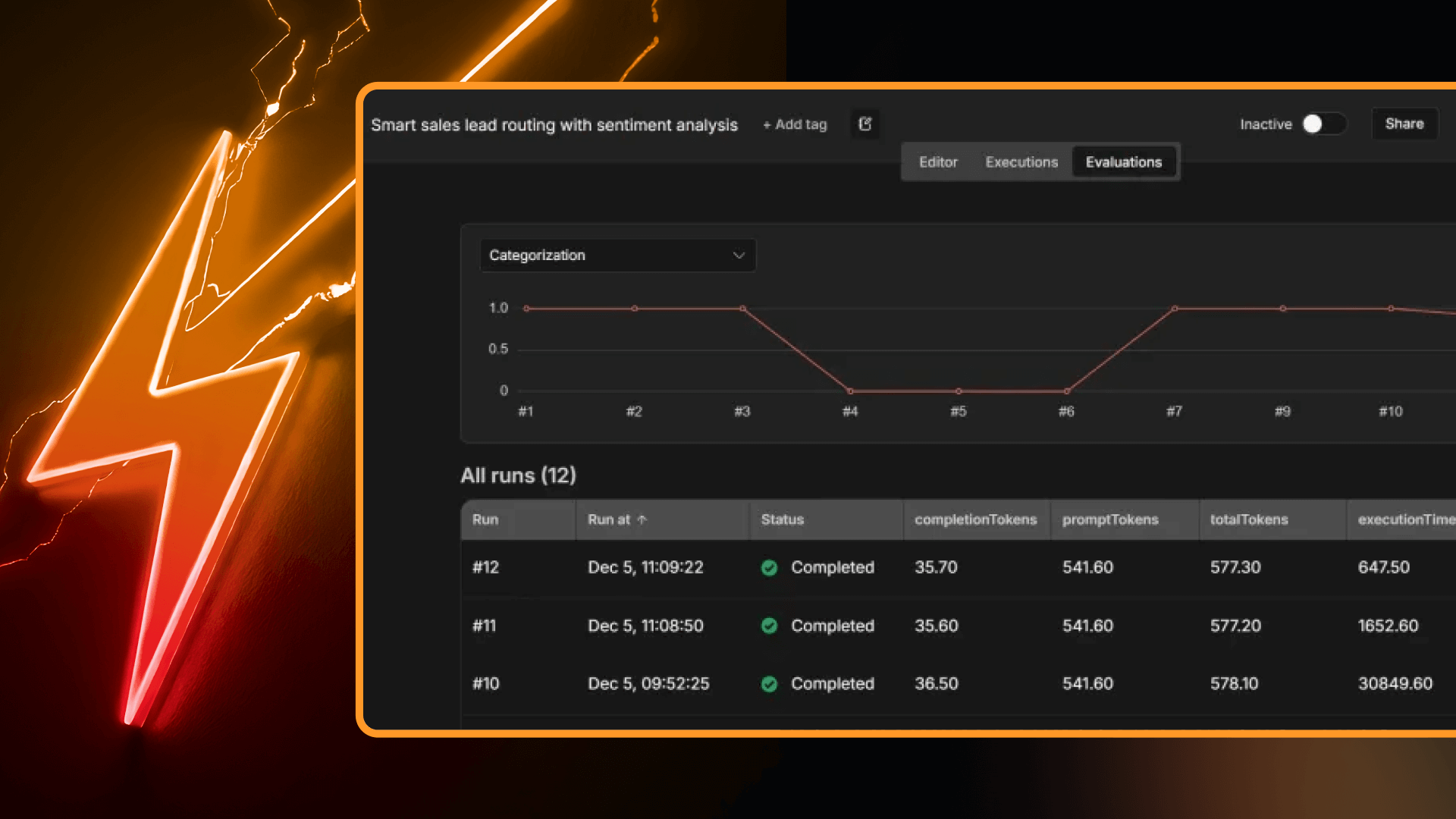
Version 2.0, released in December 2025, was deliberately unglamorous. Code runs moved into isolated task runners by default. Environment variables became unavailable to code nodes unless explicitly enabled. Save and Publish split, so editing a live workflow no longer changes production immediately. A migration report flags breaking changes. n8n also reported that a new SQLite pooling driver reached up to ten times the speed in its benchmarks. This is grown-up plumbing, and it matters more than another sparkling agent demo.
The bill, and the box it arrives in
The free Community Edition is the obvious laboratory. You can self-host it and receive the core 2.x product, but “source available” is the precise phrase. n8n uses its Sustainable Use License, which allows many internal and non-commercial uses while restricting certain resale, embedding, and competing hosted services. Read the license before building a business on top of it. Free software and free rein are different invoices.
Cloud Starter is listed at €20 a month billed annually for 2,500 executions; Pro is €50 for 10,000. Business is a self-hosted paid tier at €667 a month billed annually for 40,000 executions, adding collaboration, identity, environments, Git version control, and scaling features. Enterprise is quoted. The pleasant wrinkle is that n8n counts a complete workflow run as one execution, however many steps it contains. For a sprawling workflow, that can be easier to forecast than rivals that meter every operation. Prices change, so check before buying.
| Product | Best first thought | Main compromise |
|---|---|---|
| n8n | “I need control, code, or self-hosting.” | More concepts and operational responsibility. |
| Zapier | “Make these common apps talk by lunch.” | Complex, high-volume flows can become costly or constrained. |
| Make | “I want a rich visual builder without hosting it.” | Operations-based billing and dense scenarios require care. |
| Pipedream | “Give developers hosted workflows close to code.” | Less approachable for non-developers. |
| Power Automate | “Our company already lives inside Microsoft.” | Licensing and environment governance can be intricate. |
Receipts from the real world
The customer cases are more persuasive than star counts. Delivery Hero says one account-recovery workflow, built in five hours, saved 200 employee hours a month by coordinating approvals and calls to Okta, Jira, and Google systems. Vodafone reports that 33 workflows supporting security operations and monitoring saved 5,000 person-days and avoided £2.2 million in cost. These are company-published case studies, so treat the numbers as customer claims, not laboratory measurements. They still show the kind of work n8n is good at: repetitive, cross-system, auditable, and too peculiar for an off-the-shelf connector.
“The visual workflow builder is easy to pick up... it still lets me build fairly complex logic when I need it.”
Validated G2 reviewer · April 2026“The UI can feel overwhelming when trying to map complex JSON data without a background in Javascript.”
Validated G2 reviewer · April 2026Both comments can be true. n8n shortens the distance between idea and working system, but it does not repeal systems thinking. Credentials expire. APIs paginate. Models hallucinate. Webhooks arrive twice. A visual box labeled “AI Agent” can still delete the wrong record if you hand it a reckless tool. n8n gives you handles for those problems. It does not pull them for you.
How to buy without making a small mistake
Test one workflow that is genuinely annoying, not a ceremonial Slack notification. Pick a process with three systems, a branch, one failure case, and data you understand. Build it in Cloud during the trial if you want speed. Use Community Edition if data residency, cost at volume, or infrastructure control is the point of the experiment. Then measure run frequency, execution time, error rate, stored history, and who will maintain credentials.
Do not begin with an autonomous agent holding write access to the company database. Start deterministic. Add AI only where judgment adds value, constrain its tools, require structured outputs, and put human approval before expensive or irreversible actions. Break large workflows into named sub-workflows. Create an error workflow before the first important failure. If nobody owns the automation, it is merely a future mystery with a schedule trigger.
The final choice is simple. Buy n8n when your team wants to see and shape the machinery. Skip it when nobody wants to learn APIs, operate a server, or debug structured data. For the right builder, the canvas feels like permission: draw the process, open a trapdoor into code, and keep the robot where you can see it.
Keep digging