At 7:13 on a wet Tuesday evening, Delivery Hero is not really delivering dinner. It is clearing a queue. Somewhere, a restaurant has accepted an order; a payment has passed its checks; an algorithm has estimated when the kitchen and a rider will be ready at the same time. A customer watches a tiny vehicle inch across a map. The food is the visible object. Coordination is the product.
The Berlin company has spent fifteen years assembling that product across a map most consumers never connect. In the Gulf, they know talabat. In Southeast Asia, foodpanda. Latin America has PedidosYa; Turkey has Yemeksepeti; South Korea has Baedal Minjok. Add foodora, Glovo, efood, foody and InstaShop, and Delivery Hero looks less like one global app than a federation of local habits.
That distinction explains both its reach and its operating logic. The restaurant names, language, promotions and neighborhood instincts stay local. Much of the expensive machinery underneath - ranking, payments, fraud controls, dispatch, estimated arrival times, data systems and experimentation - can be shared. Delivery Hero's edge is not that everyone recognizes its corporate logo. It is that eleven consumer brands can borrow one another's engineering homework.
The global company that prefers a local name
Delivery Hero began with online food ordering. Niklas Östberg had started a Swedish ordering service in 2008; in 2011 he joined Markus Fuhrmann, Lukasz Gadowski and Kolja Hebenstreit to form the group in Berlin. The early pitch was almost quaint: no telephone call, no paper menu, a restaurant could receive the order by fax or computer, and the platform took a commission.
The fax disappeared. The commission survived. So did a more important idea: demand can be aggregated locally and infrastructure can be scaled internationally. Acquisitions brought foodpanda, Yemeksepeti and other operators into the group. Delivery Hero went public in Frankfurt in 2017, joined the DAX in 2020 and later returned to the MDAX. Its portfolio now reaches around 65 countries on four continents.
For a customer, the bargain is time. The app turns dozens of menus and shop inventories into one searchable shelf, handles payment and gives the uncertainty of a courier trip a progress bar. For a restaurant or retailer, it supplies discovery, order processing, promotions and - when needed - a delivery fleet. The merchant gives up a commission and some control in exchange for demand and logistics it may not be able to build alone.
Dinner was the habit-forming wedge
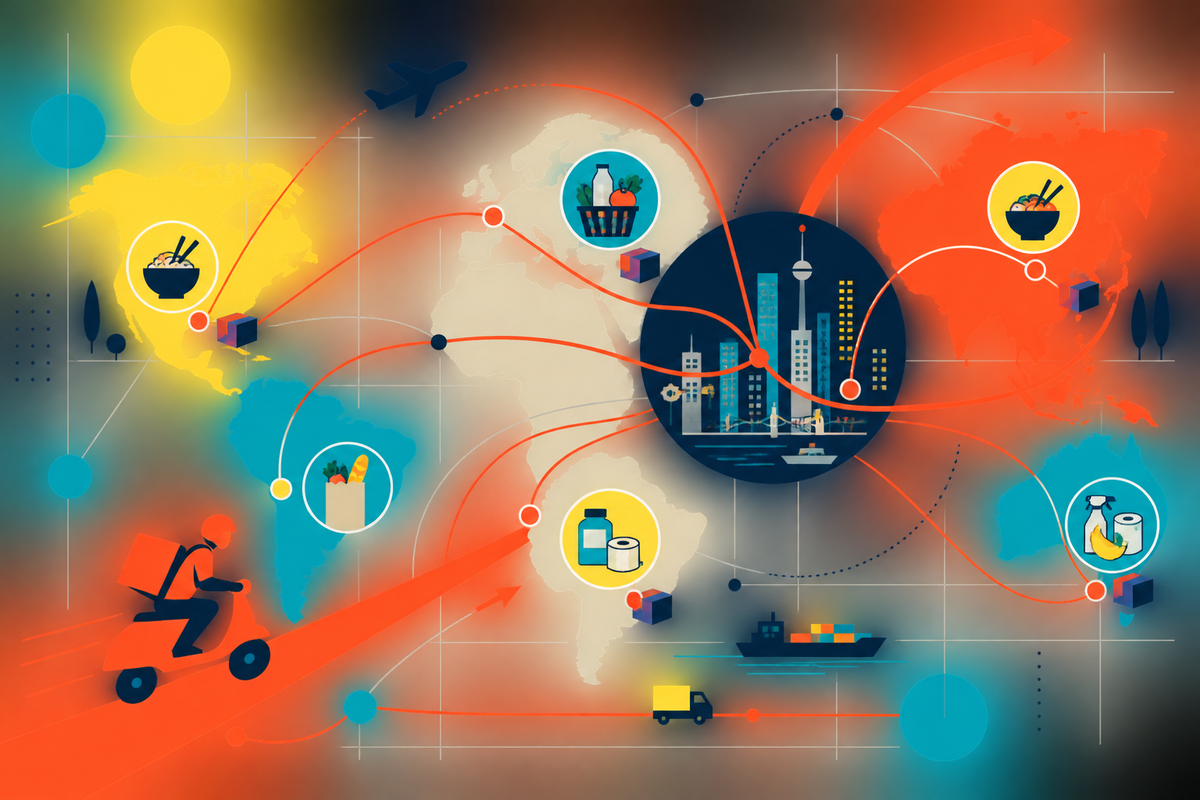
Prepared food is urgent, emotional and pleasantly repetitive. It taught millions of people to trust a stranger with the last mile. Delivery Hero's next move is to reuse that trust for the things people forgot, ran out of or simply do not want to fetch: milk, diapers, pet food, flowers, painkillers, shampoo.
The company calls the strategy the "Everyday App." The phrase is corporate, but the behavior beneath it is plain. A food-only customer might order on Friday night. A multi-category customer has reasons to open the app from breakfast through bedtime. Delivery Hero says customers who use food and quick commerce spend about five times more than food-only customers. In 2025, quick-commerce GMV grew more than 30 percent to over EUR 7.5 billion.
Two supply systems make the promise possible. Local shops contribute breadth: a pharmacy, florist, supermarket or coffee specialist can expose nearby inventory without Delivery Hero owning it. Dmarts contribute control. These compact, delivery-only supermarkets stock frequently ordered goods in layouts designed for picking rather than browsing. Delivery Hero says an order is usually picked, packed and ready to leave in less than four minutes.
“Real life is messy and people just want things to work.”Milena Lazarevska, head of quick commerce
That four-minute pick is impressive and incomplete. The costly portion is still moving one small basket through a city. Density matters: more nearby orders can improve rider utilization, shorten empty travel and spread local operating costs. Forecasting matters because a fast warehouse with the wrong bananas is just a very efficient disappointment. The technical expertise sits in balancing inventory, courier supply, merchant preparation and a promise made before any of those variables settle.
How the checkout becomes revenue
Delivery Hero earns from several layers of the transaction. Restaurants and retailers pay marketplace commissions. Customers may pay delivery and service fees. Dmarts generate retail sales because the group controls the inventory. Subscriptions trade a recurring fee for delivery benefits. Advertising lets merchants and consumer brands buy sponsored visibility at the moment a shopper is deciding. Some markets add payment fees.
The mix matters. A courier trip has a physical cost every time. An ad impression does not. A subscription can improve retention before a new order arrives. A denser route can make the same delivery fee more useful. The strategic aim is to stack higher-frequency demand and higher-margin services on top of infrastructure already in place.
The financial turn is visible. Total segment revenue reached EUR 14.8 billion in 2025. Adjusted EBITDA increased 30 percent to EUR 903 million, and free cash flow before extraordinary items reached EUR 250 million, the second positive year in a row. Integrated Verticals, which includes much of the owned quick-commerce infrastructure, reached adjusted EBITDA break-even for the year. Growth is no longer being graded without a margin column.
The moat comes with traffic
Competitors are everywhere: Uber Eats, DoorDash and Wolt, Grab, Just Eat, iFood, Swiggy, Meituan and strong national apps. The offline rivals count too - a restaurant's own website, the phone, pickup, a supermarket around the corner. Switching costs for customers can be little more than a second app and a coupon.
Delivery Hero's defense is a bundle rather than a single trick: local brand recognition, hundreds of thousands of merchants, courier density, a broad geographic portfolio, Dmarts and an engineering base that works on search, recommendations, fraud, payments and route prediction at unusual scale. Its verified public GitHub organization offers a small window into that technical culture, with open-source work spanning Go pipelines, Android tooling, observability and Kubernetes.
Scale also magnifies friction. Worker classification can change costs abruptly. Glovo shifted roughly 15,000 Spanish couriers toward employment status after years of regulatory pressure. In June 2025, the European Commission fined Delivery Hero and Glovo a combined EUR 329 million for cartel conduct involving labor-market allocation and exchanges of sensitive information. Delivery platforms solve coordination problems while creating new questions about bargaining power, work and market concentration.
The company has tried to give its far-flung workforce common language through principles such as Deliver Value Fast, Raise the Bar, Stay Humble and Bring Good Vibes. It reports employee resource groups, accessibility programs and a DEI advisory board. At the end of 2025 it employed 54,721 people, swollen partly by Spain's shift from freelance riders to direct employment. Culture here is not office decoration. It is how a central team asks a local operator to move faster without losing the local knowledge that justified buying it.
The deal that redraws the delivery map
On July 16, 2026, Delivery Hero and Uber signed a business-combination agreement supporting a cash offer of EUR 41.50 per share, implying an equity value of about EUR 13 billion. The companies say they will remain fully independent until closing, expected in the second half of 2027 if acceptance, competition approvals and other conditions are met.
The map cannot simply be folded together. Delivery Hero separately agreed to sell businesses in 14 markets where it overlaps with Uber Eats to SSW Partners for about EUR 1.4 billion. Those operations include parts of foodora, Glovo, PedidosYa, efood, foody and Yemeksepeti. Fifty other markets, representing $42 billion of 2025 GMV, are slated to join Uber. The carve-out is a practical diagram of where delivery consolidation runs into competition policy.
A food-ordering marketplace begins turning local menus into a global portfolio.
Delivery Hero raises approximately EUR 1 billion in Germany's largest listing that year.
Groceries, household goods, Dmarts and own delivery become central to the strategy.
The MENA subsidiary raises about $2 billion gross while Delivery Hero keeps majority ownership.
A conditional takeover and a 14-market carve-out open the next chapter.
There is a sharp strategic logic to the proposed combination. Uber brings mobility, memberships and a vast consumer network. Delivery Hero brings leading local brands in markets where Uber wants more density. Yet the reason the assets are valuable is the same reason integration will be delicate: local delivery is local. A route model can travel. Restaurant relationships, labor rules and dinner preferences often do not.
Until the deal closes, Delivery Hero's job remains stubbornly operational. Put the right item in the right bag. Send the right rider at the right minute. Predict an arrival without pretending cities are predictable. Do it often enough that a Friday dinner app earns a place on Tuesday morning. The company started by removing the telephone call from takeaway. Its larger invention is the expectation that a city can answer almost any small need on demand.