On a university campus, a little delivery robot is almost too easy to love. It waits at a crossing, threads through a crowd, and brings lunch without asking for a tip. On the commercial ledger, though, the performance is judged by a colder audience: the calendar. Students leave for summer. Dining contracts expire. The robot still needs work.
- Starship builds and operates small, autonomous sidewalk robots for food, grocery and site deliveries.
- Its fleet passed 10 million deliveries in 2026, after years of work on U.S. campuses and European city streets.
- In June 2026, Starship said it would wind down U.S. campus operations and redeploy more than 1,200 robots toward urban grocery and hot-food routes.
- The reason is economic: Starship says a robot grocery drop costs $3–$4 less than traditional courier fulfillment. That is the company’s figure, not an audited market average.
This is the odd shape of Starship Technologies’ story. The six-wheeled machine was the star of its first act. The second act depends on something less photogenic: whether a grocer can send that machine out often enough, over short enough routes, to make a basket of ordinary shopping profitable to deliver. In 2026, Starship decided the answer mattered more than keeping its robots on the American quad.
A moon rover found its earthly errand
Starship was founded in Tallinn in 2014 by Ahti Heinla and Janus Friis, both tied to Skype’s founding era. Heinla had previously entered a NASA robotics challenge. The moon rover did not win; the experience helped point him toward a more immediate assignment. The distance between a shop and a front door is shorter than a lunar traverse, but the pavement has a talent for surprises.
Starship’s product is a delivery service built around a compact electric robot, not merely a robot sold in a box. Its current e-model travels mainly on sidewalks at walking pace, carries up to three shopping bags in an insulated compartment, and lets the recipient unlock the lid by phone. Cameras, radar, ultrasonic sensing and software help it recognize people, pets and other obstacles. A remote human can assist when needed. Starship says the fleet operates at over 99% autonomy; the point of that figure is operational, since a delivery business cannot place a person behind every vehicle.
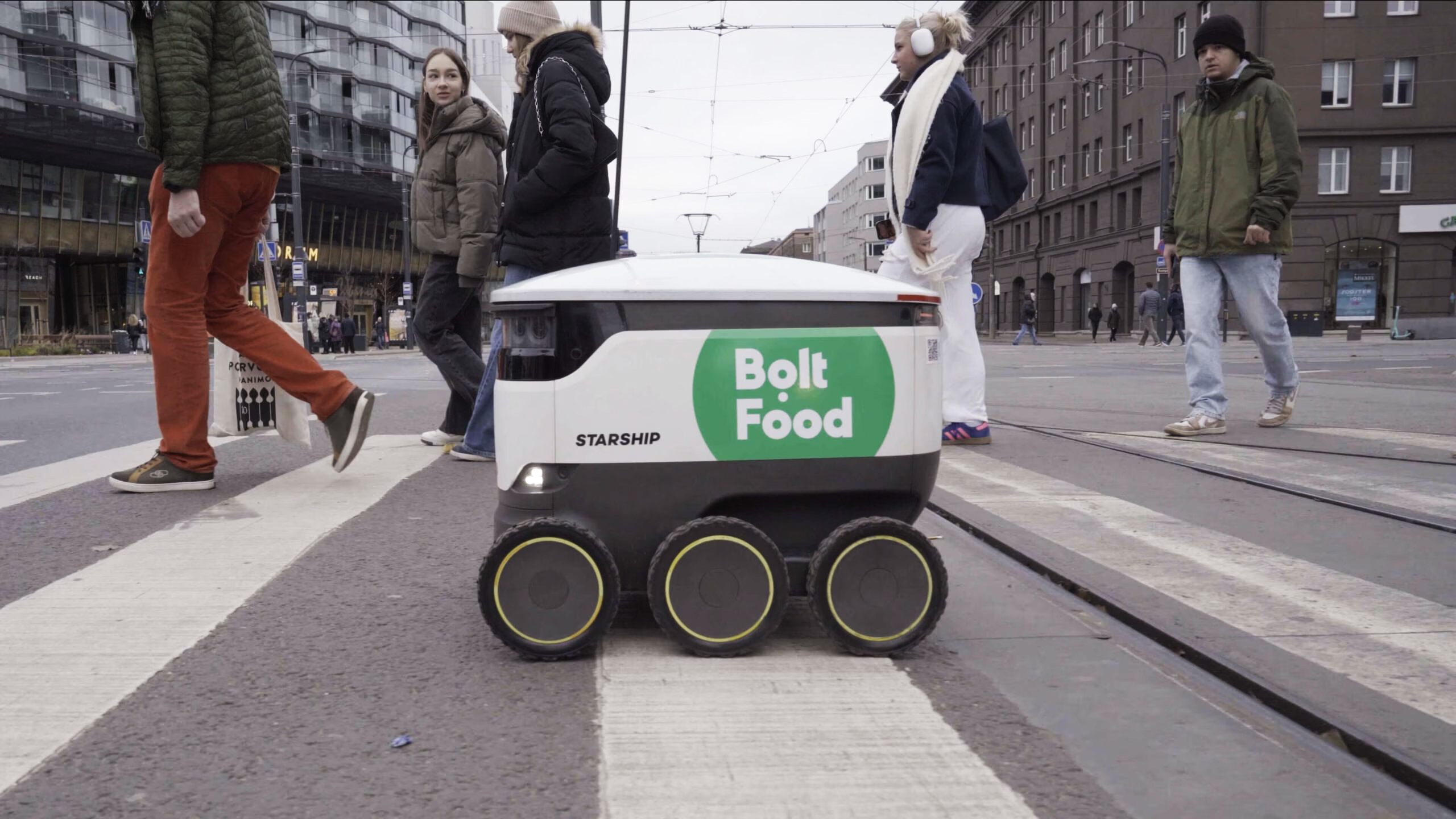
The robots serve grocery chains, takeaway restaurants, delivery apps and industrial sites. A customer might see one through the S-kaupat service in Finland, Co-op in the UK, or an app such as Bolt Food, foodora, Uber Eats or Just Eat in a city where a partnership operates. At an industrial site, the cargo may be spare parts, samples or internal mail. Starship also sells branding and advertising on the moving fleet. Each use asks the same basic question: does the journey justify sending a person in a car or on a bike?
The campus was a classroom, not the destination
The U.S. university business gave Starship recurring customers, defined routes and enough foot traffic to make failure visible. It grew from early campus launches, including George Mason University, to more than 60 U.S. campuses. Students could order meals through familiar dining systems, then watch a robot arrive. The company’s own survey of 5,000 students found 97% said they liked or loved the robots. That is an unusually warm reception for a device that shares a sidewalk with everyone.
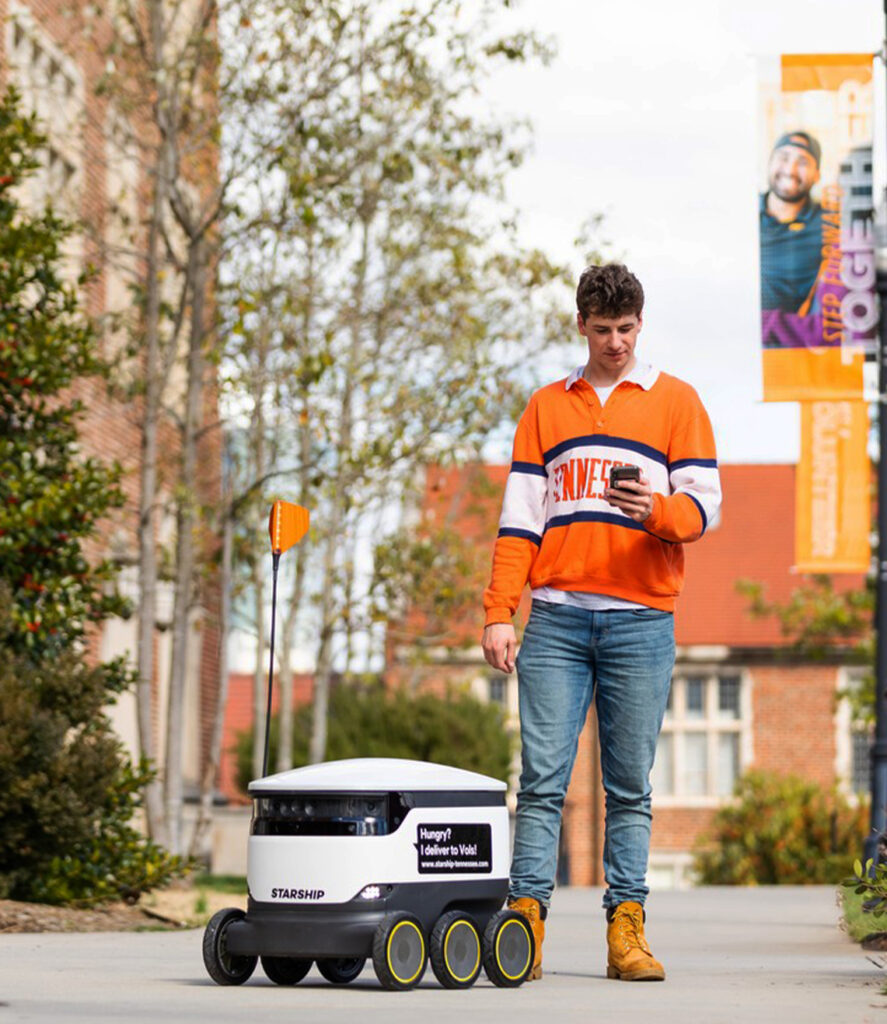
Affection is useful. It does not settle the economics. In June 2026, Starship announced it would wind down U.S. campus operations and redirect more than 1,200 robots to grocery and hot-food delivery in cities across Europe and the United States. Heinla described campuses as seasonal and contract-driven; groceries, he said, were a year-round urban operation. The company planned transitions with campus partners, but affected schools still had to find a replacement. Miami University publicly confirmed that its Starship service had ended.
“Campus and grocery are fundamentally different operations: One is seasonal and contract-driven, the other is a 365-day urban business.”Ahti Heinla, co-founder and CEO, June 2026
What changed the company’s mind was not a single dramatic mishap. It was a better-looking route to repeat business. In Finland, Starship and S Group reached one million robot grocery orders by December 2025, in less than three years. Robot delivery was available from more than 170 Alepa, Sale and S-market stores and across 79 Finnish towns and cities. S Group said robot trips accounted for about 20% of its online grocery orders at that point. A campus can prove that a robot can be useful; a grocery chain can reveal whether it can become routine.
The cost of the last two miles
Starship says autonomous grocery delivery currently costs it $3–$4 less per order than traditional courier fulfillment. It has also spoken of a longer-term target near $1 per drop. Neither figure is a price a shopper can count on seeing at checkout. They describe Starship’s claimed operating economics, which depend on order density, the distance from store to doorstep, local labor costs, charging, maintenance and how often a remote assistant must step in.
The robots work within a short radius, generally about two miles from a store. That constraint is the business model’s discipline. A robot carrying three bags cannot replace a van’s weekly shop. It can make a small, nearby order economical if a retailer has enough customers close together. For a city with sprawling roads, thin sidewalks or scattered demand, the same machine may spend too much time traveling empty. Starship’s advantage over a conventional courier grows from many repeated local trips, not from a magical wheel.
That loop also explains why Starship’s software and street data matter. By April 2026 the company reported 22 million autonomous kilometres and roughly 200 million individual road crossings accumulated across its operations. It said its robots made more than 125,000 road and driveway crossings a day. The figures are company-reported, but they reveal what a rival must reproduce: years of navigation experience, local approvals, store workflows and customer support. Competitors such as Serve Robotics, Coco Robotics and Avride have their own fleets and partnerships; the contest is for reliable routes as much as clever vehicles.
A machine with manners
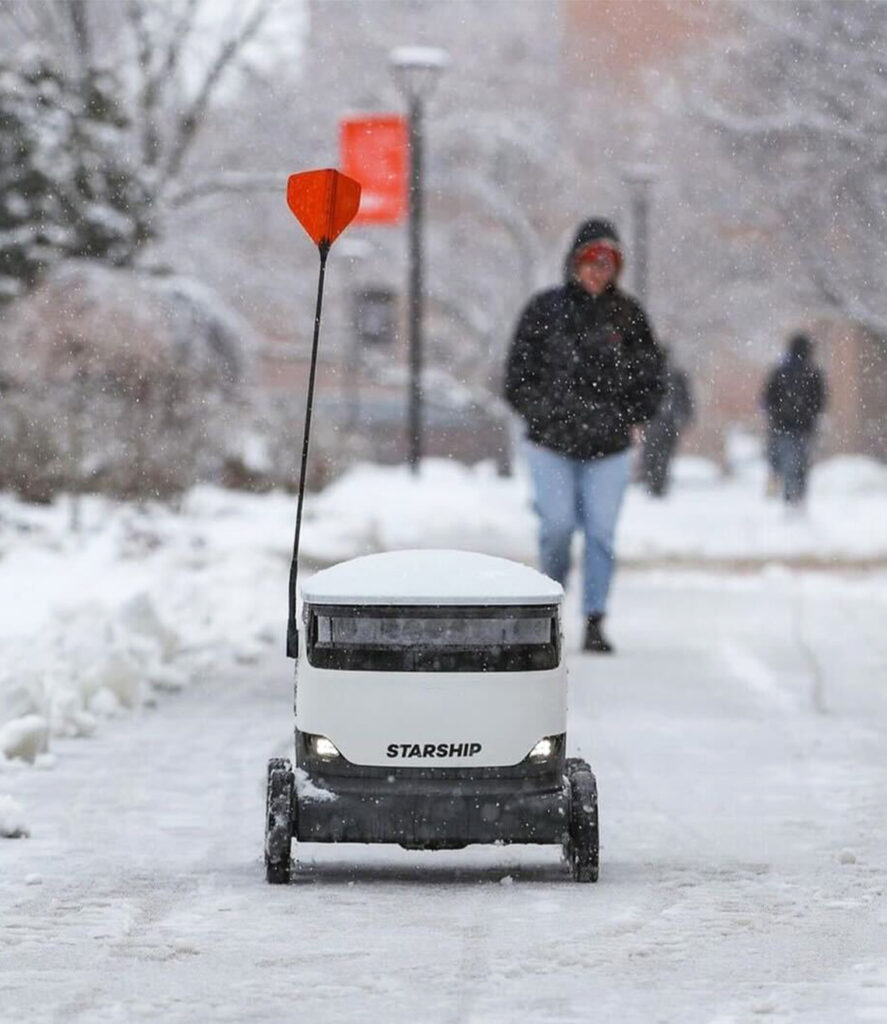
There is a social problem hidden inside the engineering one. A sidewalk belongs to pedestrians first. Starship’s robots are lightweight, visibly flagged and programmed to stop or make room. They also play music and sometimes wear seasonal costumes. Such details can look frivolous until one considers the daily negotiation a robot makes with strangers. It cannot deliver a profitable order if the neighborhood regards it as an obstruction.
The company’s expansion has followed retail and app partners. Bolt brought robots into Tallinn grocery delivery; foodora launched with Starship in Stockholm; Uber Eats began in Leeds; Just Eat began in Sunderland. These integrations spare customers from learning a new ritual: they order where they already order, and the small vehicle arrives as one delivery option. Starship, meanwhile, supplies the machines, routing and operation behind the scene.
Starship raised $50 million in a Series C round in October 2025, led by Plural, bringing its stated total funding to more than $280 million. That capital buys time to turn a technical demonstration into a logistics network. It does not make every street a good robot street. The company’s own pivot is a useful admission that scale is a choice of terrain. Its campus robots were popular. Grocery routes offered a stronger reason to keep them moving.
What a grocer can borrow
There is a practical sequence here for anyone considering local automation. Begin with a bounded service area. Record every human intervention, stalled route and empty return trip. Measure cost per completed order rather than the price of the machine. Then find a year-round anchor customer before multiplying the fleet. Starship’s campus years supplied the route data; S Group supplied the grocery proof. The model is least persuasive where orders are sparse, sidewalks are poor, trips are long or store staff cannot load robots quickly. Under those conditions, a bicycle courier may remain the better tool.
The next chapter will be judged in ordinary units: orders per robot, cost per drop, complaints per crossing, and whether a retailer keeps renewing the arrangement. The robot may still sing when the lid opens. The grocery bill is less easily charmed.