The first thing Snapp! sold was not a ride. It was the end of an argument. In Tehran’s dense, improvisational taxi culture, a passenger could spend as much energy settling the fare as reaching the destination. Snapp’s original app, launched in 2014 under the name Taxi Yaab, moved that conversation onto a screen. Enter the pickup, enter the destination, see the price. The driver and rider met with one source of uncertainty already removed.
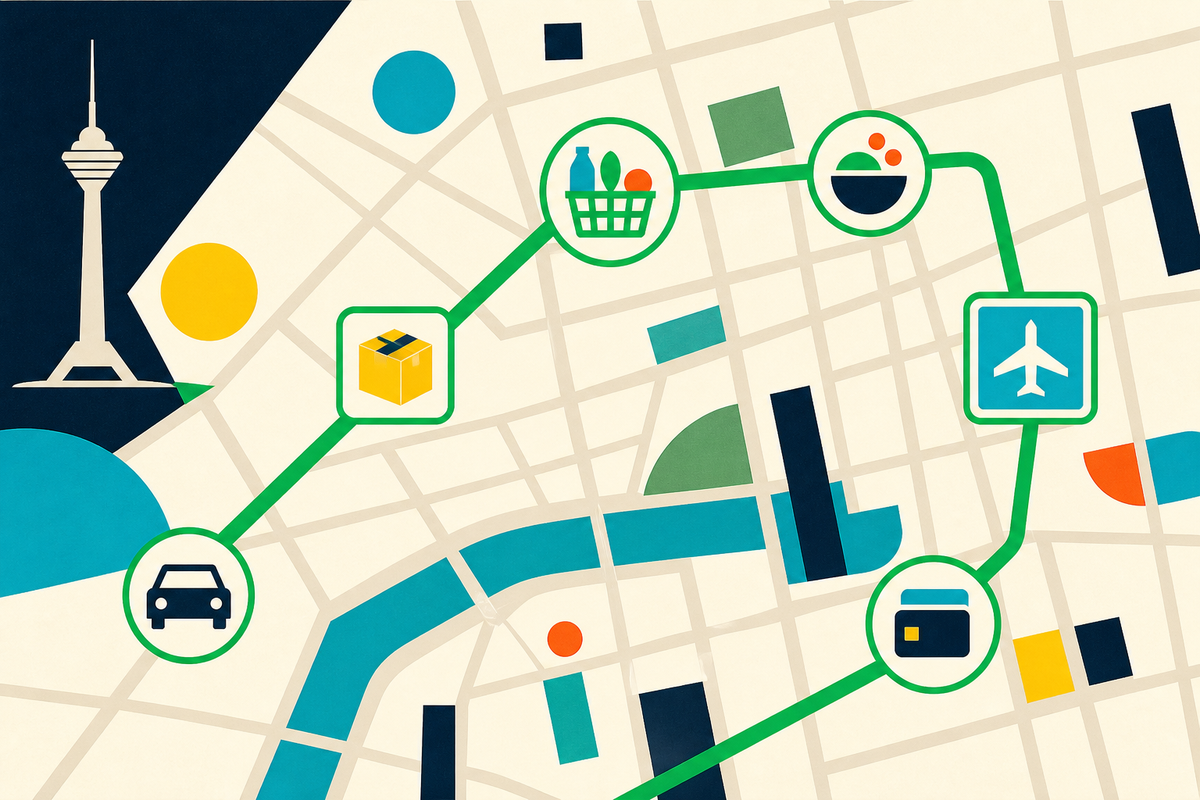
That detail sounds modest beside the company Snapp describes today: 20 services, more than 60 million users and a footprint of 287 cities. The green app now opens onto cars and motorcycles, restaurant meals, supermarket baskets, parcels, flights, trains, hotels, online doctors, retail shopping, loyalty rewards and credit. A task that began at the curb has expanded into a digital switchboard for Iranian urban life.
Calling it “Iran’s Uber” is convenient, but increasingly incomplete. Uber is a useful ancestor for the ride interface. Snapp is closer to a locally evolved cousin of Grab, Gojek or Careem - a super app whose services share attention, identity, payment relationships, customer support and logistics. Its real product is not any single tile. It is the permission to solve the next errand.
01 / The wedgeA price before the journey
Former chief executive Shahram Shahkar described upfront pricing as the original value proposition because it eliminated haggling. Snapp also required a valid licence and insurance, conducted background checks and inspected vehicles before approving drivers. Together, those choices formalized parts of a market that had long mixed official taxis, private cars and freelance drivers.
“This pre-pricing is our value proposition; it eliminates haggling.”Shahram Shahkar, former chief executive, 2016
The model found frequency quickly. In 2016, when MTN put €20 million into the business, Snapp reported roughly half a million users and 10,000 drivers, all in Tehran. The funding - about $22 million at the time - gave it room to expand while the daily ride created something more durable than a promotional download: muscle memory. A customer who opens an app several times a week is cheaper to introduce to a meal or a parcel than a stranger is to acquire from scratch.
02 / The bundleHow a ride became a home screen
The expansion did not happen only by inventing features inside the taxi app. The wider group assembled and renamed businesses. ZoodFood became SnappFood in 2017. Travel, grocery, parcel delivery, shopping, medical consultation and payment products gathered beneath the same bright green identity. The result is a portfolio that feels unified to a customer even when the operating businesses behind it remain specialized.
This is the practical appeal for users. A commuter can book a morning ride, send paperwork by motorcycle in the afternoon, order dinner, arrange a domestic flight and split a purchase into instalments without establishing a fresh relationship each time. For restaurants, grocers, retailers, doctors and travel suppliers, Snapp offers access to an audience already arriving for something else. For drivers and couriers, it converts idle vehicles and hours into on-demand supply.
The business model follows those connections. Snapp acts as a multi-sided marketplace, taking commissions or service fees when transactions are completed. SnappPro adds subscription economics by bundling benefits across services. SnappPay adds payments and buy-now-pay-later credit. Promotions, loyalty points and a shared account encourage movement between categories, while common support, technology and marketing keep every new service from starting at zero.
There are several customers hiding inside the word “customer.” A rider wants a car to arrive at the promised price. A driver wants enough nearby demand to make the working hour worthwhile. A restaurant wants orders without building its own delivery software and courier pool. A supermarket wants a digital aisle; a traveller wants inventory and support; a clinician wants a channel for remote consultations. Snapp has to make each participant feel that the marketplace is working for them, even when their interests pull in different directions.
That balancing act explains why logistics is one of the company’s core skills. Matching is only the visible beginning. Behind it sit route estimation, supply forecasting, dispatch, merchant menus and inventory, payment reconciliation, fraud controls, promotions and support for transactions that can go wrong in the physical world. A delayed car, a missing grocery item and a cancelled hotel room are different problems, but they all arrive through the same account. The super app wins on convenience only if its operations can absorb that variety.
From ride app to national distribution
03 / The moatThe city could not be imported
Snapp’s advantage has always been intensely local. Tehran is a city of traffic restrictions, informal transport habits, changing routes and payment behaviour that cannot be mastered from a foreign playbook. Shahkar once said, “You can’t just learn this market in a day.” The company’s maps, dispatch systems, driver network, local support and pricing knowledge accumulated trip by trip.
Sanctions deepened that distinction. International cards and app stores could not be treated as dependable infrastructure. Snapp had to work with domestic payment rails and Iranian app distribution. Reporting on the company described the contortions required to keep an iPhone app available, including presenting one version as a music application. What might be a back-office choice elsewhere became product architecture in Iran.
The company’s technology footprint reflects the range of problems. Public hiring and technology data point to mobile development, large-scale event systems, containerized infrastructure, data platforms and several web frameworks. The point is not the length of the tool list. It is that a live transport marketplace cannot pause while a food catalogue updates, and a payment failure cannot be treated like a late promotional banner. Reliability has to be designed service by service, then made coherent at the group level.
That makes Snapp difficult to compare cleanly with international platforms. Uber and Careem are recognizable references, but neither can simply reproduce a decade of Iranian supply and operating knowledge. Domestically, Tapsi is the clearest ride-hailing alternative. AloPeyk contests courier demand; Digikala competes for ecommerce and grocery attention; specialists challenge each travel, health and finance tile. Snapp’s defense is the bundle and the frequency of the ride at its center.
04 / The billScale makes trust a product
Breadth also creates liabilities. In 2023, Iran’s Competition Council penalized Snapp after rival Tapsi alleged that it used passenger accounts to obtain driver contact details and recruit drivers. Snapp disputed the allegations and the ruling. The episode exposed the sharp edge of marketplace competition: both companies need the same scarce supply, and conduct at the network boundary matters as much as interface design.
Then, at the end of 2023, SnappFood confirmed a major data breach affecting customer, courier, location and order information. The unit accepted responsibility and said it would negotiate to prevent publication of the stolen data. For a super app, this was not a side story. When one identity links dinner, movement, medicine and money, security is part of the bundle too. Convenience increases the amount of trust a platform has to earn.
The challenge is organizational as well as technical. Snapp Group describes a culture of flat hierarchies, entrepreneurship and knowledge transfer across disciplines. Recruiting materials promise continuous learning, flexible hours and remote work. Employee reviews are more mixed and more human: many praise talented peers, modern technical work and learning opportunities, while others point to uneven management, promotion and work-life balance. A portfolio with thousands of employees and multiple ventures will not feel like one workplace just because it shares a color.
05 / The next tripA mature platform still has errands
Snapp’s recent moves suggest that the group is still working both sides of its network. Shared rides, added in 2024, revisit the original transport problem with a lower-cost carpooling format. The Polaris program, launched with the University of Tehran, Sharif University of Technology and Amirkabir University of Technology, is intended to develop a pipeline of graduate talent. An internal AI hackathon invited participation beyond engineering, a sign that the group wants automation ideas to come from operations and product teams as well as code.
The latest annual figures are almost too large to picture. Snapp says users visited the super app 8.2 billion times during Iranian year 1404, while the group facilitated more than 1.5 billion urban rides and employed over 8,500 people. Those are company-reported numbers, but their direction is plain: Snapp is no longer testing whether Iranians will summon a car with a phone. It is deciding how many daily decisions one domestic platform should mediate.
The most revealing part of the company may therefore remain its first feature. Upfront pricing made a messy offline exchange clearer. Everything that followed - the driver network, the recurring customer, the delivery fleet, the merchant base, the payments layer - was built on that small act of legibility. Snapp did not begin by promising to organize everyday life. It began by telling a passenger what the ride would cost.