Deliveroo moved 296 million orders in 2024. After the commissions, delivery charges, rider costs and corporate bills, its reported annual profit was £2.9 million. That is a surprisingly small final course for a business with £2.07 billion in revenue. It also explains why the familiar teal delivery bag keeps acquiring new jobs.
Dinner was the opening act. Groceries, flowers, beauty products and household essentials are now part of the pitch. DoorDash completed its acquisition of Deliveroo in October 2025, ending the company’s brief life on the London stock market. The app remains, but the ambition has widened: become somewhere people go when they need something locally and would rather somebody else make the trip.
The banker who became the delivery man
Will Shu’s insight was ordinary enough to be useful. London had restaurants he wanted to eat from, but getting their food delivered was another matter. In 2013, he and software developer Greg Orlowski started Deliveroo. Shu spent the early period making deliveries himself, learning what it actually took to connect an order, a kitchen and a hungry customer.
His first audience included friends from banking. They enjoyed the spectacle of their former colleague turning up with dinner, Shu recalled in a London Business School account. They also kept buying. The repeat order mattered more than the joke.
“They thought it was really comical”
Will Shu, on delivering to his friends
There was also a memorable advantage in restaurant recruitment: Shu’s first partner, The Stockpot on King’s Road, was beneath his flat, and its owner was his landlord. Years later, Shu said the business had nearly been called Boozefood. Mercifully for its future grocery partnerships, the founders chose a name with room to manoeuvre.
There is something worth copying here. Perform the service before deciding which parts to automate. A founder carrying dinner can notice an awkward handover, a slow kitchen or a confusing address that looks perfectly tidy in a presentation. Deliveroo’s early work gave its software a real job to do.

Three sides, one impatient customer
To a consumer, Deliveroo is a catalogue with a checkout and a moving delivery estimate. To a restaurant, it is access to customers plus the means to reach their doors. To a rider, it is a system offering paid delivery work. All three have to find the arrangement worthwhile for the next order to happen.
The company earns merchant commissions, consumer fees, subscriptions and advertising income. Restaurants gain another sales channel without having to organise every delivery themselves. They also have to account for the commission, packaging and preparation work. More orders are useful only if the resulting business makes sense for the kitchen.
For customers, the practical benefit is choice without a trip. Enter an address, see what is available and compare the total at checkout. Location matters: this is a neighbourhood service, even when the logo belongs to an international group. A national partnership does not put every product within every rider’s reach.
Deliveroo competes with Uber Eats and Just Eat, as well as direct restaurant ordering and supermarket delivery. Its particular mix includes restaurant selection, Editions kitchens, grocery operations and a recognised consumer brand. None makes comparison shopping disappear. The contest is decided locally, through availability, price, reliability and whether the place you actually want is taking orders.
Your dinner is an appointment with Frank
Deliveroo calls its order-allocation algorithm Frank. According to its rider guidance, the system uses machine learning to estimate timings from factors including the dish, restaurant location, day, time, rider supply and live order demand. It then considers riders’ locations and travel times when deciding whom to offer an order.
The goal is coordination. Send someone too early and they wait while the kitchen finishes. Too late, and the meal waits instead. Matching those clocks is the unglamorous expertise beneath a smooth ordering screen. Faster cycling cannot fix a badly timed collection.
Preparation time
Location + travel
Orders + supply
Offer the order. Time the collection.
That focus also appears in the company’s stated culture. Its careers material stresses operational excellence, curiosity and understanding the people behind the marketplace. Those are employer promises, rather than a verdict on working life. They nevertheless describe the right problem: a delivery business needs people who care about small failures that happen thousands of times.
A kitchen without tables. A shop without the trip.
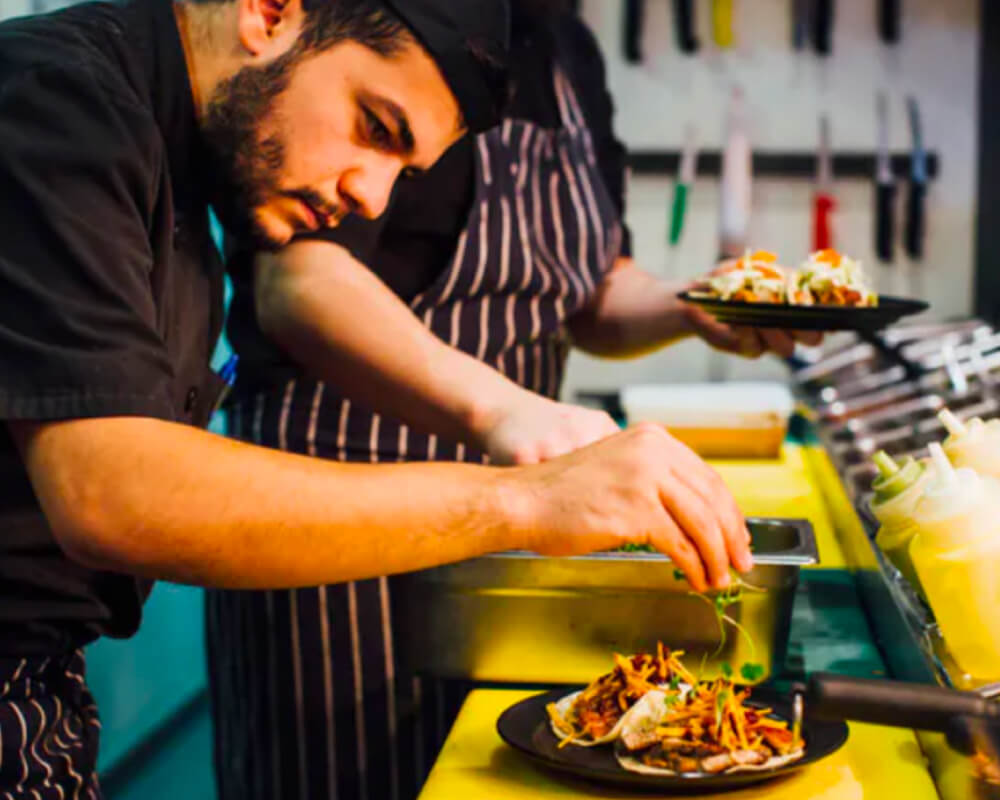
Deliveroo Editions, launched in 2017, gave restaurant partners delivery-only kitchens from which to serve new areas. The attraction is geographic expansion without recreating a full dining room. The customer sees another restaurant option; behind it may be premises designed principally for dispatch.
That changes the restaurant’s calculation, but does not abolish it. A kitchen still needs demand, staff, ingredients and food that travels well. Editions can address the cost of reaching a neighbourhood. It cannot make a disappointing meal worth reordering.
HOP applied another version of the idea to groceries. It launched with Morrisons in Vauxhall in September 2021, using grocery operations organised for rapid fulfilment. Waitrose later announced a trial. Deliveroo has also offered grocery partners its operating expertise, inventory management and picking technology.
Shopping, introduced in November 2023, broadened the catalogue beyond food. Express added a different route to market in April 2025, launching with Tesco in Ireland: white-label delivery for retailers and grocers. Here, Deliveroo can help fulfil a merchant’s order without requiring the entire purchase to start in its own marketplace.
The distinction matters. One product sells access to shoppers already browsing Deliveroo. The other sells delivery capability to a business with customers of its own. Both make use of the difficult work of getting local goods to local doors.
What the convenience actually costs
The UK service charges applicable delivery and service fees, with extra charges possible for distance or small orders. Plus offers a different bargain: pay for membership, then receive benefits on qualifying orders. The current UK FAQ lists Gold at £4.99 or £7.99 monthly depending on the customer; the offer shown at signup governs.
Silver is available through selected partnerships, including Amazon Prime and Blue Light Card, and selected students. Diamond is invitation-only. Free delivery does not remove every possible charge. The useful consumer calculation is the delivery cost you would actually avoid on orders you already intended to place.
For Deliveroo, membership creates another reason to return. But a subscription cannot make every delivery economical. Small baskets, long journeys and waiting time still consume resources. That is why the 2024 figures deserve attention: a large flow of transactions can leave a very thin financial cushion.
Building the company required substantial outside backing. Amazon led a $575 million funding round in 2019. The March 2021 flotation valued Deliveroo at £7.6 billion, with shares issued at 390p. DoorDash’s later offer paid 180p per share. Its closing filing put aggregate cash consideration at approximately £2.8 billion. Those are different moments and different measures, but they tell an expensive story for an investor buying at flotation.
The map got smaller as the basket got bigger
Expansion encountered its limits. Deliveroo announced its Hong Kong exit in March 2025, selling certain assets to foodpanda and closing others. The market had represented 5% of group transaction value in 2024 and remained loss-making on an adjusted EBITDA basis. The board concluded that continuing was not in shareholders’ interests.
DoorDash then announced in February 2026 that Deliveroo would leave Singapore and Qatar after a review of country conditions. Its stated priority was directing investment toward markets where it could build sustainable scale and leadership. Deliveroo’s current consumer FAQ describes seven markets. A working app was clearly not enough to justify staying everywhere.
That is the limit to copying the model. Dense demand helps coordinate delivery, but strong competitors, expensive fulfilment and insufficient order volume can overwhelm the attraction of convenience. A merchant considering a delivery channel should examine repeat demand and the money left after each order, rather than treating another pin on a map as success.
The next delivery might be a birthday present
Under DoorDash, with Miki Kuusi succeeding Shu as CEO, Deliveroo has continued widening its UK offer. A Tesco marketplace partnership announced in July 2026 included plans for Clubcard Prices and points. LOOKFANTASTIC followed in August; Hotel Chocolat announced on-demand gifting in September. These are different shopping occasions using a familiar ordering habit.
The inference is straightforward: dinner can introduce the app, while a wider assortment gives people more reasons to return. For retailers, it offers access to that attention. For Deliveroo, it raises the possibility of becoming useful between meals.
The original test has survived every change of ownership and every new category. Somebody wants something nearby. Somebody else must prepare it, collect it and bring it over at a price that works. Deliveroo has spent thirteen years making that sequence easier. The next shopping basket will show how far it can stretch.