A fleet of small electric robots that decided the sidewalk - not the road, not the sky - was the real frontier of last-mile delivery.
A Kiwibot crosses Telegraph Avenue at three miles an hour, waits at the crosswalk like a polite freshman, and disappears into a dining hall. Nobody films it. Nobody tweets about it. Somebody's lunch arrives. Eight years after the first prototype rolled out on the UC Berkeley campus, that is the entire pitch - and the entire point.
Kiwibot - operating these days under the parent name Robot.com - runs more than 1,200 autonomous robots across 30-plus university campuses and a growing list of cities. The fleet hauls burritos. It also hauls textbooks, dry cleaning, and increasingly, urban-infrastructure data that municipalities pay for. Hundreds of thousands of deliveries deep, the company has done something unfashionable in 2026 robotics: it has shipped.
"We're disciplined builders. Focused on scaling proven products and long-term value."- Felipe Chavez, Co-founder & CEO
It would be more flattering to call Kiwibot a robotics company. Strictly speaking it is a logistics company that happens to own the robots. The difference matters. While the autonomous-vehicle industry kept selling investors on the year 2030, Kiwibot quietly built a business that bills you per delivery in 2026.
In 2015, Felipe Chavez ordered a pizza in Bogota and noticed something most of us shrug at: the delivery fee was almost the same as the pizza. He kept doing the math. The food traveled a kilometer. The driver burned more fuel idling at traffic lights than moving. Half the energy of the city's combustion fleet was being spent moving a single hot box from one block to another.
This is the part of the story that delivery executives prefer not to discuss. The last mile - the final stretch from store to door - accounts for roughly half of the entire cost of getting an item to a customer. Cities optimized themselves around two-ton vehicles carrying one-pound packages. We accepted it because the alternative was uncomfortable: most of our delivery infrastructure is gloriously, expensively, embarrassingly oversized.
"The cheapest road in any city is the one nobody uses for logistics - the sidewalk."- Editorial paraphrase of Kiwibot's founding thesis
The conventional fix in 2017 was either fully autonomous cars or aerial drones. Both required regulatory miracles, infrastructure overhauls, and unit economics that did not yet exist. Both have spent the last decade burning capital. Kiwibot looked at the same problem and made a smaller bet: a robot the size of a microwave, slow enough to be safe around a stroller, cheap enough to break even, polite enough that the city would let it stay.
Felipe Chavez, Jason Oviedo and Sergio Pachon were not the obvious people to build the future of urban logistics. They were Colombian engineers running a small courier service in Bogota, watching American venture capital fund robotaxi companies that wouldn't survive their own headlines. In 2017, Chavez landed in the Global Founders program at UC Berkeley and walked the Telegraph Avenue corridor with a single observation: students would pay $3 for a delivery if it actually showed up.
They built the first Kiwibot the only way you can build a robot when you don't have $200 million to spend: with parts you can solder yourself, software you can debug at 2 a.m., and a teleoperations team in Medellin watching the camera feeds. The early bots were not fully autonomous. They were partly autonomous and partly piloted by humans in Colombia who earned a real wage for what was, essentially, playing the world's most consequential video game. That arbitrage is the part that the autonomy purists never wanted to admit: it worked, and the unit economics shipped first.
"You don't have to be fully autonomous to be fully useful. You just have to be useful enough that someone pays for it tomorrow."- Spirit of the Kiwibot operations playbook, c. 2018
The bet, if you boil it down, was three lines long. Build small. Move slow. Charge by the delivery. Everything else - the AI, the fleet management, the sensor stack, the rebrand to Robot.com - is downstream of that.
The shortest way to test a robotics company is to look at who is paying it twice. Kiwibot has Sodexo as a strategic investor and operational partner - the same Sodexo that serves around 100 million meals a day globally. It has the City of San Jose for municipal pilots. It has Shopify and Grubhub plugged into its routing. The on-platform brand list includes Chick-fil-A, Domino's, Dunkin', Subway and Pizza Hut.
That is not a sponsorship deck. That is a customer list with hot food on it.
The advertising business - mostly inherited from the 2024 Nickelytics acquisition - turns each robot into a moving billboard. It is a second revenue line that costs almost nothing to operate once the robot is already rolling. Kiwibot's gross margins are not public. The arithmetic, however, is suggestive.
"A delivery robot is the only billboard that knocks on the door at the end of the route."- A Kiwibot deck slide that was, allegedly, removed for being too on-the-nose
If you press Kiwibot on its mission, the answer is unremarkable: make last-mile delivery cheaper, cleaner, and accessible to more people. That is what it says on the brochure. It is also what it actually does. The robots are electric, which removes a delivery vehicle from the road every time one is dispatched. They are slow, which keeps pedestrians intact. They are cheap to operate, which means a delivery that previously cost $7 can cost $1.50.
None of that is poetic. All of it is structural. The interesting move is that Kiwibot does not seem interested in selling the romance of robotics. The company prefers to sell the un-romance of unit economics. In a sector dominated by demos, that is, by itself, a competitive advantage.
"The robots don't have personalities. We just stopped naming them after we noticed students were naming them anyway."- A Kiwibot operations lead, paraphrased
The robots have, of course, names. Students at Berkeley, Morgan State, Franklin & Marshall and a dozen other campuses have decorated, hugged and photographed them. The bots have appeared on TikTok being pushed gently out of snowbanks by undergraduates. One was rescued from a flooded curb in 2023 by a stranger who tweeted about it. This is the part of robotics that no business plan ever predicts.
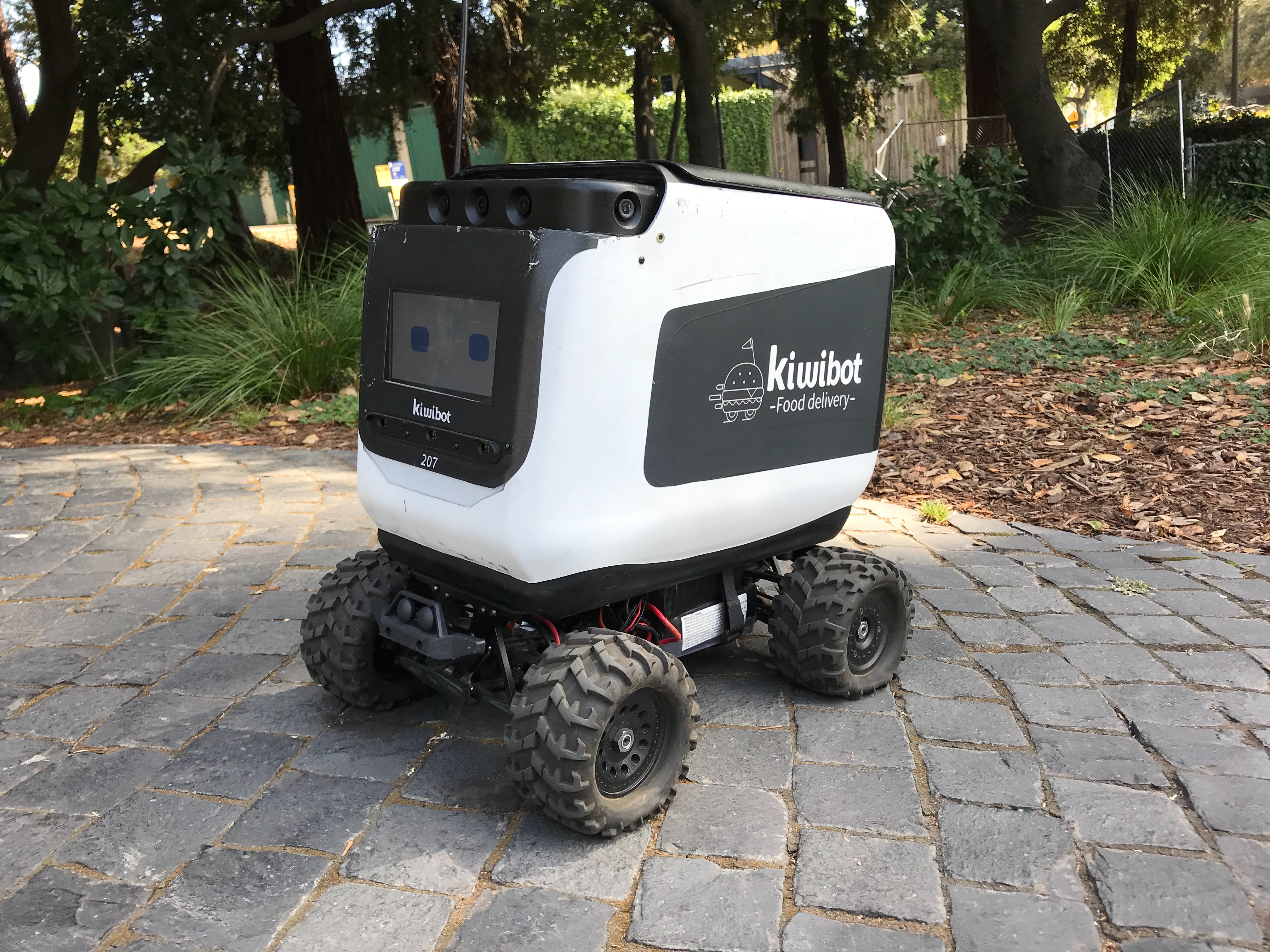
Return to Telegraph Avenue. The Kiwibot is still crossing - same three miles an hour, same polite pause, same dining hall on the other side. The student picking up the order does not know that the robot's autonomy stack was iterated 4,000 times. They do not know that the cargo bay was redesigned to fit three medium pizzas, or that the bot was probably teleoperated for a few seconds while it sorted out a construction cone two blocks ago. They do not care.
That is the whole victory. The robot is boring. The delivery is cheap. The sidewalk - the most underrated road in any American city - is finally being used for the thing it was always best at.
Kiwibot did not announce the future of delivery. It just rolled into the future, very slowly, carrying somebody's lunch.