In June 2021, a reporter in San Francisco ordered groceries worth less than two dollars from a new app called Food Rocket. She added a few things, perhaps from embarrassment, and waited. Seven minutes later the order arrived. This is a wonderfully modern magic trick: summon an avocado, watch a bicycle move across a screen, open the door. The trick is so clean that the machinery vanishes.
Food Rocket's machinery did not vanish. It sat in leased mini-warehouses stocked with milk, eggs, toothpaste and napkins. It wore hot-pink shirts. It drew a salary, received benefits and rode e-bikes through San Francisco hills. It forecast which neighborhood would want cucumbers and which would want prepared lunch. The company was not a courier layer pasted onto somebody else's supermarket. It was the supermarket, the warehouse, the software and the last mile - compressed into a promise of 10 to 15 minutes.
The story in one shopping bag
- The offer: roughly 3,500 grocery and household items, delivered in minutes.
- The lure: retail pricing, no minimum order and initially no delivery fee.
- The engine: dark stores, local inventory, forecasting software and employee riders.
- The score: about $27 million raised; a reported $30 average basket and 60% second-order rate.
- The ending: capital ran out in March 2023, weeks after the company retreated to Charlotte.
The cheap prototype behind the expensive promise
Vitaly Alexandrov did not begin with a warehouse. He began with photographs copied into Shopify, products bought from Whole Foods, and a friend waiting in a car nearby. The page advertised 10- to 15-minute delivery. Orders came. It was an inelegant experiment, which is another way of saying it was an excellent one: the team tested the desire before purchasing the machine.
The idea had emerged from failure elsewhere. Alexandrov and his partners had built Foody, software for restaurant procurement. Then the pandemic closed dining rooms. The team still knew suppliers, food operations and San Francisco; consumers suddenly wanted groceries without lingering in a store. Food Rocket was a pivot assembled from parts already on the table.
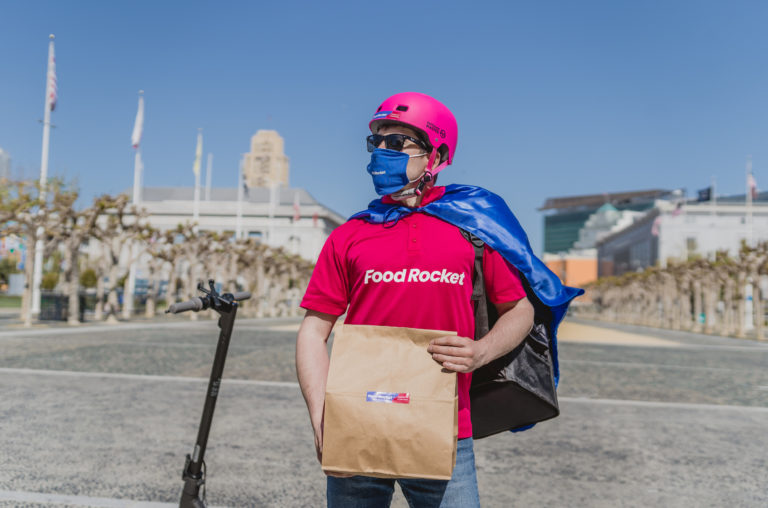
“We are faster than you.”Vitaly Alexandrov, explaining why the service could beat a walk to the corner store
A store small enough to hide
The operating thesis was geometric. A dark store of about 3,000 square feet could hold a few thousand frequently purchased items. Put roughly 50,000 households within a 1- to 1.5-mile radius, pre-position riders, and the city becomes a set of short lines. Software forecast stock, assigned workload and chose the fulfillment point with the quickest, cheapest route. An order took two or three minutes to pick; the ride took about ten.
This made Food Rocket closer to a neighborhood retailer than to Instacart. Instacart could offer the breadth of a full supermarket because a shopper walked somebody else's aisles. Food Rocket sacrificed breadth for certainty. It knew whether the milk was there because it owned the milk. It could dispatch immediately because the rider was already working.
Its assortment also leaned fresh. Food Rocket said fresh groceries made up 60% of orders, distinguishing it from convenience apps built around snacks and alcohol. Ready-to-eat meals were the next move: lunch, coffee, bagels and pizza prepared quickly enough to stay inside the promise. Beyond that sat a more interesting ambition. Once the network and software worked, traditional retailers could plug into Food Rocket rather than build instant delivery themselves.
places app order
picks local stock
covers 1-1.5 miles
The magic depended on density at every step. Distance was not merely inconvenient; it was an attack on the model.
Free delivery has a bill
For customers, the cost was almost comically attractive: products advertised at retail prices, no minimum and no delivery fee. For Food Rocket, the invoice was less charming. Rent arrived whether orders did or not. Perishables aged. Riders waited on payroll. Picking a two-dollar basket required much of the same machinery as picking a thirty-dollar one.
Alexandrov admitted that a single-avocado order lost money and that the discounts and free delivery would eventually change. The first order was often a little trial - bananas, avocados, proof that the rocket flew. The hope lived in the next orders. Early customers reportedly ordered six or seven times a month, with baskets growing as confidence grew. The promotion acquired a habit; scale was expected to make the habit profitable.
What customers saw
Retail prices. No minimum. No delivery fee. A grocery bag before the kettle had properly boiled.
What the company carried
Inventory, leases, spoilage, picking labor, employee riders, insurance, software and customer acquisition.
The investor who owned the corner stores
In April 2022, Alimentation Couche-Tard, Circle K's parent, led a $25 million Series A. The partnership looked unusually sensible. Circle K brought procurement, supply chains, marketing and thousands of stores. Food Rocket brought software and speed. Each side could borrow the other's expensive education.
Ambition immediately expanded. Food Rocket had opened in Chicago that February and announced plans for 160 dark stores, more than $15 million of local investment and over 2,000 jobs. It discussed Boston, Los Angeles, Philadelphia and Washington. The rhetoric belonged to 2021; the calendar, unfortunately, said 2022.
The broader quick-commerce market was already losing altitude. Rivals including Buyk and Fridge No More closed. Investors who had once rewarded expansion began demanding evidence. Circle K itself asked the correct, impolite question: did consumers truly care about ultrafast delivery, or had capital mistaken a stunt for a market?
Three locations made the 15-minute promise plausible.
A second city arrived with a plan for 160 dark stores.
Two Circle K stores hosted tiny fulfillment centers.
San Francisco and Chicago went first; the remaining operation followed in March.
What failed first was the map
In February 2023, Food Rocket shut San Francisco, laid off 42 people there, left Chicago and moved its remaining attention to Charlotte. The explanation was cost. A micro-fulfillment area inside an existing Circle K could occupy as little as 170 to 500 square feet. That was a more economical map than a network of independently leased dark stores.
The change of mind was revealing. Food Rocket had once spoken of replacing convenience stores. In Charlotte, it moved inside them. Existing retail infrastructure was no longer the enemy; it was the shelter. This was not hypocrisy. It was learning, performed under cruel time pressure.
A few weeks later, the company ceased operations. Food Rocket said it had achieved overall profitability but exhausted its funding and could not arrange a bridge from Couche-Tard amid the venture downturn. Both claims can be true. Profitability is an accounting result over a period; survival is the cash available on a particular morning. Inventory businesses can be profitable on paper while working capital quietly empties the bank.
Food Rocket proved that seven-minute groceries could feel ordinary. It did not prove that the capital required to make them ordinary would remain patient.
What is worth stealing
- Prototype the promise by hand. A Shopify page and a friend in a car answered the first question without pretending to answer the hundredth.
- Treat density as product design. Food Rocket selected cities and neighborhoods around household concentration, income and route length.
- Watch the second order. A subsidized first basket proves curiosity. Repeat frequency and larger baskets begin to prove habit.
- Own the operational data. Forecasting stock and employee workload made the physical network faster and could have become a retailer-facing product.
- Partner before building everything. The Circle K pilot showed a less capital-hungry route: place software and fulfillment inside infrastructure that already exists.
The conditions that make the trick possible
Very dense neighborhoods, short routes, high repeat frequency, predictable baskets, disciplined inventory and enough gross margin to pay for idle capacity. Remove two of those conditions - especially density and repeat use - and the 15-minute promise becomes a theatrical subsidy.
Food Rocket's mistake was not believing that people wanted convenience. They plainly did. Its mistake was building a business whose proof required money for longer than the money wished to stay. The company arrived at a plausible, cheaper shape - software plus existing retail stores - just as its runway disappeared.
There is a melancholy precision to the ending. On March 7, 2023, Food Rocket updated its iPhone app, polishing the login screen and promising more features. Days later it stopped. The software was still learning to welcome customers while the company behind it was saying goodbye.