A second-hand clothing seller had a peculiar problem. A garment could appear on several online marketplaces, but it could only be sold once. After a sale, somebody had to remove the surviving listings. Miss one and the business might sell something it no longer possessed. Success at the checkout created another job behind the screen.
According to ElectroNeek’s published case study, employees spent two hours a day on this chore. Thrive Automation, an implementation partner, connected email triggers to automated browser activity, including work involving Shopify. The reported saving was 14 person-hours a week. No theatrical robot was required. The valuable machine was the one making a sold shirt disappear.
- ElectroNeek connects desktop bots, document processing and AI workflows.
- Its RPA offer includes unlimited free bot licenses within paid platform packages.
- Service providers build and maintain automations for business clients.
- Start with a recurring task whose time and errors you can count.
The buyer who already had the keys
ElectroNeek began in 2019 and joined Y Combinator’s Winter 2020 batch. Its founding group included Sergey Yudovskiy, Dmitry Karpov, Mikhail Rozhin and Alexey Astafiev. The early proposition was attractive: give ordinary business operators the ability to automate work themselves. A company could keep its existing software and put a bot between the tasks.
Then the inconvenient part emerged. In a 2021 founders’ interview, the team described how difficult it was for customers to establish the people, technology and governance needed for internal automation. Their answer was to change the buyer. Managed service providers, already responsible for clients’ technology, could build automations across many businesses.
“We switched from reducing costs for the end-users to empowering entrepreneurial MSPs to make money.”
ElectroNeek’s founders / June 2021
That changes the incentive. An individual business has a finite collection of repetitive jobs. A service provider can find another client, another workflow and another service contract. The product becomes a tool for earning revenue as well as reducing administration. ElectroNeek’s About page now reports more than 200 partners helping businesses implement automation.
Free bots, paid plumbing
The commercial twist is the bot license. ElectroNeek’s pricing page advertises unlimited free attended and unattended RPA bots. It sells platform packages rather than adding a separate bot-license charge each time a customer deploys another software worker. For a provider serving smaller businesses, that can make modest projects easier to price.
The distinction needs careful handling. A free bot license does not make an automation project free. The platform package still has a price. Somebody must design the workflow, test it, supply infrastructure and maintain it when applications change. Current packages require a sales conversation. The clothing case supplies an hours-saved figure rather than an implementation invoice, so it cannot establish a cash payback period.
Time reclaimed from removing sold clothing listings across marketplaces.
Investors backed the approach. ElectroNeek announced a $2.5 million seed round in 2020 and a $20 million Series A in June 2021, led by Baring Vostok. The latter announcement put its valuation above $100 million. Those are historical financing figures, useful for understanding the bet rather than pricing the company today.
Three kinds of work, one handoff
ElectroNeek operates where several software categories meet. Studio Pro builds RPA workflows; Bot Runner executes them; Orchestrator schedules and monitors the work. This is the part that clicks through desktop applications and browsers. Document Intelligence handles another burden: converting invoices, receipts and other documents into fields a business can use.
AI Workflows adds a visual environment for agents, application connections and human inputs. An illustrative invoice process could extract document data, pass it through checks, ask a person to approve an exception, then launch a desktop workflow. The point is the handoff. Reading a document and entering its contents into an older application require different capabilities.
- 01 / ReadDocument Intelligence extracts the fields
- 02 / CheckA workflow applies rules and routes exceptions
- 03 / ApproveA person reviews the uncertain result
- 04 / ActAn RPA bot enters the approved data
The details are moving quickly. The October 2, 2026 update announced 707 connectors, human approval actions and full-platform on-premises support. It also added AI-provider token-usage tracking. That last feature is revealing: a company that removes a bot-license meter still has to help customers watch other meters.
Its alternatives depend on the job. UiPath, Automation Anywhere and SS&C Blue Prism compete in RPA. Microsoft Power Automate covers desktop and cloud automation. SaaS integration tools overlap with the application-connection side. ElectroNeek’s particular proposition combines those kinds of work with document processing and a service-provider channel. The right comparison begins with the workflow you actually need.
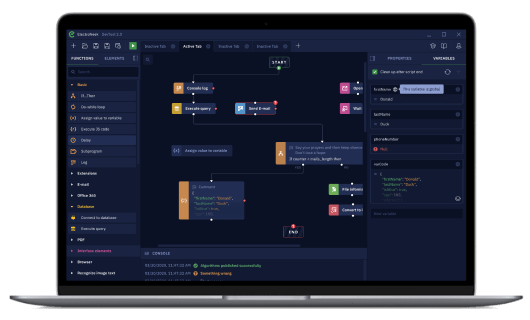
Maintenance deserves its own line in the budget. The October release includes fixes for queued launches, workflow schedules and document recognition jobs. These are ordinary operational concerns, but they determine whether an automation stays useful after its demonstration. A provider’s continuing service has value precisely because somebody must own that work.
The sensible place to start
The clothing case offers a practical lesson: choose a task with a clear trigger and a recognizable finish. Count the time it consumes. List the exceptions. Decide who will receive a failure alert. Then build a small proof of concept and compare its output with the human process before expanding it. This is a suggested method, not a promise of identical savings.
It works best when the repetition is real and the rules are sufficiently stable. A frequently redesigned website can turn browser automation into maintenance work. A task that happens rarely may not justify the setup. Studio Pro and Bot Runner also require supported Windows environments. AI outputs need suitable validation, especially when a mistaken value can become a payment or customer commitment.
The attraction of ElectroNeek is that it makes room for the unglamorous job. A business need not begin with an elaborate theory of artificial intelligence. It can begin with a sold shirt, a crowded inbox or a stubborn spreadsheet. The useful question is beautifully ordinary: how many times must a person do this again?