The first thing Rewst founder Aharon Chernin had to automate was an assumption. In 2021, he described a platform that could link the scattered tools used by managed service providers, or MSPs, and remove the small manual chores hiding between them. The room went quiet. Many operators thought they were already automated. They had scripts. Their remote-monitoring software could run tasks. A few dependable employees knew which buttons to press and which spreadsheet to open next.
Look closely, though, and the machinery still had people inside it. A new employee request might begin in a ticket, jump to Microsoft 365, detour through licensing, touch a password vault, update documentation, and return to the service desk. Monthly billing meant comparing vendor counts with customer contracts. Security alerts needed enrichment, prioritization, remediation, and proof. Each tool could do its own job. The expensive bit was the swivel-chair travel between them.
That gap became Rewst: a Tampa software company founded in 2020 and built expressly for MSPs. Its multi-tenant platform now connects more than 90 common tools and offers more than 100 prebuilt automations. Rewst says more than 1,500 MSPs use it worldwide. In the year preceding its June 2026 customer conference, those customers ran 19.5 billion automated tasks - nearly 2.4 times the previous year’s volume.
The product is the space between products
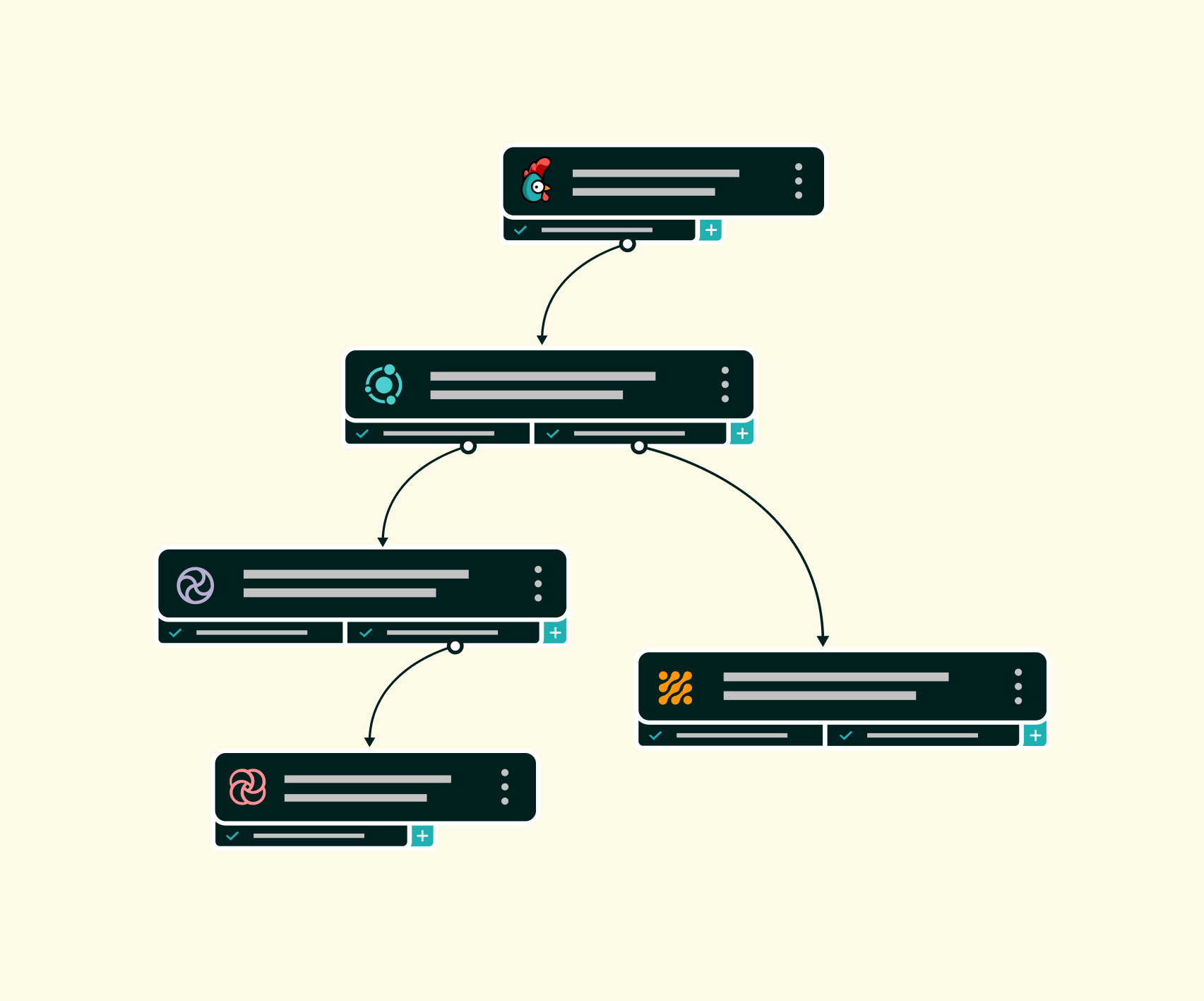
Rewst does not ask an MSP to throw away its professional-services automation system, remote-management software, security stack, or distributor. It sits across them. A visual canvas lets an operator arrange triggers, actions, branches, loops, approvals, and error handling. Jinja templating supplies sharper logic when drag-and-drop reaches its limit. A form can collect a client request. An app can give that client a branded front end. The workflow carries the request through the back office.
One request, five systems, fewer swivel chairs
The less glamorous feature may be the most important: Rewst maintains the API connections. Generic tools such as n8n, Power Automate, and Zapier can orchestrate an impressive range of work. Internal Python and PowerShell can do nearly anything. But someone must build, secure, monitor, and repair those connections when a vendor changes an endpoint. Rewst’s wager is that MSPs would rather buy that upkeep for the tools they share than make each customer rediscover it alone.
Its ready-made workflows are called “Crates,” because the company has never encountered a poultry pun it could not put on payroll. Crates bundle the workflow, triggers, forms, templates, and scripts for repeatable jobs: user onboarding and offboarding, billing reconciliation, MFA alerts, ticket categorization, license checks, reporting, and privileged-access requests. Cluck University teaches customers to adapt them. A Robotic Operations Center helps them get unstuck. The jokes are silly; the adoption strategy is not.
A billing chore becomes a business case
Marcus Networking offers the useful, unvarnished version of the pitch. As its tool stack expanded, staff spent 20 to 40 administrative hours each month checking vendor bills against customer contracts. Counts could change the next day. Founder Eric Marcus encountered Rewst at a trade show in 2023 and brought the company his exact problem. By the next day, he said, Rewst had built a rough framework. The eventual billing-reconciliation automation saved more than $120,000 annually, according to the case study.
The sequence matters. Rewst did not begin by announcing an “automation transformation.” It began with an annoying, measurable process, demonstrated the data path, and put a number on the reclaimed labor. Nucleus, a Canadian MSP serving more than 200 clients, followed a similar logic with quarterly business reviews. Two connected workflows kept asset data synchronized and generated a client-ready scorecard. Preparation fell from six hours to minutes; the delivery team shrank from ten people to two. The people moved toward client conversations, where software remains poor company.
If automation always requires a skilled builder, it will never scale.Aharon Chernin, founder and CEO
This is also how Rewst wants customers to think about return on investment. Five minutes removed from one ticket is a rounding error. Five minutes removed from a ticket repeated across hundreds of client tenants becomes a capacity plan. The company says its users saved more than 15 million hours in the latest reported year. That is a company claim, not an audited labor ledger, but the multiplication is the point: frequency makes humble workflows valuable.
Three reported before-and-after wins
The AI is learning to use the canvas
Rewst introduced RoboRewsty in 2023 as an OpenAI-powered documentation helper - a modern Clippy with feathers. By September 2025 it had become an in-platform assistant that could explain a customer’s workflows, diagnose failed runs, surface setup guidance, and turn logic into readable documentation. The newer version goes further. An operator describes the desired process in ordinary language; RoboRewsty adds triggers, tasks, transitions, and code to the visible workflow canvas, where a human can edit and approve the draft.
That last clause is the sensible one. An MSP controls privileged access across many client environments. A poetic chatbot is less useful than a boring audit trail. Rewst positions AI as the reasoning layer and its workflow engine as the governed execution layer. The assistant can propose; the platform controls what runs, under whose authority, and with which record. Human approval tasks can pause a workflow where judgment is required.
Agent Smith extends that logic to endpoints. The open-source Go command executor uses a customer-controlled Azure IoT Hub to receive workflow messages and sends results directly back to a single-use Rewst webhook. It fills the awkward gap between cloud orchestration and the machine that actually needs a script. Rewst’s own documentation advises testing on a few agents before mass deployment. Even the robot company knows to try the small lever first.
What the invoice buys - and what it does not
Rewst does not publish a dollar price. Buyers choose between usage-based pricing, counted by workflow tasks that actually execute, and a predictable model priced per managed endpoint. The full platform is included: concurrent workflows, integrations, Crates, custom integration tooling, workflow, app and form builders, RoboRewsty, single sign-on, role controls, and multi-tenancy. There is no trial because each tenant requires configuration. A demonstration and quote come first.
That makes the buying question more operational than cosmetic. An MSP should arrive knowing the workflow it wants to fix, how frequently it runs, who owns it, what exceptions occur, and what one hour of the current process costs. Without that baseline, “hours saved” becomes decorative arithmetic. With it, the company can compare Rewst’s quote not only with PIA or n8n, but with an internal developer, a stack of scripts, PSA-native features, and the recurring cost of doing nothing.
The alternatives differ by job. PIA leans toward prebuilt service-desk automation. General platforms offer breadth and more do-it-yourself control. PSA and RMM vendors automate inside their own borders. Rewst is strongest when work crosses several vendors and client tenants, and when the MSP values maintained connectors and shared recipes. If a team needs only two simple automations, already has durable integration engineering, or refuses to assign an owner, the economics become less obvious.
The first thing to fail is usually not the robot
Production workflows fail in wonderfully ordinary ways: a typo, a case mismatch, a missing value, broken Jinja, an expired authorization, or an outside API behaving differently. Rewst provides execution inputs, context, requests, responses, live expression testing, and reruns to diagnose those faults. RoboRewsty can help explain them. None of this abolishes maintenance. It makes maintenance visible.
The larger risk is organizational. Low-code can move tribal knowledge out of a technician’s head and into a maze only that technician understands. Rewst’s training, community, versioning, documentation, and AI assistance are attempts to prevent that outcome. They work only if customers use them. A workflow that touches billing, identity, or security needs an accountable owner, peer review, test tenants, cautious permissions, exception paths, and a rollback plan. “No coding required” should never be translated as “no operating discipline required.”
The copyable play
Ask someone what repeatedly ruins their Tuesday. Make the answer specific. Count its frequency and manual minutes. Map the systems and exceptions. Start from a prebuilt workflow, test it on one client, document the owner and rollback, then measure the result before expanding. The cleverness is not starting big. It is making the first small win repeatable.
Chernin’s original audience changed its mind because “already automated” proved to be a generous description. Scripts handled islands. Rewst went after the water. The company has since raised about $104 million, including a $31 million Series B and a $45 million Sapphire Ventures-led financing in 2024. The funding followed a narrow thesis with a large downstream market: MSPs serve the small and midsize businesses that cannot staff every IT specialty themselves, while the MSPs face their own shortage of time and technical labor.
Rewst now wants those providers to do more than automate backstage. Forms, apps, portals, and dashboards can turn internal capability into “Automation as a Service” for clients. That is the more ambitious endgame. Saving a technician from a repetitive ticket protects margin. Selling a dependable automated service creates revenue. The same workflow stops looking like an efficiency trick and starts looking like inventory.
The bird names make Rewst easy to remember. The sober idea underneath them is why it matters: modern IT work is often not trapped inside one application, but stranded between five. Rewst is building a toll road across those gaps. The winners will not be the MSPs with the prettiest canvas. They will be the ones that know exactly which traffic belongs on it.