The printer has a talent for becoming the most important object in the room precisely when it stops working. Until then, it is furniture. A purchase order goes in, a document comes out, and nobody gives much thought to the peculiar little economy of toner, service calls, leases and people waiting beside a machine. SumnerOne has built a business in that gap between buying equipment and getting useful work from it.
- What it sells: print equipment, managed print, document workflows and IT support.
- Who buys: businesses, schools, colleges, public agencies and print producers.
- The interesting move: redesign the operation around the equipment, then support it.
Four shops, one question
St. Louis Community College had four print shops and a fleet of 180 devices when expiring leases created an opportunity to reconsider the arrangement. SumnerOne’s case study describes overlapping capacity alongside work still being outsourced. The college asked bidders about consolidation. SumnerOne sought a more detailed conversation about how the operation actually worked.
The eventual project combined the shops, reduced the fleet, added production capabilities and created a Canon-assisted ordering portal. SumnerOne also employed the college’s full-time internal mail and courier staff to continue their work. Its estimate put five-year savings at $1.65 million. That is a projection reported by the provider, rather than a completed five-year accounting.
The useful detail is the staff. An organization can replace its equipment and accidentally discard the knowledge that makes it function. Here, the people who knew the campuses stayed involved. The technology decision reached all the way into how work was ordered, produced and delivered.
PROVIDER-REPORTED COLLEGE PROJECT
The technician came first
Bud Sumner entered the printing business as an A.B. Dick service technician in 1937. He bought an Oklahoma City distributorship in 1952, then the St. Louis business in 1955. Those two purchases explain the two founding dates attached to SumnerOne. The company’s roots precede the office copier’s long reign; its early equipment included mimeographs and spirit duplicators.
There is something pleasing about a technology company whose origin story begins with repairing things. The customer’s question is already waiting there: can you make this work? Equipment changes; the question remains remarkably durable.
The business subsequently added leasing and copiers, developed separate dealership operations and built relationships with equipment manufacturers. Its historical account says Copying Concepts moved into the former Scullin Steel building in 1985. The marble floor’s large “S” stayed. A steel company and a printer dealer can apparently agree on the expensive business of replacing a lobby.
The invoice is part of the product
SumnerOne is a dealer and service provider. It helps customers select equipment from several manufacturers, then installs, maintains and supports it. Its office network spans Missouri, Kansas, Illinois, Arkansas and Oklahoma. The appeal is straightforward: a buyer can discuss the job with a local service organization that has more than one equipment line to offer.
Managed print extends that relationship into the everyday operation of a fleet. Monitoring, maintenance and supply coordination turn scattered devices into something an organization can measure and manage. The machine still matters. So does knowing who has responsibility when it needs attention.
Saint Louis University’s Blue Prints program makes the economics unusually tangible. The university identifies SumnerOne as its managed-print partner and says its negotiated Kyocera lease and usage rates include consumables, parts and repairs. Paper is excluded. Departments receive internal billing rather than separate supplier invoices. It is a specific university arrangement, but it illustrates the ingredients that buyers should separate when comparing offers.
Lease + usage
Consumables, parts and repair included. Paper excluded.
One monthly rate
Unlimited printing, service and support for the contract term.
SumnerOne also markets OneWorks, a flat monthly contract with unlimited printing, service and support. Installation, maintenance and training are part of its advertised offering. A buyer’s task is to compare the full contract against actual demand. A predictable invoice has value; whether the price is attractive depends on what the organization needs and uses.
A catalog has to come with a brain
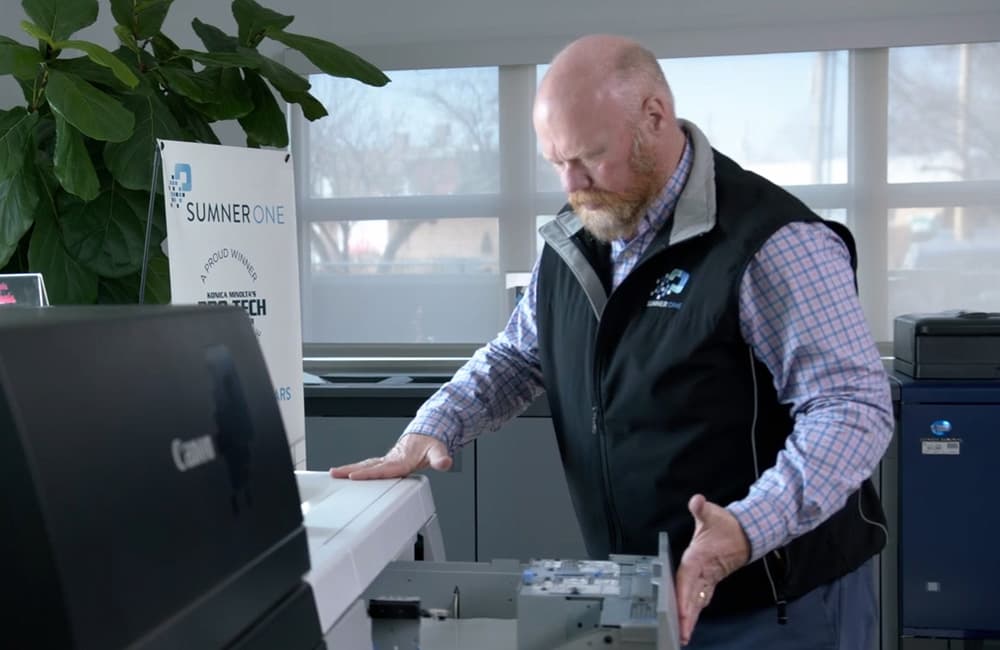
The company’s account of entering modern production print contains a useful admission. In a 2024 interview with The Cannata Report, Edmund Sumner said: “In our experience we would have to say our organization was not ready.” He described recruiting people with practical production experience and training the team. He also said carrying multiple equipment lines is expensive, and competition from manufacturers’ direct operations can squeeze margins at the higher end.
That is the price of choice on the supplier’s side. A broad catalog needs knowledgeable people behind it. The buyer should therefore ask about the person who understands the intended application, the people who service the equipment and how that expertise reaches a particular location. A collection of manufacturer logos cannot answer those questions.
There are alternatives. Marco Technologies also offers managed print, fleet assessments and support across brands. Customers can consider manufacturer-direct contracts, other dealers or their own staff. Multiple brands and bundled service are established features of this market. SumnerOne’s more distinctive combination is its long print history, regional service network and recent investment in industrial-print support.
The industrial turn
In February 2024, SumnerOne acquired Production Print Solutions, or PPS. In April 2025, Fujifilm announced a partnership covering production, wide-format and industrial print. Fujifilm described SumnerOne as its first North American dealer partner focused on its REVORIA PRESS and ACUITY offerings; PPS would also offer J PRESS and integrated printbar solutions.
The service capacity explains why this pairing matters. Fujifilm’s announcement described more than 70 PPS technicians, over 125 site-stocking locations and nationwide customer support. An industrial press needs a different kind of support operation from a departmental copier. Parts, specialist knowledge and dispatch arrangements become part of the equipment proposition.
Support capacity belongs in the purchasing conversation.
This expansion gives SumnerOne a route from everyday office documents to high-volume manufacturing applications. The analytical point is simple: the equipment offering widened after the business bought specialist service capacity. The support organization helped make the larger catalog credible.
Follow the document
Printing is one stage in a document’s working life. SumnerOne’s enterprise content management offering addresses capture, storage, retrieval, permissions and automated workflows. Its managed IT portfolio includes SmartIT monitoring and maintenance, SmartBACKUP and SmartMAIL, alongside infrastructure, security and remote-work services. These are adjacent problems for the same organization: keeping information available, usable and appropriately controlled.
A small technical detail makes the managed-print approach clearer. SumnerOne’s published monitoring FAQ describes a move from Printfleet to Predictive Insight. The data collection agent gathers device information, meter readings, supply status and service alerts. The document says it does not collect print content or user-related information. This is equipment telemetry, and the company says the change was intended to improve service, supplies and support.
That distinction matters when discussing a networked fleet with an IT team. Monitoring a machine and inspecting a document are different activities. The software’s collection scope should be understood before deployment, alongside the customer’s own network requirements.
Start with the room, then buy the machine
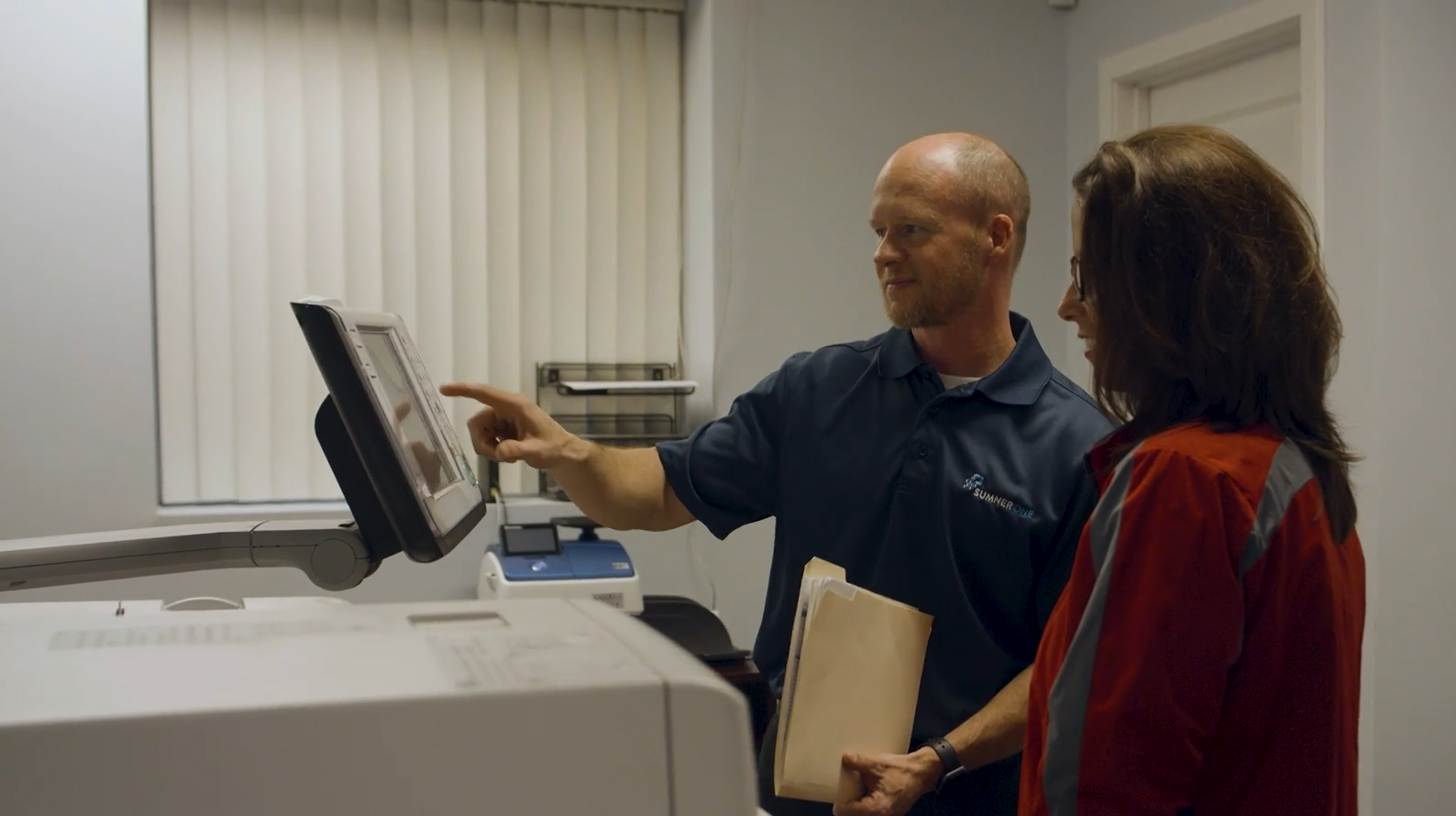
The lesson a reader can copy is modest enough to be useful. Inventory the fleet. Measure demand. Ask the people who use the equipment where work stalls. Compare the complete cost of supplying, supporting and replacing devices. SumnerOne advertises a free print assessment; the value of any assessment rests on whether it makes those questions easier to answer.
Consolidation also requires judgment. Geography, urgent work and necessary redundancy can justify keeping capacity close to users. A central print shop needs dependable intake and delivery. These are practical conditions implied by the operating model, rather than promised outcomes. The sensible number of machines follows the work.
A customer offers the briskest description of what is at stake. In SumnerOne’s Minuteman Press-Des Peres case study, owner Bob Stalinski emphasizes how quickly he needs an answer. He had previously worked for SumnerOne. Familiarity may help explain the relationship, but the demand itself is universal: someone has to answer while the answer still matters.
“I don’t have three days for customer service to answer my question.”Bob Stalinski · Minuteman Press-Des Peres
SumnerOne even has a joke tucked into its identity. The company calls its logo the Squoosh, a blend of swoosh and squid. Squids, it observed, release ink. The name is absurd enough to remember. The business underneath it is easier to judge: how well does the equipment, the contract and the service organization fit the work you actually need to do?
Keep the conversation going
Explore SumnerOne’s website, its technology blog and OneWorks. Read about the Fujifilm partnership or look at the college print project.
WATCH THE WORK▶ SumnerOne Service Company service video ↗▶ Change printing defaults in Windows 11 A practical how-to ↗